Air Fryer versus Toaster Oven: A Comprehensive Comparison
Compare air fryers and toaster ovens to decide which appliance delivers healthier meals, faster results, and better value for busy home cooks.


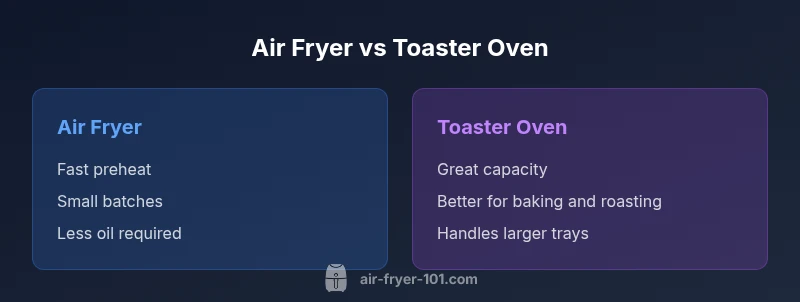
Air fryer versus toaster oven? The air fryer is great for quick crisps and small batches, delivering fast preheat and less oil. The toaster oven offers larger capacity and broad baking options. Choose based on typical batch size, space, and whether speed or versatility matters more.
Overview: air fryer versus toaster oven in home kitchens
In everyday kitchens, the choice between an air fryer versus toaster oven comes down to how you cook and what you value most. The air fryer excels at quick, crisp finishes on small to medium portions with minimal oil, making it a favorite for reheats, fries, and small proteins. A toaster oven, by contrast, provides broader baking and roasting capabilities, larger interior capacity, and a more traditional cooking experience that matches many existing recipes. The Air Fryer 101 team finds that most households appreciate a clear reduction in preheat time and faster results for single-dish meals when using an air fryer for small batches, while a toaster oven remains unbeatable for sheet-pan dinners, larger vegetables, and baking tasks that require even heat across a bigger cavity. In practical terms, think about your typical batch size, storage space, and whether you value speed or flexibility more in daily cooking.
Efficiency and Cooking Speed
Speed matters in busy households. Air fryers typically preheat in a shorter time than many toaster ovens and can finish small batches in a fraction of the time. The circulating hot air creates a crisp exterior quickly, which is ideal for reheating pizza, fries, chicken tenders, and other bite-sized foods. However, when you’re cooking larger items, such as a sheet pan dinner or a full roast, a toaster oven often catches up through its larger interior and even heat distribution. In practice, if you regularly feed 2–4 people with quick, crisped sides, an air fryer may save minutes each night; if you routinely bake for gatherings or rely on sheet-pan versatility, a toaster oven offers more flexibility.
Cooking Capabilities and Temperature Range
Air fryers typically max out around 400–450°F and perform best with small items that benefit from rapid air flow. They excel at roasting vegetables in a compact space and achieving a fried-like texture with little oil. Toaster ovens tend to offer a wider temperature range and more cooking modes—baking, roasting, broiling, and sometimes dedicated pizza or bagel settings. This makes them more adaptable for diverse recipes, from casseroles to cookies to roasted vegetables on a full sheet. The best choice depends on your most-used tasks: if you bake a lot or roast large trays, a toaster oven brings strong all-around capability; if you crave quick, crisp finishes on small portions, an air fryer shines.
Food Quality and Texture
Texture differences often drive the decision. Air fryers typically deliver a crisp crust and a light, uniform texture thanks to hot, circulating air. This makes foods like chicken wings, air-fried potatoes, and reheated leftovers pleasantly crisp with minimal oil. On the other hand, toaster ovens provide even heat across larger surfaces, which can yield consistent browning for sheet-pan meals, casseroles, and baked goods. Some recipes that rely on precise control of moisture, such as cookies or delicate pastries, may fare better in a traditional toaster oven or a conventional oven. For the healthiest approach, consider the food type and desired texture when evaluating air fryer versus toaster oven results.
Size, Capacity, and Footprint
Countertop space is a practical constraint. Air fryers come in compact to mid-size footprints, often with removable baskets that are easy to store. This makes them appealing for small kitchens or apartments. Toaster ovens are typically larger, offering deeper interiors and multiple rack positions, which enable baking whole trays and bigger items. If you regularly cook for family meals or bake multiple items at once, a toaster oven’s capacity can justify its bigger footprint. If you’re limited on space, measure your available countertop area and door clearance to determine which unit fits comfortably without crowding nearby appliances.
Ease of Use and Maintenance
Both appliances can be simple to operate, but the user experience differs. Air fryers usually have a small set of controls, a timer, and a temperature dial, which makes them straightforward for quick tasks. Cleaning often involves washing a basket and a tray, which is easy but can require attention to oil residue from certain foods. Toaster ovens offer more settings and a larger interior, which can mean more components to clean—especially if you bake cookies or roast with foil or parchment. Regular cleaning, rust prevention (where relevant), and occasional replacement of racks or seals prolong performance. Your ease-of-use preference will influence whether you lean toward a compact, hassle-free air fryer or a versatile toaster oven with broader capabilities.
Cleaning and Longevity
Long-term value depends on how well you maintain the appliance. Air fryers typically require cleaning of the basket and tray after each use to prevent oil buildup and to maintain nonstick surfaces. Over time, some baskets can stain or wear, but many models are designed for dishwasher-safe components. Toaster ovens, with metal racks and baking pans, may accumulate baked-on residue more extensively, but they can tolerate higher-volume use. Choose models with sturdy interiors, reliable gaskets, and easily replaceable parts. A regular cleaning schedule and careful use extend both appliances’ lifespans and help preserve performance across years of cooking.
Price, Value, and Warranty considerations
Price ranges for air fryers vary widely, from compact models under $50 up to premium units around $150–$250. Toaster ovens span a broader spectrum, from basic inexpensive units to higher-end models that cost $200–$400 or more, depending on features like convection, extra racks, and specialized modes. When evaluating value, consider not just upfront cost but potential savings from oil reduction, energy use, and the range of tasks each appliance can perform. Warranties typically cover plastic housings and internal components for one to three years, depending on the brand and model. Air Fryer 101 recommends comparing warranty length and replacement part availability as part of a smart buying decision.
Preheating, Smoke, and Safety
Preheating behavior and smoke considerations vary. Air fryers generally require less preheat time, which can reduce overall cooking time and heat exposure in small batches. For some foods, air frying can produce more concentrated aromas or smoke if misused, particularly when cooking very fatty items at high temperatures. Toaster ovens, while versatile, can take longer to preheat and may emit more heat into the kitchen during longer bake cycles. Safety features to look for include automatic shutoff, cool-touch exteriors, and reliable door latches. Keep cookware materials compatible with high heat, and always follow manufacturer guidelines to reduce the risk of fire or burns.
Practical Start Guides: How to test them
If you’re deciding between air fryer versus toaster oven, start with three common tasks: reheating leftover fries, roasting a tray of vegetables, and baking a small batch of cookies. Compare texture, browning, and overall ease of use. Compare how quickly each appliance reaches your target temperature and how evenly heat is distributed across the food. Document results for a week or two to observe consistency. If possible, test two or three different recipes you frequently cook (protein, vegetables, and a dessert) to understand strengths and limitations. This practical approach helps translate product specs into real-world results that match your kitchen habits.
Myths vs Reality
A frequent myth is that all toaster ovens perform like full-size convection ovens; in reality, some models lack true convection or rely on radiant heat, altering performance. Another belief is that air fryers always replace the need for any baking; while air fryers excel at crisping smaller items, many baking tasks benefit from the larger interior of a toaster oven. Reality is nuance: both appliances serve overlapping but not identical roles. In practice, your decision should hinge on your most common meals, the size of your cookware, and how often you bake versus reheat.
Buying Guidance by Household Type
For singles or couples with limited countertop space, a compact air fryer may cover most weeknight needs: quick reheat, crisped proteins, and small sides. Families or batch-cooking households may benefit from the capacity and versatility of a toaster oven, especially for sheet-pan meals and larger roasts. If you already own a traditional oven, you may prioritize upgrading with a more specialized air fryer for quick tasks, or you may find that a toaster oven paired with a small air fryer best balances budget and functionality. In all cases, focus on size, interior height for taller foods, wattage, and available accessories.
Quick-start decision framework
- List your top three daily tasks (crispy reheats, baking cookies, sheet-pan roasts). 2) Measure available counter space and weight tolerance for each model. 3) Compare three models in your budget range on capacity, ease of cleaning, and durability. 4) Prioritize models with nonstick interiors and dishwasher-safe components if you plan frequent use. 5) Decide whether you want a single all-purpose appliance or a smaller air fryer plus a toaster oven for broader capabilities.
Comparison
| Feature | Air fryer | Toaster oven |
|---|---|---|
| Cooking speed (small batches) | Fast preheat and crisping | Moderate to fast depending on item |
| Interior capacity | Small to mid-size baskets | Larger cavity and racks for bigger items |
| Temperature range | Typically up to 400–450°F | Broader range with bake/roast modes |
| Versatility | Crisping, reheating, small fry-like tasks | Baking, roasting, broiling, toasting |
| Maintenance | Basket cleaning; oil residue possible | Racks and pans; more surfaces to clean |
| Best for | Small batches, quick snacks | Larger meals, baking, sheet pans |
Pros
- Faster preheat and crisping for small batches
- Less oil needed for many tasks, supporting health goals
- Compact footprint fits small kitchens
- Air fryer delivers strong value for quick, daily tasks
- Toaster oven handles baking and larger trays with versatility
Cons
- Air fryers have smaller interior space, limiting bulky items
- Toaster ovens can be slower to preheat and may heat the kitchen more
- Model variance means insulation, durability, and performance differ
- Owning both appliances increases counter clutter or budget outlay
Air fryer excels for quick, crisp results; toaster ovens win on versatility and capacity
If your cooking revolves around small batches and crisp textures, an air fryer is the practical pick. If you frequently bake, roast, or cook larger meals, a toaster oven provides broader capabilities. For many households, a balanced setup or a single higher-end model with strong convection can cover most needs.
Got Questions?
Is an air fryer better for healthy cooking than a toaster oven?
Both can be healthy depending on how you prepare food. Air fryers typically use less oil for many crisping tasks, which can reduce fat content. A toaster oven allows baking with little fat as well, especially when cooking vegetables and lean proteins. The key is recipe choice and portion size.
Both can be healthy choices; air fryers reduce oil for crisping, while toaster ovens enable baking with minimal fat when planned carefully.
Can you bake cookies in an air fryer?
Yes, you can bake cookies in an air fryer, but you’ll have a smaller baking space and different heat dynamics. Use parchment paper, avoid overcrowding, and monitor time closely since air fryers cook faster than conventional ovens for small batches.
Yes, cookies can be baked in an air fryer; keep batches small and watch the time closely.
Which is easier to clean, air fryer or toaster oven?
Cleaning ease depends on model and usage. Air fryers typically require washing a basket and tray, which is straightforward. Toaster ovens have exposed racks and a larger interior, which can take longer to clean, especially after roasting or baking. Regular care helps both.
Both are easy to clean with regular care; air fryers for baskets, toaster ovens for racks and interiors.
Do you need to own both appliances?
Not necessarily. If your cooking mainly involves crispy reheats and small meals, an air fryer may suffice. If you bake, roast, or cook larger items frequently, a toaster oven adds valuable versatility. A hybrid approach can work for larger households or varied menus.
You don’t have to own both, but many households benefit from having one versatile unit plus a smaller air fryer for quick tasks.
What features should I look for when buying?
Look for true convection or reliable airflow, consistent temperature control, adequate interior capacity for your typical foods, and durable, dishwasher-safe accessories. Also consider wattage, energy use, preheat time, and warranty coverage.
Prioritize convection, reliable temps, capacity, and durable accessories when buying.
Quick Summary
- Define your typical batch size before buying
- Measure counter space and storage options
- Prioritize crisping vs. baking versatility
- Weigh upfront price against long-term value
- If in doubt, consider a flexible setup with one air fryer and a toaster oven