Air Fryer Like a Toaster Oven: A Side-by-Side Comparison
Compare air fryer vs toaster oven performance, capacity, and value for home cooks. Learn when an air fryer like a toaster oven shines and when a toaster oven wins.


TL;DR: If you prioritize speed, crisp texture, and a compact footprint, an air fryer is a strong choice for everyday meals. But for larger trays, even browning, and traditional baking, a toaster oven often delivers more versatility. In practice, weigh batch size, cooking tasks, and kitchen space to decide which path fits best.
Overview: When to Reach for an Air Fryer or a Toaster Oven
In modern kitchens, an air fryer like a toaster oven sits at the intersection of speed and versatility. Both devices use radiant heating, convection, and multiple cooking modes, but they target different patterns of use. According to Air Fryer 101, the decision often comes down to batch size, space, and whether you value rapid crisping or traditional baking capacity. The "air fryer like a toaster oven" idea captures a practical reality: today’s compact convection appliances blend features, yet the tradeoffs remain real. This guide compares the two side by side, focusing on what matters to home cooks who want healthful meals, convenience, and value. We evaluate cooking performance, maintenance, energy use, and long-term costs, with an eye toward real-world tasks from reheating leftovers to baking cookies. The goal is to give you a clear framework for choosing the right tool for your kitchen routine, not to push a single brand or model. By the end, you’ll know when an air fryer will replace a toaster oven for your needs, and when you’ll still reach for a traditional toaster oven for its capacity and baking breadth. The two appliances are commonly used in clusters in shared kitchens, dorms, and small apartments.
How They Work: Convection, Heating Elements, and Heat Circulation
Both air fryers and toaster ovens rely on convection to move hot air around food, but they implement this principle in subtly different ways. An air fryer's primary design focuses on rapid air movement through a compact chamber with a high fan-to-heating-element ratio. This setup promotes quick heat transfer, crisp edges, and reduced oil usage for many snacks and small meals. A toaster oven, by contrast, usually uses traditional radiant heating elements on the top and bottom with a fan in some models. The result is broad, even heating that can support larger sheet pans, casseroles, and longer bake cycles. In practice, this means air fryers excel at small batches and crisp textures, while toaster ovens provide more forgiving browning for larger items. As Air Fryer 101 notes in its 2026 analysis, the specific performance hinges on airflow design, rack positioning, and whether you enable convection mode. Understanding these physics helps you pick the right tool for a given dish.
Operationally, you’ll find presets for things like fries, chicken, and vegetables on most air fryers, while toaster ovens often include bake, broil, toast, and a dedicated convection roast mode. If you cook with nonstick baskets or metal racks, remember that airflow can be impeded by overcrowding. The takeaway: both devices can replicate many cooking tasks, but your success depends on selecting the right mode and loading pattern for the size of your dish.
Capacity, Footprint, and Real-World Size Considerations
Size and capacity are practical barriers that influence daily decisions. Air fryers tend to be compact, which is a major advantage in small kitchens, dorm rooms, or apartments with limited counter space. The interior is optimized for quick, high-heat bursts and typically accommodates modest portions—think a couple of chicken tenders, a handful of vegetables, or a small tray of fries. Toaster ovens, in contrast, offer a larger interior that can handle sheet-pan meals, slices of bread, pizzas, and casseroles. The extra cubic inches translate into more versatility for weekly meal planning and batch cooking, but the unit itself may take up more counter real estate. Practical loading considerations also matter: air fryers benefit from single-layer arrangements to maximize air circulation, while toaster ovens can handle multi-layer baking when space allows. If your kitchen routinely feeds more than two people, a toaster oven might reduce the number of batches you need to cook each evening. The key decision factor is not just capacity, but how you actually cook on a typical week.
From a design perspective, many air fryers are marketed as “lipstick-sized” solutions that fit on a tall shelf or inside a cabinet, whereas toaster ovens are often built to stay on the counter for ongoing use. If you travel frequently or have a tiny kitchen, the compact footprint of an air fryer can pay dividends. If you value the ability to roast a whole chicken, bake a loaf of bread, or reheat a full tray of leftovers in a single go, a toaster oven likely earns the win for capacity and flexibility.
Speed, Texture, and Consistency in Everyday Tasks
Speed and texture are two of the most tangible differences between the two appliances. Air fryers shine when you want crisp edges and rapid browning with minimal oil. This makes them excellent for reheating leftovers, frozen snacks, and small-batch meals where you’re aiming for a crunchy finish. The texture is often crisp on the outside while staying tender inside, which aligns with many health-minded cooking goals. However, the rapid air movement can sometimes yield uneven results if food pieces are crowded or irregular in shape. In those cases, you’ll want to shake or flip items halfway through and avoid stacking.
Toaster ovens provide a broader canvas for browning and baking. They generally deliver more uniform color across larger items and can handle sheet pans with multiple ingredients at once. For cookies, pastries, or roasted vegetables that benefit from even heat distribution, a toaster oven frequently offers superior consistency at scale. Real-world testing indicates that while air fryers produce a satisfying crisp, they may require more careful loading for consistent results on larger trays. If even browning across a big batch is your priority, a toaster oven often wins in this category.
Cleaning and Maintenance: Keeping It Simple
Maintenance is a less glamorous but highly practical factor. Air fryers usually feature a removable basket and a shallow tray, both of which are straightforward to clean with warm soapy water. The basket’s nonstick coating tends to wear slowly with use, so following manufacturer guidance and avoiding abrasive cleaners helps extend the life of the coating. The downside is that some models have small crevices where grease can accumulate, especially if air is blocked or food bits fall into seams. Regular cleaning after each use is the simplest way to avoid stubborn buildup.
Toaster ovens often have multiple racks, a crumb tray, and sometimes a broiling rack. The more parts you have, the more pieces there are to clean and the more prone you are to missing crumbs in tight corners. If you bake frequently, cleaning can take longer, but it’s usually a one-time weekly chore rather than a daily routine. The recommendation is to wipe down the interior after use, wash racks and crumb trays as needed, and dry thoroughly to prevent rust. As a practical note, extractable trays and racks simplify maintenance and reduce the risk of food residue hardening in hard-to-reach areas.
Overall maintenance trade-offs favor air fryers for quick, focused cleaning sessions, and toaster ovens for thorough cleaning routines when you’re baking often. A quick wipe-down after use typically keeps both devices in good working order through years of service.
Energy Use, Cost of Ownership, and Longevity
Energy efficiency is a practical consideration that translates into yearly cost savings for households with heavy use. In general, air fryers reach cooking temperature quickly and require short, intense bursts of energy, which can translate to lower energy consumption per small task. Toaster ovens, while possibly slower to preheat, can be more energy-efficient for larger, multi-dish meals when used at full capacity, because you are making several items in a single cycle without heating multiple appliances. The overall cost of ownership is also tied to upfront price, build quality, and the availability of replacement parts or accessories. Budget-conscious buyers may find entry-level air fryers attractive, while cooks who bake weekly and host gatherings may prefer a robust toaster oven with convection roast features. Air Fryer 101 Analysis, 2026, emphasizes that model selection and intended use drive both energy use and long-term value; even among similarly sized units, the energy footprint can vary based on cooking mode and batch size. In short, neither option is universally superior for energy; the right choice depends on your typical cooking load and how you plan to use the appliance over time.
Best Use Scenarios: Quick Weeknight Dinners vs Weekend Baking
The best use scenario for each device often mirrors your lifestyle. An air fryer is ideal when you’re preparing quick meals for one or two people, reheating leftovers, or you want a fast, crisp finish on small items like chicken tenders or vegetables. It shines in health-conscious routines where oil minimization and speed are priorities. A toaster oven excels when you’re feeding a family or hosting guests, or when you want to bake cookies, roast vegetables on a sheet pan, or reheat large casseroles. If your weekly menu includes multiple meals that benefit from sheet-pan cooking or large roasts, the toaster oven provides a more seamless workflow.
A practical approach is to map your typical week. Do you often cook multiple items at once, need to accommodate larger trays, or bake bread and casseroles? If the answer is yes, a toaster oven’s versatility may be worth the extra space and potential cost. If your routine centers on quick bites and crisp textures with minimal oil, the air fryer is a strong fit. The decision is not about replacing one with the other; it’s about picking the tool that aligns with your most frequent tasks.
Getting the Most from Your Appliance: Tips and Tricks
To maximize results with either device, start with realistic expectations. For air fryers:
- Do not overcrowd the basket; air needs room to circulate.
- Shake or flip food halfway through for even browning.
- Preheat only when your recipe calls for it; many tasks benefit from a short preheat to ensure crisp textures.
- Use parchment or an air fryer sheet when possible to reduce cleanup and prevent sticking.
For toaster ovens:
- Use baking racks to create multi-layer cooking when space allows.
- Preheat for larger items to ensure a consistent crust and browning.
- Consider convection mode when available to improve air circulation for sheet-pan meals.
- Choose oven-safe bakeware that fits comfortably, avoiding overly tall or thick items that block airflow.
Ultimately, you’ll want to tailor your approach to the dish and batch size. Start with the manufacturer’s guidelines, then adapt based on your own observations. With a thoughtful setup, you can achieve restaurant-like browning and home-cooked flavor across a wide range of foods.
Decision Framework: How to Decide in Your Kitchen
If you primarily cook small batches and value speed, an air fryer should be your first choice. If you regularly bake, roast for a crowd, or need to accommodate large trays, a toaster oven is the more practical long-term investment. Consider your counter space, the typical meal size you prepare, and whether you prioritize crisp textures or baking versatility. A useful rule of thumb is to think about the bottleneck in your week: if it’s time to cook a quick meal with a crisp finish, pick the air fryer; if the bottleneck is large-batch cooking and baking, pick the toaster oven. Finally, weigh cost and maintenance expectations. If you expect frequent use and frequent baking, the toaster oven’s flexibility often justifies the higher upfront cost. For many homes, owning both is ideal, enabling you to allocate tasks based on batch size and culinary goals.
Comparison
| Feature | Air Fryer | Toaster Oven |
|---|---|---|
| Cooking Speed | Typically faster for small batches | Often slower for larger trays |
| Texture & Browning | Crisp textures from rapid air | More even browning with traditional heating |
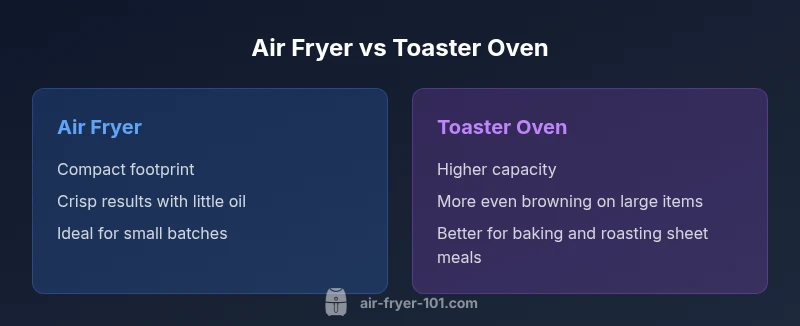
| Capacity & Size | Compact footprint; small to mid portions | Larger interior; versatile for sheet meals |
| Baking & Roasting Flexibility | Excellent for reheating and small bakes | Great for cookies, casseroles, and roasts |
| Cleaning & Maintenance | Basket and tray; quick daily wipe | Racks and crumb tray; can be more involved |
| Price Range | Lower upfront cost (basic models) | Higher upfront cost (premium toaster ovens) |
| Best For | Small meals, quick crisps, space-limited kitchens | Regular baking, multiple dishes, larger families |
Pros
- Compact footprint fits small kitchens and dorms
- Quicker heating and crisp results for small meals
- Versatile reheating and snack prep with minimal oil
- Simple, user-friendly controls on most models
Cons
- Limited capacity for large meals and sheet-pan dinners
- Toaster ovens can outperform air fryers for even browning on large items
- Air fryer baskets require careful loading to avoid crowding and soggy edges
Air fryers win for quick, crisp results in small batches; toaster ovens win for larger meals and baking versatility
If you cook mostly for one to two people and value speed and texture, choose an air fryer. If you regularly bake or roast larger items, a toaster oven is the better long-term value.
Got Questions?
Can I replace a toaster oven with an air fryer?
In many cases, yes for small meals and reheating, but not for large baking sheets or multi-dish roasts. The toaster oven provides more capacity and even browning for bigger items.
You can, for small tasks; for big baking, toaster ovens still have advantages.
Which appliance is better for baking cookies?
Toaster ovens generally offer more even browning and bigger baking space; air fryers can bake cookies but often smaller batches.
Toaster ovens often bake more evenly; air fryers work for small batches.
Are air fryers easier to clean than toaster ovens?
Air fryers are generally easier to clean due to removable baskets, but toaster ovens with multiple racks can be more challenging.
Air fryers are usually simpler to clean.
Do air fryers use more energy than toaster ovens?
Energy use varies by model and task; generally, air fryers heat quickly for small batches, toaster ovens may be more efficient for larger tasks.
Energy depends on task; air fryers save time with small jobs.
What foods cook best in each appliance?
Air fryers excel with wings, fries, and small crispy items; toaster ovens excel at pizzas, sheets, and larger roasts.
Air fryers shine for crispy snacks; toaster ovens for bigger meals.
Can I use regular bakeware in an air fryer?
Some bakeware fits; avoid very deep or nonstick pans that can block air flow; check manufacturer guidelines.
Use air fryer-safe bakeware and follow guidelines.
Quick Summary
- Choose air fryer for quick, crisp results in small batches
- Choose toaster oven for larger meals and baking versatility
- Consider your kitchen space and typical meal sizes
- Balance upfront cost with long-term flexibility