Air Fryer and Toaster Oven Combo: Side-by-Side Comparison
Compare air fryer and toaster oven combo units against separate appliances. Learn which option saves space, fits your cooking style, and offers the best value for small kitchens.


An air fryer and toaster oven combo can replace several kitchen appliances by offering air frying, baking, toasting, and broiling in a single unit. The core trade-off is speed and compact footprint versus overall cooking versatility and even heat distribution. If you mainly reheat, crisp, and bake small batches, a combo is convenient; if you need heavy-duty baking or large capacity, consider separate units.
Why an air fryer and toaster oven combo matters
In many homes, countertop real estate is precious. An air fryer and toaster oven combo is designed to consolidate functions that used to require multiple devices into a single unit. The value proposition is straightforward: you gain space, reduce clutter, and simplify meal workflows. For readers of Air Fryer 101, the appeal is not just saving space but also aligning with healthier cooking goals through efficient air circulation and shorter preheat times. The air fryer and toaster oven combo is particularly attractive for small households, apartment living, or anyone who cooks small to medium batches. It’s not a perfect replacement in every scenario, but for everyday meals and reheating tasks, it often hits the right balance between speed, texture, and convenience.
Key features to compare in a combo unit
When evaluating a combo unit, focus on three core criteria: capacity, power and heating performance, and control flexibility. Capacity determines how many servings you can prepare at once, while power affects preheat speed and how evenly heat is distributed across racks. Look for convection capabilities, multiple rack levels, and a consistent temperature range that covers common cooking tasks from light to medium bake cycles. Controls should be intuitive and reviewable—digital panels, accessible presets, and a simple manual override for precise temperatures matter. Finally, consider build quality, door design (top vs bottom hinge), and interior materials that withstand frequent reheating and roasting without excessive wear. According to Air Fryer 101, a well-balanced combo offers predictable results across usual tasks like reheating leftovers, toasting bagels, and baking small desserts; compromise is more likely in specialized scenarios. The goal is straightforward: pick a model that aligns with your typical cooking repertoire without forcing frequent workarounds.
Real-world use cases: who benefits
The primary beneficiaries are people who cook for one to four servings, and those who want a single appliance that handles multiple tasks. In compact kitchens, a combo saves countertop space and reduces the number of cords and surfaces you manage. Health-conscious cooks often favor combos because shorter cook times can preserve nutrients while still achieving desirable textures. Weekend hosts or busy families appreciate the versatility for quick breakfasts, lunches, and weeknight dinners without firing up a full-size oven. However, if you regularly prepare large roasts, bake sheet-pan meals for many people, or rely on highly specialized features (like dedicated pizza ovens or deep-frying rigs), the limits of a single unit may become apparent. For those cases, a plan that includes at least one separate appliance for high-capacity tasks remains sensible.
Performance deep dive: air frying vs baking
Air frying relies on rapid, high-velocity heat circulation to crisp foods with less oil. In a combo unit, the effectiveness of air frying hinges on fan design, air channeling, and how the rack positions interact with the circulating air. Baking and roasting leverage the same heating elements but benefit from steadier heat distribution across multiple racks. In practice, you’ll notice faster browning on smaller items and crisper exteriors with air fry mode, while larger roasts and casseroles benefit from a steady bake cycle. Temperature accuracy matters here; a unit that drifts more than 15–20 degrees can lead to uneven results. If you frequently bake delicate items like soufflés or multi-layer cakes, consider test-batching to understand heat behavior in your chosen model. Overall, the best-performing combos offer tight temperature control, reliable convection, and a forgiving user interface that makes everyday tasks predictable.
Size, capacity, and countertop footprint
Capacity is not just a measured quart or liter—it’s about how many pieces you can fit on the racks and how much separation exists between the heat source and the food. A compact cavity might suit reheating and small-sheet cooking, while a larger interior expands what you can bake or roast in a single session. The footprint also includes door clearance and whether the unit sits flush against a backsplash or sits on a countertop with space for ventilation. Another practical consideration is whether you can remove racks and trays for easier cleaning or if they are fixed. For many households, the ideal balance is a unit that feels substantial enough to handle common meals yet compact enough to fit in a standard kitchen without dominating the counter.
Cleaning and maintenance considerations
Cleaning a combo unit is simpler when you choose models with straightforward crumb trays, nonstick interiors, and dishwasher-safe racks and trays. Regular maintenance reduces wear and extends life. A common pitfall is neglecting the interior after heavy use, which can lead to residue buildup and reduced airflow efficiency. Wipe down the exterior after cooking to keep the touch controls responsive, and periodically check seals and racks for wear. If you regularly reheat bread, consider a model with a moisture-control feature to avoid soggy results. The simplest path to long-term satisfaction is a consistent cleaning routine and choosing a model with accessible components and user-replaceable parts.
Pricing, warranty, and longevity considerations
From an economics perspective, a well-chosen combo unit should offer competitive value by reducing the need for multiple devices. Budget models exist, mid-range options provide more consistent performance, and premium units emphasize build quality and extra features. Warranty length and coverage are important factors, especially for parts that experience repetitive use like door seals and heating elements. Longevity depends on how often you use the appliance, the types of foods you cook, and how well you maintain it. For most households, a mid-range model that balances performance and durability tends to deliver the best long-term value, with fewer surprises in maintenance costs over time.
How to choose by use case: 4 scenarios
- Scenario A: Small apartment dweller who cooks for one. A compact, energy-efficient combo with reliable reheating, quick baking, and toast setting is ideal. Look for short preheat times and easy cleanup.
- Scenario B: Busy family with varied meals. Seek a mid-size interior, flexible racks, and good convection. A model with multiple presets can streamline weeknight dinner prep.
- Scenario C: Health-focused cook who bakes and roasts. Prioritize even heat distribution, moisture control, and a strong bake function for vegetables and lean meats.
- Scenario D: Hospitality on weekends. If you entertain, you may want more capacity and the option to run two functions in tandem (e.g., bake a tray while toasting). In these cases, you might keep a separate appliance or select a larger-capacity unit with robust airflow.
Common mistakes and how to avoid them
One common mistake is overloading the cavity, which reduces airflow and leads to uneven results. Always follow manufacturer guidance on rack placement and recommended pan sizes. Another pitfall is underestimating the cleaning effort—choose units with easy-to-remove trays and accessible interior surfaces. Finally, don’t assume more presets automatically mean better results; rely on core settings for bread, vegetables, and meat to gain consistency. Start with simple recipes to dial in time and temperature, then expand your repertoire as you become familiar with the model’s nuances.
Authority sources and further reading
To ground this guide in a practical viewpoint, several trusted sources offer broader context on kitchen appliance versatility and reliability. For analytical context on efficiency and performance in compact ovens, see Air Fryer 101 Analysis, 2026. Industry perspectives emphasize the importance of heat distribution and build durability when evaluating multi-function units. While product-specific claims vary, the overarching guidance is consistent: align your choice with your typical batch sizes, cooking tasks, and kitchen footprint. For more detailed, model-specific guidance, refer to manufacturer manuals and independent reviews from reputable outlets.
Comparison
| Feature | Air fryer and toaster oven combo | Separate air fryer + toaster oven |
|---|---|---|
| Countertop footprint | compact single unit | two devices, larger footprint |
| Versatility | air frying, toasting, baking, broiling | specialized tasks per appliance |
| Cooking speed (small batches) | fast for small batches | two-step coordination may be slower |
| Capacity per batch | moderate per batch | potentially larger combined capacity |
| Heat distribution | generally consistent with convection | depends on model; potential hotspots |
| Cleaning | one set of trays/racks | two devices to clean |
| Price/value | often lower upfront if only one unit needed | possible higher upfront for two devices |
| Best for | space-constrained, everyday meals | heavy baking or large batches |
Pros
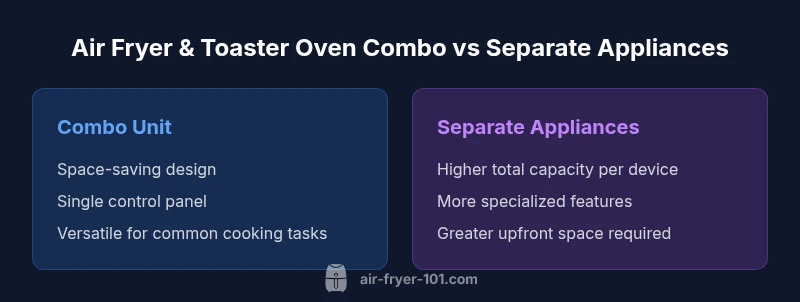
- Saves countertop space by combining functions
- Single control panel simplifies cooking
- Versatile for common kitchen tasks and quick meals
- Typically adequate for small households and apartments
- Potentially lower energy use for small batches
Cons
- Limited capacity vs dedicated ovens for large families
- Heat distribution can be uneven on some models
- Fewer specialized features than stand-alone appliances
- Replacement outcomes may require compromises for very complex meals
Air fryer and toaster oven combos offer the best balance for small kitchens, while power users may prefer dedicated appliances for maximum capacity.
For most households, a combo provides space savings and convenient versatility. If you frequently cook large batches or need highly specialized functions, consider separate units to maximize performance and capacity.
Got Questions?
What is the difference between an air fryer and a toaster oven combo and separate devices?
A combo unit merges air frying, baking, toasting, and broiling into one appliance, saving counter space. Separate devices offer larger capacities and specialized features, which can improve performance for certain tasks but require more room and maintenance. Your choice depends on space, budget, and the types of meals you cook most often.
A combo unit combines several tasks into one device, saving space. Separate devices give you more capacity and specialization, but take more room.
Can I truly replace a full-size oven with a combo unit?
For many daily tasks and small to medium batches, a good combo can substitute for a traditional oven. It has limitations for large roasts or big sheet-pan meals. If your cooking style regularly requires high-volume baking, a full-size oven or additional equipment may still be necessary.
A combo can replace many everyday baking needs, but it may not handle large batches like a full-size oven.
Are combo units easy to clean?
Most models emphasize removable racks and crumb trays to simplify cleaning. Regular maintenance— wiping the interior after use and checking for residue—helps maintain performance. Look for dishwasher-safe components if you prioritize convenience.
Cleaning is easier when racks and trays are removable and dishwasher-safe.
What wattage should I look for in a good combo unit?
Look for a model with sufficient wattage to deliver consistent heat and reasonable preheat times. Wattage affects performance across modes, but effectiveness also depends on airflow design and overall build quality. Higher wattage is generally better for versatility, but check real-world performance reviews.
Choose a model with solid heating power and good airflow, and read reviews for real-world performance.
Do combo units have convection features?
Yes, most air fryer and toaster oven combos include convection as part of the cooking process. Convection helps with even heat distribution and browning, which is especially important for air frying and sheet-pan meals. Verify that the convection function works well across rack positions for best results.
Most include convection for even heating and browning; check performance across racks.
Which scenarios benefit most from a combo unit?
Combo units excel in small kitchens, quick meals, and versatile everyday cooking. They’re well-suited for singles, couples, or small families who value space savings and straightforward operation. If your needs include heavy baking or large batch cooking, dedicated appliances may be more appropriate.
They’re great for small spaces and everyday cooking; if you bake large batches regularly, you might want separate devices.
Quick Summary
- Prioritize your typical batch size and meals.
- Check capacity, convection quality, and rack flexibility.
- Consider cleaning simplicity and interior materials.
- Balance upfront cost with long-term value and warranty.