Air Fryer and Toaster Oven in One: A Comprehensive Comparison
A comprehensive, analytical comparison of combo air fryer and toaster oven units versus separate appliances, covering capacity, performance, energy use, footprint, price, and best-use scenarios for home cooks in 2026.


Combo air fryer and toaster oven in one units offer space-saving versatility by combining air-frying, baking, and toasting in a single countertop appliance. This guide compares a true all-in-one unit against separate appliances, focusing on capacity, performance, cost, and fit for different kitchens. The goal is an evidence-based choice tailored to your cooking patterns and space constraints.
Market Context and Definition
The term air fryer and toaster oven in one refers to a single countertop device that merges high-velocity air frying with traditional toaster-oven functions, often including bake, broil, roast, and dehydrate modes. For busy home cooks, this means fewer cords, less counter clutter, and a simpler setup. According to Air Fryer 101 analysis, 2026 has seen growing demand for multipurpose kitchen devices that deliver crisp results without the need for deep-frying. These units are especially appealing to health-conscious households, small-space dwellers, and budget-minded shoppers who want value without sacrificing performance. In this guide we compare two pathways: a dedicated combo unit that handles air frying and toaster-oven tasks in one chassis, versus maintaining separate devices that cover the same tasks. We’ll examine capacity, heat control, preheat times, energy use, ease of cleaning, and reliability to help you decide which approach best fits your kitchen routine.
In the air fryer and toaster oven in one category, model variety spans compact 0.8–1.2 cubic feet units to larger 1.5–2.0 cubic feet cavities. Buyers should consider typical usage: quick-crisp snacks, reheating, baking small batches, and family meals. As the Air Fryer 101 Team notes, the right choice aligns with how you cook most often, how much space you have, and how much you’re willing to invest upfront. This section sets the stage for evaluating two core options: a true all-in-one platform vs separate devices that each excel in their specialty.
Comparison
| Feature | Combo unit (air fryer + toaster oven) | Separate appliances (air fryer + toaster oven) |
|---|---|---|
| Capacity | Interior typically 1.0–1.8 cu ft for compact models; 1.5–2.0 cu ft for mid-size | Two dedicated cavities, often 1.5–2.5 cu ft combined capacity across devices |
| Heat distribution | Single fan + heating elements; optimized for smaller cavities | Separate paths allow tailored airflow and browning per task |
| Preheat time | Often faster to preheat due to smaller interior | May take longer if both devices run in sequence or if set to high convection |
| Cook speed and batch size | Good for small batches and quick snacks | Better for larger meals and higher-volume cooking |
| Footprint and countertop space | One footprint saves counter space | Two devices require more counter real estate but may offer more flexibility |
| Price range | Typically $100–$300 depending on features | Two-device cost can be similar or higher depending on brands and features |
| Best for | Small kitchens, space-conscious buyers, quick meals | Families or frequent entertainers needing larger batches |
| Maintenance | One cavity to clean, fewer knobs, easier storage | Two units mean more crevices to clean but potentially easier access to parts |
Pros
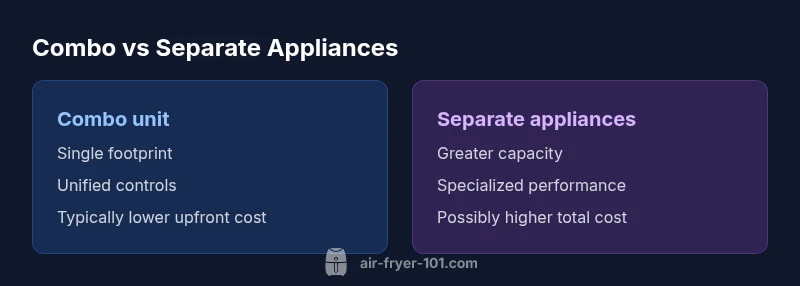
- Space-saving design reduces countertop clutter
- Unified controls can simplify meal workflows
- Typically lower upfront cost than two separate devices
- Often quicker warm-up for small meals
Cons
- Smaller interior may limit batch size and cooking versatility
- Potentially slower browning or inconsistent results on larger items
- Limited upgrade path if you outgrow the unit’s capabilities
Combo units win for space and convenience; separate devices win for capacity and specialized performance
If you cook small meals in tight spaces, a well-chosen all-in-one can streamline meals. If you frequently prepare larger batches or require peak performance in multiple modes, two dedicated devices may deliver better results and flexibility.
Got Questions?
What exactly is meant by 'air fryer and toaster oven in one'?
It’s a single countertop unit that combines air frying with toaster-oven functions such as baking and broiling. Some models add dehydration or rotisserie. The key is a shared cavity and control system that enables multiple cooking modes without requiring separate devices.
An all-in-one countertop unit combining air frying and toaster-oven functions, sometimes with extra modes like dehydration. It’s designed to replace two devices with one, saving space.
Is a combo unit worth it for a small kitchen?
For very small kitchens, a true all-in-one unit can free up counter space and simplify meal prep. The decision depends on your typical cooking volume and whether you’ll benefit from having two vessels in one footprint. If you regularly cook large meals, two dedicated devices might be more practical.
In small kitchens, an all-in-one can save space, but consider your cooking volume before choosing.
How should I compare models effectively?
Focus on capacity, heat distribution, preheat time, and ease of cleaning. Check user reviews for consistency in browning and reliability, and compare energy use based on preheat and cycle length rather than label claims alone.
Compare capacity, heat, preheat, and cleanability; read reviews for real-world results.
Can I bake pizza in a combo unit?
Yes, many all-in-one units support pizza at low to moderate temperatures, but results depend on the interior size and stone/plate options. Expect slightly smaller pizzas or shorter bake times than a full-size oven.
Most can bake small pizzas; check interior size and recommended temperatures.
What maintenance matters most for longevity?
Regularly clean the interior after use to prevent flavor transfer and residue buildup. Replacing seals and ensuring the door latches stay secure also helps. Avoid harsh abrasives that can damage nonstick surfaces.
Keep the interior clean, check seals, and avoid harsh cleaners to extend life.
Are combo units more energy-efficient than standalone devices?
Energy use depends on how you use them. A single all-in-one unit can be efficient for small meals, but for frequent large-batch cooking, separate devices may incur less energy per dish due to optimized, task-specific performance.
Energy can be similar for small meals; separate devices can save energy on large batches.
Quick Summary
- Evaluate your typical batch size before buying
- Prioritize heat distribution and fan performance for your cooking style
- Consider countertop footprint as a primary constraint
- Balance upfront cost with long-term versatility
- Check ease of cleaning and accessibility of replacement parts