Oven Air Fryer vs Countertop Air Fryer: A Practical Comparison
A rigorous, evidence-based comparison of oven air fryer vs countertop air fryer to help home cooks choose based on batch size, versatility, space, and value. Learn how each design performs in real kitchens and which is best for your weekly meals.


For most homes, countertop air fryers deliver quick, crisp results for small meals; oven air fryer offers larger capacity and greater cooking versatility. The choice depends on kitchen space, batch size, and how often you bake. If you regularly roast poultry or bake cookies, an oven-style unit can consolidate tools. If you mainly reheat and fry snacks, a compact countertop model shines.
Context and Framing: The Oven Air Fryer vs Countertop Debate
The choice between an oven air fryer and a countertop air fryer matters for daily cooking, not just for showy features. In the oven air fryer vs countertop air fryer decision, the key factors are capacity, versatility, speed, and footprint. According to Air Fryer 101, most households prioritize healthful cooking and convenient weeknight meals, so the best choice balances size with objective performance. This section outlines the situational logic: if you frequently bake or roast for a crowd, an oven-style unit can reduce dish counts and consolidate equipment; if you mostly need a quick crisp for small portions, a compact countertop model often wins on speed and cost. Throughout, we will compare how each design affects health outcomes, energy use, and meal planning, while keeping the focus on practical, real-world cooking tasks.
Core Differentiators: Size, Heat, and Capacity
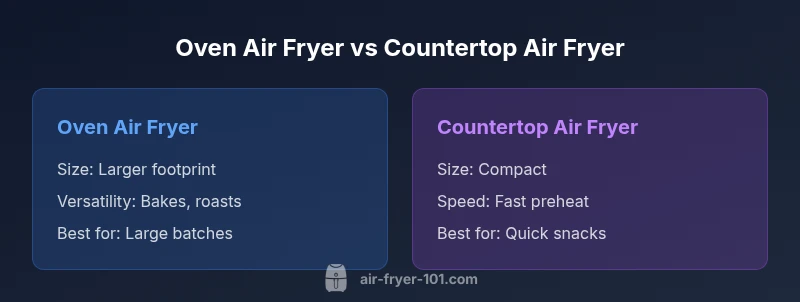
When you compare the two formats, the first and most obvious difference is size. An oven air fryer sits in a larger footprint, with more interior volume and multiple rack options. In contrast, a countertop air fryer is compact, typically with a single basket or tray. This size gap influences heat behavior: oven-style units often provide more even heat distribution across a larger cavity, while basket designs can produce crisp edges quickly but may require strategic loading to avoid hot spots. Second, capacity matters: oven air fryers can handle larger batches, vegetables and proteins on multiple racks, or even small baking projects. Countertop air fryers typically excel for single meals or snacks. Finally, control complexity and features vary; oven units may offer bake, roast, broil, and dehydrate modes, while countertop models focus on speed and simplicity with preset programs. The practical takeaway is to map your typical batch size and cooking goals to the right format.
Heating Dynamics: Airflow, Temperature, and Cooking Protocols
Air fryers rely on convection to circulate hot air, producing a crispy exterior with less oil. The oven air fryer vs countertop air fryer distinction extends to airflow paths and thermal mass. In an oven-style unit, air travels in a larger chamber and can be directed across multiple racks, which tends to reduce browning irregularities for big trays. A countertop air fryer uses a compact chamber with a focused airflow, often converting chips, wings, and vegetables into crisp textures rapidly. Temperature control and preheat behavior also differ: countertop units typically reach target temperatures quickly, while oven-style appliances may need longer preheat to ensure uniform heat across a wider interior. If you value consistent browning on large sheets, an oven air fryer may offer advantages; if you want quick, predictable results for smaller portions, a countertop model is often more convenient.
Real-World Cooking Scenarios: Snacks, Meals, and Batch Cooking
In daily kitchen life, your choice influences how you prepare meals. For quick snacks and small portions, countertop air fryers deliver excellent crispness in short cycles, with minimal cleanup and faster preheating. For family meals or batch cooking where you might roast vegetables while baking chicken, an oven air fryer shines because it can operate more like a conventional oven with air frying as a mode. This section compares typical use cases: french fries and chicken tenders, roasted veggies, and baked goods. The oven air fryer tends to produce more even browning on large sheets, while basket models shine when you need rapid, tiny batches. Both types can deliver health benefits by reducing oil, but the method and timing will differ based on capacity and airflow geometry. The keyword oven air fryer vs countertop air fryer remains central to the decision.
Cost, Warranty, and Long-Term Value
Price and value are crucial when choosing between oven air fryer vs countertop air fryer. Countertop models are typically less expensive upfront and require less counter space, which appeals to budget-conscious shoppers or those with limited kitchen real estate. Oven-style units command higher upfront costs but offer additional cooking modes and larger batch capacity, potentially saving money by replacing multiple appliances. Warranty terms, build quality, and availability of replacement parts also influence long-term value. This section highlights how to compare total cost of ownership: factor in energy use, frequency of use, space constraints, and potential replacement costs. We also discuss maintenance costs, such as the need for liners, baskets, racks, and cleaning supplies. The result is a framework for deciding whether the extra upfront investment pays back over time given your cooking patterns.
Cleaning, Maintenance, and Longevity
Different designs demand different maintenance routines. Countertop air fryers with baskets can be easier to clean after quick meals, but require more frequent basket cleaning and occasional deep cleans to remove baked-on residue. Oven air fryers, with racks and larger interiors, may need more systematic cleaning but can benefit from routine wipe-downs that keep interior surfaces gleaming. Both types benefit from careful loading to minimize splatter and oil residue. Regular checks of seals and airflow paths help sustain performance. A practical habit is to plan a monthly cleaning routine that includes checking the venting, wiping the interior, and cleaning removable parts with warm, soapy water. This approach extends the life of either appliance and preserves health benefits of air frying with less oil.
Practical Buying Guide: How to Decide for Your Kitchen
To decide between oven air fryer vs countertop air fryer, begin with your typical meals and batch sizes. If you frequently cook for four or more people, or enjoy baking alongside air frying, an oven-style unit can replace several appliances and manage larger volumes in a single session. If you live alone or with one other person, and you crave quick crisping for leftovers, a countertop model is likely the better fit. Consider space, energy costs, and how much you value multi-function capability. Finally, evaluate ease of use and cleaning: some models prioritize presets and simple interfaces, while others offer advanced controls and more flexible cooking modes. The goal is a decision you can defend with a plan for your weekly menu, including proteins, vegetables, and snacks. The oven air fryer vs countertop air fryer should appear naturally to reinforce relevance without overloading the copy.
Common Misconceptions and a Final Check
A common misconception is that bigger is always better; in reality, the best choice depends on your cooking patterns. Some buyers overestimate the utility of advanced features on an oven air fryer and overlook the convenience of a small countertop unit for routine meals. Conversely, assuming that all convection air fryers cook identically can lead to unpredictable results. The final check is a practical test: map out your weekly meals, estimate batch sizes, and note how often you bake or roast. This data helps you pick the format that minimizes cleanup and maximizes health benefits, while still keeping your budget in check. The oven air fryer vs countertop air fryer comparison remains the central lens for making a confident, informed purchase.
Comparison
| Feature | Oven air fryer | Countertop air fryer |
|---|---|---|
| Size & footprint | Larger built-in/oven-style footprint | Compact countertop unit with small footprint |
| Cooking speed | Longer preheat and batch cooking for larger cavities | Typically quicker preheat for small batches |
| Heat distribution | Potentially more even with multiple racks or larger cavity | Efficient, basket-based air flow with possible hotspots |
| Capacity per batch | Higher capacity per batch in oven-style units | Lower capacity per batch due to basket size |
| Price range | $150-$350 | $60-$150 |
| Best for | Frequent batch cooking, baking, family meals | Quick snacks, small households, space-limited kitchens |
Pros
- Versatility to bake, roast, and air fry in one unit
- Higher batch capacity suitable for families or meal prep
- Can function as a regular oven, expanding cooking options
- Better long-term value if used for multiple cooking methods
Cons
- Higher upfront cost than small countertop units
- Larger footprint may not fit in compact kitchens
- Longer preheat times for larger cavities
For most homes, countertop air fryers win on convenience and value; oven air fryers win for batch cooking and baking versatility.
Choose countertop when space and budget are top concerns. Choose oven air fryer when you regularly cook larger meals or want to combine air frying with baking.
Got Questions?
What is the essential difference between an oven air fryer and a countertop air fryer?
An oven air fryer is a larger, multi-purpose oven that uses convection to crisp foods, while a countertop air fryer is a compact, dedicated unit designed for quick crisping of small batches. The main trade-off is capacity and versatility versus footprint and price.
The oven air fryer is bigger and more versatile, while a countertop model is smaller and faster for quick meals.
Which cooks faster for small meals: oven air fryer or countertop air fryer?
For small batches, countertop air fryers typically preheat and cook faster due to their compact design, while oven-style units may take longer to reach temperature and complete larger batches.
Small meals heat up faster in countertop models; oven-style units take longer but handle bigger batches.
Are there energy or health considerations when choosing between the two?
Both use convection to reduce energy spend compared to a full-size oven. The energy difference often depends on batch size and frequency of use; the health impact is similar when using air frying with little or no oil.
Energy use scales with batch size; air frying is generally healthier with less oil.
Can I cook frozen foods effectively in both types?
Yes, both handle frozen foods well, but you may need to adjust time and shake or flip halfway to ensure even browning. Start with lower oil usage and follow manufacturer presets when possible.
Frozen foods work well in both; adjust time and flip for even browning.
How should I clean and maintain each appliance for longevity?
Regular cleaning after use, avoiding harsh abrasives, and ensuring vents are clear extend life. Basket units require daily cleaning of the basket and tray, while oven-style units need interior wipe-downs and rack cleaning at intervals.
Keep it clean after use; wipe interior, check vents, and clean the basket regularly.
Quick Summary
- Choose based on batch size and cooking versatility
- Countertop air fryers offer quick results for small meals
- Oven air fryers excel in larger batches and multi-method cooking
- Consider kitchen space and maintenance when deciding
- Use the comparison table to weigh price vs. performance