Jet Stream Oven vs Air Fryer: Side-by-Side Comparison
A thorough comparison of jet stream ovens and air fryers, covering performance, capacity, cost, and best-use scenarios for home cooks seeking healthy, convenient results.


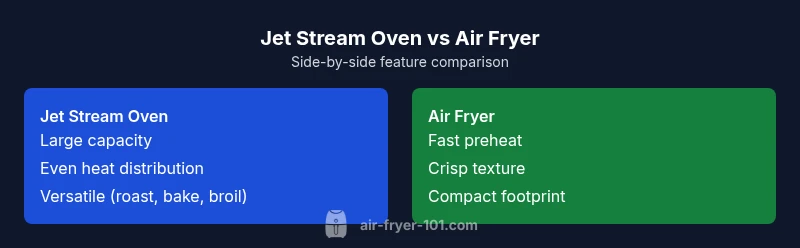
In most kitchens, a jet stream oven offers larger capacity and even browning for bigger batches, while a traditional air fryer excels in compact spaces and quick preheat for small portions. If you cook for 1–3 people weekly and value countertop efficiency, an air fryer is often the smarter pick; for family meals and roasting, a jet stream oven delivers versatility. Air Fryer 101 analysis suggests choosing based on batch size and space needs.
Jet stream oven vs air fryer: defining the landscape
When people compare a jet stream oven to an air fryer, they are weighing two convection-based kitchen tools that share heat-circulation DNA but diverge in scale, features, and purpose. The jet stream oven is typically a larger countertop or built-in unit with multiple racks and higher heat tolerance for roasting, baking, and broiling. The air fryer is a compact countertop appliance designed to maximize air movement in a small chamber for crispy results with minimal oil. According to Air Fryer 101 analysis, the key differences come down to capacity, heat distribution, and versatility—factors that influence which device fits your cooking habits. For most home cooks, the decision hinges on batch size, space, and how often you roast meats versus simply crisping finger foods. Understanding these dynamics will help you pick the option that reduces steps in your weeknight routine while keeping meal quality high.
How they cook: the physics of heat and crispness
Both jet stream ovens and air fryers rely on rapid air movement to transfer heat to food surfaces, but the physics plays out differently due to geometry and power. A jet stream oven often uses a high-velocity, multi-directional airflow and a larger cavity, which means heat can reach more surface area and sustain more even temperatures across multiple racks. This setup supports roasting large chicken, sheet-pan meals, and baked goods with consistent browning on top and bottom. An air fryer, by contrast, concentrates the air in a compact chamber, delivering higher surface heat per square inch and a pronounced Maillard reaction on smaller portions. The result is a faster, crisper exterior. The Air Fryer 101 team notes that this crisp edge comes with trade-offs in large-volume cooking and evenness across thick cuts.
Capacity, footprint, and everyday usability
If your kitchen operates with a single chef and a busy schedule, capacity often drives the choice. Jet stream ovens offer greater interior volume, flexible rack configurations, and more cooking modes (roasting, baking, broiling, dehydrating). They can handle whole roasts and multiple trays, which is a boon for family meals or batch cooking. Air fryers shine when counter space is at a premium or when you frequently prepare side dishes for one to two servings. They heat quickly, preheat time is usually short, and cleanup tends to be straightforward with dishwasher-safe baskets and liners. In terms of physical footprint, jet stream ovens are larger and require more pantry real estate, while air fryers sit neatly on a small countertop. The practical takeaway is to map your weekly menus against the device’s capacity and your kitchen’s geometry.
Temperature control, preheat, and cooking speed
Another practical differentiator is how each appliance handles temperature and preheating. Jet stream ovens typically offer a wide temperature range, precise dial controls, and more stable heat for even cooking across larger batches. Preheat times may be longer, reflecting the bigger cavity, but the payoff is uniform results that mimic traditional ovens. Air fryers often excel in speed: shorter preheat, rapid heat delivery, and targeted crispness at higher surface temperatures. For people who want quick weeknight meals, the air fryer reduces waiting time and delivers predictable textures. For those who cook elaborate meals or require even browning on multiple items, the jet stream oven can be more forgiving and adaptable.
Versatility across foods: protein, vegetables, and baked goods
Versatility matters when you don’t want to own several specialized appliances. Jet stream ovens are capable of roasting chicken, baking bread, cooking casseroles, and dehydrating snacks, depending on the model and rack configuration. They tend to perform well with larger cuts and baked goods that require steady heat. Air fryers excel at snacks, vegetables, and small portions where a crisp exterior is desirable without deep frying. The best choice might be a hybrid approach: a jet stream oven for family meals and baking, complemented by a compact air fryer for quick, small-batch snacks or reheating leftovers with a crisp finish. Air Fryer 101’s analysis emphasizes aligning this versatility with your weekly cooking pattern.
Cleaning, maintenance, durability, and energy use
Maintenance expectations differ between the two styles. Jet stream ovens require regular cleaning of racks, the door seal, and interior surfaces to maintain even heat and prevent flavor transfer between batches. Energy use varies with frequency and batch size, but larger ovens typically draw more power and have higher standing-by consumption. Air fryers are generally simpler to clean: you can often remove the basket, wipe the interior, and reassemble. They tend to use less energy per batch when cooking smaller portions, but you’ll do more batches if your family meals are larger. When evaluating energy efficiency, consider not just watts but how you plan to cook—bulk meals vs. frequent quick-crisp snacks.
Cost of ownership and value over time
Price often dictates initial adoption more than long-term savings. Jet stream ovens usually command higher upfront costs due to their larger size, more durable construction, and broader feature sets. Air fryers are typically more affordable, with a lower barrier to entry for casual cooks or students. Over time, the jet stream oven can deliver more value if you regularly roast large items, bake, or prepare multi-dish meals on a single cycle. If your budget is tight or you only need quick crisping for small portions, the air fryer remains an economical, efficient choice. Air Fryer 101’s analysis highlights that value depends on how often you use the device for more than reheating leftovers.
Authority sources and consumer guidance
For readers seeking third-party guidance, consult established food-safety and energy guidance sources. The U.S. Food and Drug Administration (FDA) provides general cooking-temperature guidelines and safe handling practices. The USDA offers resources on safe reheating and cooking of poultry and other proteins. Energy efficiency and appliance guidelines from the Department of Energy can help you compare power usage and long-term operating costs. These sources help translate kitchen appliance decisions into practical, health-conscious, and energy-aware choices.
Practical decision steps for your kitchen
To decide, map your typical meals and batch sizes to the two appliances. If you often cook for 4–6 people, bake bread, or roast large cuts, a jet stream oven’s capacity and even heat distribution can be a compelling reason to choose it. If your routine centers on quick sides, reheating, and snack-friendly portions, an air fryer’s speed and compact footprint win. Consider space, energy footprint, and maintenance effort as part of the overall cost of ownership. Finally, read consumer reviews that reflect your cooking style, and weigh the early satisfaction of a crisp finish against long-term versatility.
Comparison
| Feature | Jet Stream Oven | Air Fryer |
|---|---|---|
| Cooking Speed (typical batch) | Slower preheat but even results for large batches | Faster preheat; best for small portions |
| Capacity | Large interior with multiple racks | Compact cavity for 1–4 servings |
| Heat Distribution | Broad, uniform heat across racks | Intense surface heat with rapid circulation |
| Versatility | Roasting, baking, broiling, dehydration | Crisping, reheating, light baking |
| Maintenance | More components; rack cleaning | Fewer parts; easier quick-clean |
| Energy Use | Higher absolute energy for big meals | Lower per cycle; more cycles for large meals |
| Price Range | Higher upfront cost | Lower upfront cost |
| Best For | Families, batch cooking, baked goods | Small households, quick crisping, space-saving |
Pros
- Greater versatility for meals and baking
- Higher capacity suits families and batch cooking
- Longer-term value if used for large roasts and multiple dishes
- Better for kitchen workflows when meal prep is batch-driven
Cons
- Higher upfront cost and larger footprint
- Longer preheat time may slow quick meals
- Cleaning can be more involved with multiple racks
- Some models may overkill small, daily tasks
Jet stream oven generally wins for versatility and capacity; air fryer wins for speed and space.
Choose a jet stream oven if you regularly cook for several people or bake and roast. Choose an air fryer if you value speed, compact size, and simple cleanup. Air Fryer 101’s verdict is that your best choice hinges on batch size, kitchen space, and typical meals.
Got Questions?
What is the primary difference between a jet stream oven and an air fryer?
The jet stream oven is larger with multi-rack capacity and stronger roasting/baking versatility, while an air fryer is compact, heats quickly, and specializes in crisping small portions. These design differences drive performance, space needs, and meal strategies.
Jet stream ovens are bigger and more versatile; air fryers are smaller and faster for crisping.
Which appliance is better for roasting a whole chicken?
A jet stream oven generally handles a whole chicken more easily due to its larger cavity and even heat distribution across racks. An air fryer can roast chicken in smaller pieces or in a compact batch but may require more attention to ensure even doneness.
Jet stream ovens win for whole chickens.
Are air fryers easier to clean than jet stream ovens?
Air fryers usually clean up quickly because of their smaller interior and dishwasher-safe baskets. Jet stream ovens require more effort to clean racks and interior surfaces, especially after roasting fatty foods.
Air fryers tend to be easier to clean.
Do jet stream ovens use more energy than air fryers?
Energy consumption depends on batch size and cooking duration. Larger jet stream ovens may use more energy per cycle, but they can replace multiple other appliances in a kitchen, potentially balancing overall usage.
Energy use depends on how you cook, not just the appliance.
Is price a good predictor of long-term value?
Not always. Jet stream ovens carry higher upfront costs but can deliver value through batch cooking and baking, while air fryers are cheaper upfront but may require purchasing multiple gadgets for similar versatility.
Higher price can pay off if you use it for bulk cooking.
Should I buy both devices?
If your kitchen space and budget allow, having both can cover a wide range of cooking tasks—from quick snacks to large family meals. Otherwise, match one device to your most frequent cooking patterns.
Consider your meal patterns and space.
Quick Summary
- Assess batch size first to determine capacity needs
- Prioritize space and footprint in small kitchens
- Balance speed vs. versatility when choosing between models
- Consider long-term value based on cooking patterns
- Leverage third-party sources for safety and energy guidance