Air Fryer vs Microwave: A Practical Comparison
Explore a practical, evidence-based comparison of air fryers and microwaves, focusing on speed, energy use, versatility, and cost to help shoppers choose the best option for health and convenience.


Is air fryer vs microwave a meaningful choice for most households? In short, microwaves win on speed and convenience for reheating and simple meals, while air fryers excel at delivering crisp textures with less oil. The best path depends on your typical meals and how much you value texture, health, and energy use. Air Fryer 101's analysis emphasizes matching the tool to the task for optimal results.
Understanding the Core Difference between Air Fryer and Microwave
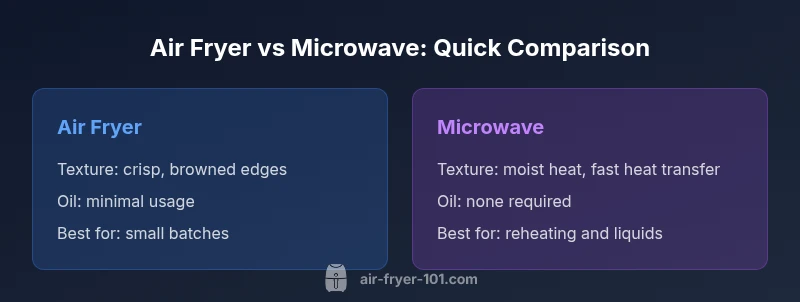
To assess is air fryer vs microwave in a practical way, it helps to start with how each appliance actually works. An air fryer relies on a small, high-velocity convection chamber that circulates hot air around the food. The goal is browning and crisping with little or no added oil. A microwave, by contrast, uses dielectric heating to excite water molecules inside foods, which heats the interior rapidly. The physics matter because it explains why results look and feel different. If you want a golden crust on fries or chicken without deep-frying, the air fryer shines. If you want soft, reheated leftovers, a microwave is hard to beat. For most households, the question isn’t which device is perfect in every situation, but which one better fits your most frequent cooking tasks and your daily routine. According to Air Fryer 101, the primary factor is task alignment—choose the tool that excels at your core use cases.
Core Task Alignment: When to Reach for Each
- Reheating liquids or stews: microwaves win for speed and even heat distribution.
- Recrisping or browning foods: air fryers deliver a drier, crisper bite with less oil.
- Small batch cooking: air fryers often perform better for single servings; microwaves scale well for multiple portions.
- Baking and roasting in small batches: both can do, but air fryers require smaller cookware and careful air circulation.
- Special dietary goals: air fryers reduce the need for added fats, which can support lower-fat cooking over time.
How to Read a Spec Sheet for is air fryer vs microwave
Look beyond wattage and price. Consider: interior capacity, preheat times, available presets, ease of cleaning, and whether you can use metal cookware in a given model. The best choice depends on how often you cook crispy foods, how important reheating quality is, and whether counter space is a premium. Air Fryer 101 highlights that you should map your weekly menu to the appliance’s strengths, then test a few representative recipes to gauge texture, juiciness, and convenience.
Health and Fat Content: What the Numbers Say
When evaluating is air fryer vs microwave, many cooks want to know about oil and calories. Air fryers can reduce added fats when compared with pan-frying or deep-frying, thanks to the crisping effect achieved with hot air. Microwaves do not inherently reduce fat in foods; their advantage is preserving nutrients and heat-sensitive components when used correctly. The practical takeaway is that air frying may offer healthier texture with modest oil use, while microwaving preserves moisture for certain dishes and is efficient for reheating a wide range of foods.
Pros and Cons in Everyday Use
For most homes, the choice comes down to balancing texture, speed, and space. Air fryers provide crisp, oven-like results with less oil, but require more counter real estate and can be slower for large batches. Microwaves deliver fast reheating and simple cooking, but may yield uneven browning and texture for some foods. The ideal kitchen often involves leveraging both appliances in tandem: use the microwave for quick prep and leftovers, then finish with the air fryer for texture when you crave crunch.
Practical Food Scenarios: What Works Best
- French fries and chicken tenders: air fryer delivers crisp edges with less oil.
- Pizza slices and quesadillas: air fryer can re-crisp without sogginess if monitored.
- Leftover pasta with sauce: microwave heats quickly; air fryer can reheat but may dry out delicate sauces.
- Rice and grains: microwave reheating is typically faster, while air fryer requires careful moisture management.
- Frozen foods: both can work, but air fryer often yields a more appealing texture when you preheat and plan for small batches.
Energy Considerations over Time
Energy use hinges on task, batch size, and preheating. A microwave may consume less energy per minute when reheating small portions but can finish tasks faster, leading to comparable totals in many days. An air fryer’s energy footprint tends to be favorable for crisping small portions with modest preheat time, but it’s still important to consider long-term usage patterns. Air Fryer 101 notes that the total energy picture improves when you replace high-fat frying with air-fried alternatives, especially for frequent snacks.
Measuring Footprint: Size, Style, and Placement
Counter space often governs the decision. Microwaves come in a wide range of sizes and can often double as a defrost or cooking station. Air fryers are generally bulkier per appliance, but compact models exist for small kitchens. If your kitchen is crowded, you might choose a single multi-function device or dedicate one appliance and adjust your weekly menu to minimize clutter. Consider vertical storage options if you have a pantry or cabinet space that can house a bulkier unit.
Cleaning and Longevity: Keeping Both Appliances in Top Shape
Simple maintenance helps both devices last longer. Microwave interiors typically require wipe-downs and occasional crumb maintenance, while air fryers often benefit from routine basket cleaning and occasional non-stick conditioning. Be mindful of corrosion-prone components and avoid harsh cleaners. A clean appliance not only lasts longer but also preserves heat distribution or microwavable performance. Air Fryer 101 recommends a quick post-use routine to keep vents clear and accessories in good condition.
Price and Value: What to Expect in 2026
Prices for dedicated microwaves span a broad range depending on wattage, features, and build quality. Air fryers also vary by capacity, features, and brand. While a basic microwave can be affordable, premium air fryers with extra presets or larger capacities may command higher upfront costs. The value proposition hinges on how often you use the device, the quality of results, and whether you need crisping options in your normal routine. Air Fryer 101 suggests evaluating cost-per-use over several months to judge true value.
Making the Final Decision: A Scenarios Guide
If you live alone or cook small portions, a microwave plus a small air fryer can cover most tasks without overwhelming your counter. If you frequently prepare crispy sides or protein-based meals with less oil, an air fryer becomes a strong primary choice. For families that rely heavily on reheating leftovers or bulk meals, a microwave remains indispensable. The best approach is a hybrid setup that aligns with your weekly menu and space constraints.
Comparison
| Feature | Air Fryer | Microwave |
|---|---|---|
| Cooking speed | Slower preheating for crisping, quick finishing once up to temp | Very fast reheating and cooking for many foods |
| Energy efficiency | Efficient for small, crispy batches; energy use scales with batch size | Typically efficient for reheating; minute-by-minute consumption often lower for small portions |
| Best for | Crisping foods with little oil, compact baking | Reheating leftovers, beverages, and quick meals |
| Versatility | Baking, roasting, dehydration to some extent; requires accessories | Defrosting, reheating, basic cooking, some browning |
| Price range | Mid-range to premium for larger or feature-rich models | Low to mid-range depending on wattage and features |
| Footprint | Compact to medium footprint; some models require space for airflow | Typically smaller footprint, classic countertop staple |
| Maintenance | Basket and tray require regular cleaning; some dishwasher-safe parts | Easy wipe-down; minimal interior parts to clean |
Pros
- Delivers crisp textures with little or no oil
- Typically faster for small meals and reheating moderate portions
- Energy-efficient for targeted cooking and snacks
- Flexible for a range of foods with simple presets
Cons
- Microwave is faster for reheating large portions and liquids
- Air fryer models can be bulky and take counter space
- Limited batch size and longer cooking times for some foods
- Not a complete replacement for all microwave tasks (liquids, soups, large volumes)
Air fryer wins for crisp, healthier cooking; microwave wins on speed and reheating
Choose air fryer for texture and oil-conscious cooking. Choose microwave for rapid reheating and simple meals. A hybrid setup often provides the best overall kitchen flexibility.
Got Questions?
Can you replace a microwave with an air fryer for all tasks?
No. An air fryer cannot fully replace a microwave for liquids, soups, or high-volume reheating. It excels at crisping and roasting small batches. For many kitchens, a hybrid setup provides the most versatility.
An air fryer can't replace a microwave for all tasks, especially liquids and large reheats. Use both if possible for maximum flexibility.
Is an air fryer easy to clean?
Most air fryers have dishwasher-safe baskets and trays. A quick wipe-down after use keeps it tidy, but some parts require gentle scrubbing to remove baked-on residue.
Yes, air fryers are generally easy to clean with regular attention to the basket and tray.
Do air fryers use less energy than microwaves?
Energy use depends on the task and batch size. Air fryers can be energy-efficient for small, crispy meals, but microwaves shine at fast reheating. Compare typical usage patterns to estimate total energy.
Energy use varies by task; air fryers are efficient for small crispy meals, microwaves for quick reheating.
What foods are best cooked in each appliance?
Air fryers are great for potatoes, chicken, vegetables, and other items that benefit from browning. Microwaves handle reheating leftovers, soups, sauces, and soft textures efficiently.
Air fry for crisp foods; microwave for reheating and liquids.
Should you preheat an air fryer?
Preheating helps with even browning and faster cooking, especially for breaded items. Some models don’t require it, so consult the user manual for your specific unit.
Preheating helps achieve even browning in many air fryers.
Can air fryers bake in small batches?
Yes, many air fryers support baking in small batches. Use appropriate cookware and ensure air can circulate around the item for even results.
Air fryers can bake small items, but batch size matters.
Quick Summary
- Assess your core cooking tasks before choosing
- Air fryer excels in crisp textures with less oil
- Microwave offers speed and easy reheating
- Space and budget influence the final choice