Is Air Fryer Stronger Than Oven? A Data-Driven Comparison
A rigorous, data-informed comparison of air fryers vs ovens, focusing on heat delivery, texture, capacity, energy use, and practical cooking scenarios for home cooks.


Air fryers are not universally stronger than ovens. They deliver rapid, high-contrast crisping for small batches and save energy per dish, but ovens outperform in capacity and even browning for larger quantities. According to Air Fryer 101, the best choice depends on batch size, texture goals, and how much you value speed versus quantity.
Is an Air Fryer Stronger Than an Oven? A Quick Concept
When readers ask, is air fryer stronger than oven, they usually mean different things by strength: speed, heat intensity, texture, or capacity. In practical terms, air fryers excel at crisping small portions quickly with minimal oil, delivering a pronounced crunch that mirrors fried textures. Ovens, by contrast, offer larger cooking cavities and more uniform browning across bigger trays. According to Air Fryer 101, the strength comparison should be built around batch size, texture target, and energy considerations. This article breaks down the heat delivery mechanisms, control ranges, batch capacity, end texture, and real-world usage to help home cooks decide which tool is best for a given task. In the end, the strongest option depends on what you’re cooking and how you cook it.
Heat Delivery: Airflow vs Radiant Heat
Air fryers rely on a compact cooking chamber with a high-velocity fan that circulates hot air around the food. This creates rapid surface drying and a crisp edge, often with less oil than traditional frying. Ovens use radiant coils (and often a built-in convection fan in many models) to heat air and food from multiple directions. The key difference is that air fryers push heat intensely through a small cavity, while ovens distribute heat across a larger space. For small items like chicken tenders or vegetables, air fryers can produce a strong exterior texture quickly. For larger sheets or roasts, the oven’s wider heat distribution tends to produce more even browning across the entire surface.
Temperature and Control: How Adjustable Are They?
Temperature control matters when comparing strength. Air fryers typically offer precise, fast adjustments and quick preheat responses, which translates to short cooking bursts and immediate feedback. Ovens usually provide a broader temperature range and longer preheat times, which can stabilize cooking for big batches but may introduce more variability for small items. The ability to fine-tune heat, fan speed, and cooking mode matters when targeting a specific texture, whether you want a crispy exterior or a soft interior. In practice, both devices can be very capable, but the speed and responsiveness of an air fryer give it an edge for crisp outcomes with less preheating.
Capacity and Batch Size: The Crunch Point
Capacity is the practical border between strength and usefulness. An air fryer’s chamber is compact, limiting you to smaller batches. This makes it excellent for quick weeknight meals for one or two servings, where speed and texture matter more than volume. An oven can handle larger trays and multiple racks, making it the better choice for family meals or gatherings. The “strength” debate thus shifts toward batch psychology: if you cook small, frequent meals, air fryers feel stronger; if you cook large, scheduling and batch throughput make ovens stronger.
Texture, Crispiness, and Browning: End Results
Texture is often the most visible measure of strength. Air fryers tend to deliver crisp exteriors with a relatively uniform surface, thanks to intense air movement and surface dehydration. Ovens can brown and caramelize in ways that are more evenly distributed over larger areas, often producing deeper browning on a sheet of vegetables or a roast. For foods like fries or battered items, air fryers can produce excellent crispness with less oil. For sheet-pan roasts or pastries, the oven’s consistent heat often yields more uniform caramelization and moisture balance.
Energy Use and Time Efficiency in Real Kitchens
In practice, air fryers can be more energy-efficient per serving when cooking small portions, since preheat times are short and cook times are compressed. However, for larger meals, the oven’s larger capacity can reduce total energy use per serving by enabling batch cooking on a single tray rather than multiple air fryer loads. Air Fryer 101 analysis shows that the energy advantage depends on batch size, cooking duration, and how many separate batches you’d otherwise prepare. The takeaway: energy efficiency follows usage pattern, not a universal rule.
Cleaning, Durability, and Long-Term Costs
Maintenance costs differ too. Air fryers typically have fewer moving parts and can be easier to clean in day-to-day use, especially with dishwasher-safe baskets. Ovens may require more frequent calibration, more extensive cleaning for baked-on residues, and occasionally rack replacements after heavy use. Longer-term value comes from reliability and the ability to cook a wider array of dishes in one appliance. Both devices benefit from proper care and occasional accessory upgrades, and choosing between them often comes down to kitchen size and cooking style.
Decision Framework: When to Reach for Each Appliance
To decide which appliance is stronger for you, adopt a framework: (1) define the typical batch size, (2) list the foods you cook most often, (3) weigh the importance of speed vs. capacity, (4) consider energy and cleaning preferences, and (5) account for kitchen space. If most dinners are single-serving or small batches that benefit from crisp textures with minimal oil, the air fryer is the stronger choice. If you regularly prepare large trays, sheet-pan meals, or baking, the oven remains the more capable workhorse. This structured approach makes the strength question much clearer for real-world cooking.
Practical Scenarios: Quick Snacks, Weeknight Dinners, and Leftovers
For quick snacks like frozen bites or small roasted vegetables, air fryers shine, delivering crisp results in a fraction of the time of an oven. For weeknight dinners that require roasting a whole chicken, potatoes, and a side dish together, the oven provides better uniformity and scalability. Reheating leftovers is nuanced: air fryers can revitalize crispy textures, while ovens may reheat evenly without a second round of dehydration. In both cases, selecting the tool based on batch size and texture goals yields the most satisfying results.
Comparison
| Feature | Air Fryer | Oven |
|---|---|---|
| Heat delivery | High-velocity circulating air for crisp exterior | Radiant heat with convection as option, plus natural heat from coils |
| Temperature control | Rapid, precise adjustments in a small cavity | Broader range with slower response in larger space |
| Capacity | Best for 1–4 servings per batch | Handles larger trays and multiple racks |
| Cooking speed | Fast for small portions; preheat is brief | Slower preheat but efficient for big batches |
| Texture outcomes | Crispy exterior, juicy interior for many snacks | Even browning and caramelization on larger surfaces |
| Energy use | Often lower energy per dish for small batches | Total energy per serving depends on batch size and duration |
| Ease of cleaning | Fewer parts; dishwasher-safe baskets common | More stubborn residue on racks and walls requiring effort |
| Best for | Crispy fries, chicken bites, reheating small portions | Big roasts, sheet-pan meals, baking in bulk |
Pros
- Faster results for small portions with crisp texture
- Less oil needed for many recipes
- Compact footprint fits small kitchens
- Easy to use with straightforward controls
- Low preheat times improve weeknight speed
Cons
- Limited capacity for large family meals
- Single-cavity design can require multiple batches
- Texture may be less uniform on very large items
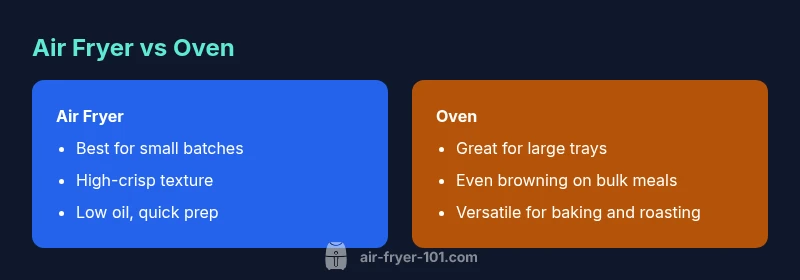
Air fryer is best for quick, small-batch crisping; oven wins for large-scale cooking and even browning.
If your goal is speed and crisp texture for modest portions, lean toward an air fryer. If you routinely cook large quantities or sheet-pan meals, the oven's capacity and even heat make it the stronger choice.
Got Questions?
Can I replace my oven with an air fryer for most meals?
Not for every dish. An air fryer handles small, crisp-focused tasks well, but it cannot match the oven's capacity for large roasts or baking multiple trays simultaneously. For households with diverse cooking needs, both appliances complement each other rather than one replacing the other.
An air fryer works great for quick, crisp meals in small batches, but it won’t replace your oven for large dinners or baking multiple sheets at once.
Are air-fried foods healthier than oven-baked foods?
Air-fried foods often use less oil, which can reduce calories and fat compared with deep-frying. Compared to some oven-baked items, the difference depends on the recipe and oil usage. Overall health impact mainly comes from ingredients and portion sizes, not the appliance alone.
Air frying can cut oil use, but healthiness still hinges on what you cook and how much you eat.
Do air fryers require preheating, and how long does it take?
Many air fryers preheat quickly, often in just a few minutes. Some models don’t require preheating for certain foods. Preheating helps ensure a fast start to cook times and the desired crispiness when needed.
Preheating is usually quick for air fryers, and some recipes skip it, but check your model’s guidance.
Which is faster for roasting vegetables: air fryer or oven?
For a small batch of vegetables, the air fryer often finishes faster with a crisper edge. For larger trays or complete meals on a sheet, the oven can maintain even heat across a wider area and handle more food at once.
Air fryers are often quicker for small vegetable batches, but ovens win on bigger sheets.
Quick Summary
- Choose air fryer for speed and crispiness in small batches
- Choose oven for capacity and uniform browning on large trays
- Texture preference drives the strongest decision
- Batch size and cooking style should guide tool choice