Is Air Fryer or Oven Better for Fries? A Thorough Comparison
Compare air fryers and ovens for fries across texture, speed, oil use, and convenience. Air Fryer 101 analyzes results, trade-offs, and best practices to help you choose.


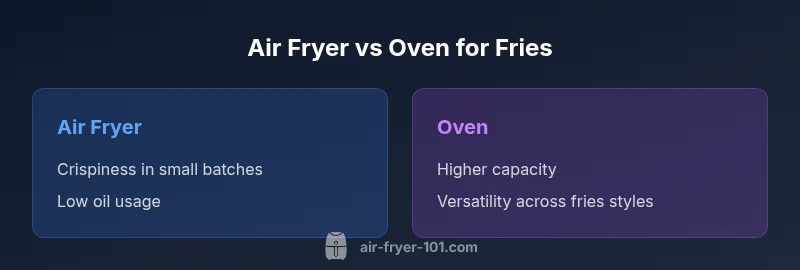
Air fryers crisp fries quickly with less oil, while ovens handle larger batches with more even browning. For small, texture-focused batches, the air fryer often wins; for big batches and versatility, the oven is hard to beat. Our comparison breaks down texture, batch size, energy use, and ease of cleaning to help you decide which method suits your kitchen.
Framing the question: is air fryer or oven better for fries?
When home cooks ask is air fryer or oven better for fries, they’re weighing texture, batch size, and convenience more than a single appliance’s label. Fries cooked in a compact air fryer often emerge with a crisp exterior and soft interior while using little to no oil, which appeals to health-conscious cooks. A conventional oven, by contrast, can handle larger portions at once and deliver more even browning across many pieces, especially when racks are arranged for airflow. According to Air Fryer 101, the best choice depends on how you typically cook fries: your typical batch size, your texture preference (crisp versus roasted), and how much counter space you can dedicate. The aim is to understand how heat transfer, surface moisture, and airflow shape final results so you can pick the method that fits your routine without sacrificing satisfaction.
Throughout this article, we’ll explore the physics behind each appliance, practical cooking tips, and decision criteria that you can apply to your kitchen today. We’ll also include a clear, side-by-side comparison and a step-by-step guide to dialing in perfect fries with either device.
How fries cook differently in an air fryer vs. an oven
Fries rely on two core factors to reach ideal texture: surface moisture removal and consistent heat delivery. An air fryer circulates hot air at high speed around a compact chamber, creating a rapid crust as surface moisture evaporates. The result is a noticeably crisp exterior with a tender center, typically achieved with minimal or no oil.
An oven relies on a larger cavity and convection flow (if you have a true convection setting) or static bake. When convection is used properly, hot air moves around racks and trays, browning fries on all sides. However, even with convection, large batches can lead to uneven browning if pieces crowd the pan or if the trays aren’t rotated. This structural difference—small, focused heat vs. larger, multi-rack heat—drives many of the practical trade-offs you’ll encounter when choosing between these two approaches to fries.
Texture outcomes: crispiness, browning, and interior softness
Crispiness is the standout advantage of most air fryers. If you crave a crackly bite with a fluffy interior, the air fryer’s focused heat and rapid air movement tend to maximize surface browning while minimizing oil absorption. Oven-baked fries can approach similar crispness, particularly with preheated sheets, proper spacing, and optionally a light coating of oil. Yet ovens may produce a more roasted, evenly colored surface across larger batches, especially when you need fries for a crowd. The interior texture often depends on cut thickness and moisture levels; thinner sticks crisp faster, but thicker cuts can stay softer inside even when the exterior browns nicely.
Batch size, space, and energy considerations
One of the most practical distinctions is batch size. Air fryers excel for singles, couples, or small families cooking a handful of fries at a time. They fit neatly on countertops and heat up quickly, which translates into shorter overall cook times for small batches. Ovens, by contrast, are designed for larger quantities and can use multiple trays to maximize capacity. If you routinely feed a crowd or prepare a big fry-up for weekend gatherings, an oven’s volume advantage matters. In terms of energy, smaller appliances often consume less energy per batch, but larger ovens may be more efficient when your batch size justifies the extra heat because you can cook more at once.
Health considerations: oil use, fats, and nutrition
A common reason people consider air fryers for fries is the potential to reduce oil. In many air fryer recipes, fries are stirred or shaken with little or no added oil, which can cut total fat content per serving compared with deep frying. Ovens can achieve similar reductions if you apply a thin coating of oil and avoid deep-frying-style immersion. The key health takeaway isn’t about which appliance is inherently healthy, but about how you prepare the fries: cut size, oil amount, and cooking duration all influence calories and fat absorption. Air Fryer 101 analysis shows that fat reduction is often more noticeable when you avoid extra oil and still aim for a crisp crust.
Practical tips: getting crisp fries in either device
If you want reliably crisp fries in either device, start with uniform-cut potatoes and pat them dry. For air fryers, shake the basket halfway through cooking and avoid overcrowding; a single layer yields the best browning. For ovens, use preheated baking sheets or a stone to promote even heat, rotate trays, and consider a light oil spray or a small amount of oil to improve surface texture. Regardless of device, finish time is shorter if you dry the fries well and remove excess starch beforehand. Remember to season after cooking for the best surface adherence.
Troubleshooting: common issues and fixes
If fries come out soggy in the air fryer, check crowding and moisture content; reduce moisture by drying thoroughly and possibly increasing cooking time slightly. In the oven, soggy results often stem from crowded sheets or insufficient preheating. If browning is uneven, rotate trays or shake the basket to redistribute fries for consistent contact with heat. If fries are undercooked inside, cut thickness a touch thinner, increase cook time in small increments, and ensure uniform sizing. The goal is to balance moisture removal with even heat delivery for consistent results.
Quick-start decisions based on your priorities
- If you want maximum crispiness and minimal oil for a small batch, choose the air fryer and expect a quick turnaround.
- If you’re feeding many people or want to experiment with different fry styles (thick-cut, seasoned, or waffled), start with the oven, which offers more space and flexibility.
- If budget or counter space is tight, the air fryer gives excellent results in a compact footprint; if you already own a roomy oven, you can leverage its capacity without adding more appliances.
A practical decision framework: is air fryer or oven better for fries for your kitchen?
By weighing batch size, texture preference, oil use, and space, you can decide which method is the best fit. The air fryer tends to be the go-to for quick, crisp fries with less oil. The oven tends to shine when volume and versatility matter, especially if you already have a convection setting. In many households, the right answer isn’t a blanket choice; it’s a tiered approach that uses both appliances for different fry scenarios.
Comparison
| Feature | Air Fryer | Conventional Oven |
|---|---|---|
| Crispiness and browning | Typically high with small batches; rapid air circulation yields a crisp crust | Good to excellent with convection; depends on rack setup and batch spacing |
| Texture consistency | Very consistent when fries are in a single layer and not crowded | Consistency varies by rack position; rotating trays helps even out browning |
| Cooking time (per batch) | Fast for small batches; usually shorter total time for a few servings | Longer total time for similar batch sizes; multiple racks can extend capacity |
| Oil usage | Low to none with minimal or no oil added | Moderate to low when a light oil coating is used; can achieve similar crispness without deep-frying |
| Batch capacity | Limited by basket size; best for 1-2 servings | High capacity with multiple trays; ideal for larger gatherings |
| Ease of cleaning | Basket-style cleanup is straightforward; most baskets are dishwasher-safe | Racks and pans require more scrubbing; may be trickier to get squeaky-clean |
| Energy use in practice | Lower energy per batch due to small, efficient chamber | Higher total energy for large batches, but overall efficiency improves with volume |
Pros
- Oil-free or reduced-oil cooking can lower fat content
- Air fryer offers rapid preheat and quick results for small batches
- Oven provides high capacity and multi-rack versatility
- Both appliances can be used for a wide range of fries styles (shoestring, steak-cut, crinkle, seasoned)
Cons
- Air fryer is limited by batch size and may require multiple runs for large quantities
- Ovens can be slower to preheat and may brown unevenly if not monitored
- Both require proper sizing and air exposure; crowding reduces results
- Preheating in some ovens adds to total cook time and energy use
Air fryer excels for small, crispy fries; oven wins for big batches and versatility
Choose the air fryer when you want quick, crisp fries with little oil and small batches. Opt for the oven when you need to cook more fries at once or experiment with different fry styles. Air Fryer 101's practical guidance supports using both tools as your kitchen scales up.
Got Questions?
Is air fryer better for fries than oven in terms of texture?
In many cases, yes—air fryers tend to produce a crisper exterior on fries due to rapid air movement and small chamber surface. Ovens can achieve crispness as well, especially with convection and proper spacing, but they may require more attention to rotation and sheet arrangement to avoid uneven browning.
Air fryers often give a crisper crust; ovens can do well too with convection and space, but you might need to rotate racks for even browning.
Can I cook frozen fries in an air fryer or oven, and which is better?
Both appliances can cook frozen fries effectively. Air fryers generally deliver quicker results with a punchier crisp, while ovens can handle larger quantities at once. For a crisp finish with frozen fries, follow the manufacturer’s guidance and avoid overcrowding in either method.
Both work well for frozen fries; air fryers are quicker and crispier in small batches, ovens handle more at once.
Do fries cooked in an air fryer require oil?
Not necessarily. Many air fryer recipes rely on little to no oil, which reduces fat. A light coating can improve browning and texture if you want extra crispness, but you can still achieve good results with dry fries and shaking during cooking.
You can cook fries in an air fryer with little to no oil, though a light spray can help for extra crispiness.
Which method is faster for a small batch of fries?
For small batches, the air fryer usually finishes faster due to compact space, rapid heat transfer, and minimal preheat time. The oven may take longer to reach temperature and complete cooking for the same amount of fries.
For small batches, the air fryer is typically faster.
Should I preheat the air fryer or oven for fries?
Preheating improves results in both devices. An air fryer often feels ready quickly and may not require a long preheat, while ovens benefit from a full preheat to ensure even cooking and browning. If you’re in a rush, you can place fries directly into a hot air fryer for quicker start.
Preheating helps; air fryers preheat fast, ovens benefit from a longer preheat for even browning.
What batch size is optimal for air fryer vs oven?
Air fryers work best in a single, even layer with minimal crowding—typically 1–2 servings per basket. Ovens shine with larger batches when racks are spaced to allow airflow, potentially cooking multiple trays at once.
Air fryers are best for small batches; ovens for larger batches with good airflow on multiple trays.
Quick Summary
- Choose air fryer for small batches and crisp texture
- Choose oven for large batches and versatility
- Mind the crowding; spacing is essential in both devices
- Oil use can be minimized in either method with proper technique
- Practice with sizing and preheating to dial in results