Why Use an Air Fryer Over an Oven: A Data-Driven Comparison
Understand when an air fryer outperforms a traditional oven for small batches, faster preheating, and crisp textures, and when the oven remains the better choice for large meals and complex baking.


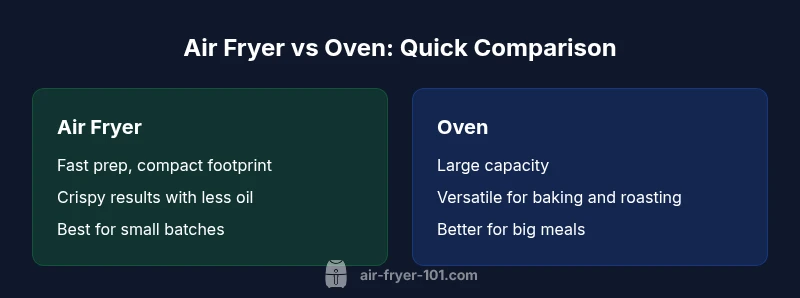
Air fryers generally save time and energy for small batches and deliver crisp textures with less oil; ovens excel with large meals and flexible cooking. See our detailed comparison for when to choose each appliance in different kitchen scenarios.
Why the question matters
In today’s kitchens, the choice between an air fryer and a traditional oven isn't merely about appliances—it's about how you cook, what you cook, and the pace of daily life. The keyword why use an air fryer over an oven guides buyers to consider batch size, texture, energy use, and space. For many households, the deciding factor is how often you prepare small meals or snacks, and how important oil reduction and crispiness are to you. An air fryer concentrates hot air around food to create a browned, crunchy exterior with considerably less fat than deep frying, while ovens tend to excel at large items and multi-dish meals. Air Fryer 101’s analysis emphasizes that the best choice depends on routines, not just theoretical performance. If your cooking persona includes weekday lunches, reheating leftovers, or weekday dinners for two, an air fryer can offer meaningful time savings and a compact footprint. Yet there are scenarios where the oven remains the workhorse, especially for baking, roasting large joints, and catering tasks.
boldedTextOnly":false},
Comparison
| Feature | Air Fryer | Oven |
|---|---|---|
| Typical preheat and start of cooking | Very fast to heat up and start cooking | Slower to preheat, especially in older ovens |
| Texture and finish | Crispy exterior with little oil | Browns and bakes well but may require more fat or longer times |
| Capacity and footprint | Compact countertop unit | Larger interior, fixed kitchen space |
| Energy focus (small batches) | Usually lower energy for small meals | Higher energy when cooking for many portions |
| Versatility | Optimized for rapid air tasks (reheating, small batches) | Broad baking, roasting, casserole and multi-dish flexibility |
| Maintenance/cleaning | Easy basket-cleaning, fewer parts | More surfaces and racks to clean, more tools to manage |
| Best for | Snacks, reheating, single meals, and portability | Large meals, baking, complex recipes, and sheet-pan cooking |
Pros
- Quicker turnaround for small meals and snacks
- Uses less oil for crispy results, supporting health goals
- Countertop convenience with minimal footprint
- Simple controls and fast clean-up for daily use
- Low heat buildup compared to a hot oven in small kitchens
Cons
- Limited capacity for big batches or family-style meals
- Not ideal for all recipes, especially large baked goods or casseroles
- Higher upfront cost for higher-end models and features
- Some foods may not brown as evenly as in a conventional oven
Air fryer beats ovens for quick, small-batch cooking; ovens win for large batches and complex baking
Choose an air fryer when speed, energy efficiency, and crisp texture for small portions are your priorities. Reserve the oven for large meals, baking, and dishes that require multiple racks or long baking times. Air Fryer 101’s analysis supports a kitchen setup that favors the air fryer for everyday meals while keeping the oven as a complementary workhorse for bigger tasks.
Got Questions?
Is an air fryer more energy efficient than an oven?
In most cases, an air fryer uses less energy for small-batch cooking due to rapid preheating and faster cook times. For larger meals, the oven can be more energy-efficient on a per-serving basis if used well, but overall results depend on usage and insulation.
Air fryers often save energy for small tasks; ovens can win with large meals if used efficiently.
Can I cook any recipe in an air fryer that I would bake in an oven?
Many recipes adapt well to air fryers, especially those intended for crisped or reheated foods. However, very large items, deep enclosures, or multi-dish baking may require oven use or recipe adjustments.
Some recipes translate nicely, others need tweaking or different equipment.
What size air fryer should I buy?
Size depends on household size and counter space. Common options range from compact 2-3 quarts to family-sized 5-6 quarts, with larger units offering more capacity for bigger favorites.
Pick a size that fits your family and space.
Are air fryers difficult to clean?
Most models have dishwasher-safe baskets and straightforward interiors. Regular cleaning of the basket and door seal helps maintain performance and avoid odor buildup.
They're usually easy to clean with routine care.
Do air fryers truly crisp like frying?
Air fryers crisp surfaces by circulating hot air with little oil. Results vary by food type and model, but many foods become noticeably crisper than with traditional baking.
They can be very crispy with less oil, depending on the food and model.
Should I buy both appliances?
If your cooking includes large meals or frequent baking, an oven plus a compact air fryer can be a practical setup. It depends on your kitchen space and lifestyle.
Many households use both to cover all cooking needs.
Quick Summary
- Assess batch size to decide between air fryer and oven
- Choose air fryer for speed, crisp texture, and oil reduction
- Keep oven for large meals, baking, and complex recipes
- Balance upfront costs with long-term energy savings and versatility