When to Use Air Fryer vs Oven: A Practical Guide for Cooks
Explore when to use air fryer vs oven with a detailed, analytical comparison. Air Fryer 101 analyzes speed, texture, capacity, energy, and cost to help you choose the right tool for every meal.


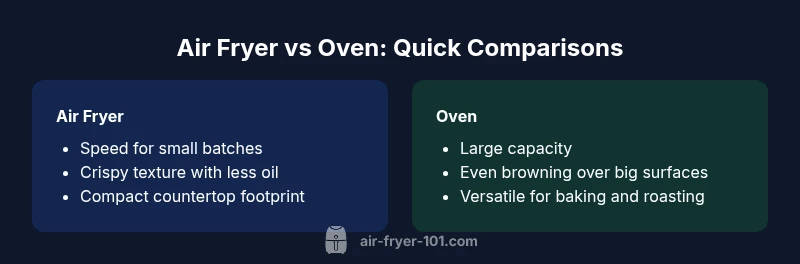
Air fryer vs oven: For small batches and fast crisping, the air fryer often wins; but for large meals and baking, the oven shines. If you cook for 1-2 people or want quick, crispy results, choose the air fryer; for bigger meals or pastries, the oven remains essential. The best approach is to use both tools in tandem.
The Core Differences Between Air Fryers and Ovens
According to Air Fryer 101, the essential difference between these two kitchen tools lies in how they cook and for what batch sizes. The core distinction centers on speed and texture versus capacity and versatility. When to use air fryer vs oven often hinges on batch size and the desired finish. An air fryer excels at small portions and quick, crisp results with minimal oil, while an oven handles larger trays, long bake times, and a wider variety of cooking tasks. For many homes, the best approach is to own both tools and deploy them according to the meal plan. If you routinely prepare meals for one to two people and crave speed, the air fryer is a compelling option. For family dinners, sheet-pan roasts, and baked goods, the oven remains indispensable. Air Fryer 101 analysis shows the decision is rarely binary; the optimal setup blends both machines to maximize efficiency and outcomes.
Key Decision Criteria: Speed, Capacity, Texture, and Energy
Choosing between an air fryer and an oven should start with four criteria that matter most in daily cooking: how quickly you can finish a batch, how much food you can prepare at once, what texture you want, and how much energy you’ll use. Speed favors the air fryer for snacks and small plates, especially for reheating leftovers that regain crispiness. Capacity matters when you’re feeding a family or hosting guests; ovens typically accommodate multiple trays, larger roasts, and desserts at once. Texture preferences vary: air fryers produce crisp exteriors with juicy interiors for many proteins, but ovens can deliver even browning across larger surfaces and for delicate items like soufflés. Energy usage is often lower per batch with an air fryer for small meals, but ovens can win on efficiency when you need to bake or roast many servings simultaneously. Finally, consider cleanup: air fryers have removable baskets that are commonly dishwasher-safe, while ovens require more involved cleaning. For most households, a balanced approach—air fryer for quick, crisp sides and oven for bulk cooking—offers the best of both worlds.
Use-Case Scenarios: Quick Snacks, Weeknight Dinners, and Batch Cooking
Certain meals clearly map to one tool over the other. Quick snacks like frozen fries or chicken tenders crispen up rapidly in an air fryer, delivering near-fryer texture in nearly half the time of traditional oven baking. For weeknight dinners, an air fryer can finish proteins or vegetables faster, freeing you to assemble a quick sauce or side dish. When you’re cooking for a crowd or preparing multiple dishes, the oven shines with its larger capacity and ability to bake a sheet pan of vegetables, a casserole, and even dessert simultaneously. For foods that benefit from gentle, even heat—like fish fillets or delicate pastries—the oven’s controlled heat and convection settings can prevent over-crisping. In short, use the air fryer for speed and crisp texture on smaller portions, and rely on the oven when you need scale, even browning, or baking versatility. Air Fryer 101 emphasizes planning ahead to leverage both tools effectively.
Texture Outcomes: Crispness, Browning, and Moisture Management
Texture is often the deciding factor in choosing between an air fryer and an oven. Air fryers excel at creating crisp exteriors with reduced oil, which is ideal for fries, wings, and battered bites. They also tend to produce drier surfaces if overused, so moisture retention becomes a consideration for items like fish or egg-based dishes. Ovens, including convection ovens, promote even browning across larger surfaces and are better suited for baking breads, pastries, and casseroles that require consistent moisture and rise. If your goal is a uniformly browned roast or a well-risen cake, the oven provides predictability. The air fryer can still produce excellent texture when cooking appropriate foods in smaller batches, but it may require shaking or tossing to ensure even exposure. Understanding these texture dynamics helps you decide when to use air fryer vs oven to achieve the desired result.
Cleaning and Maintenance: Time, Effort, and Long-Term Durability
Cleaning is a practical factor that influences your tool choice. Air fryers typically have a compact footprint with a removable basket and tray, which makes cleanup quick and often dishwasher-friendly. This convenience is particularly appealing for weeknight cooking and single servings. Ovens may require more time for cleaning, especially if you bake with sugars or sauces that can caramelize on interior surfaces. The interior racks and drip pans in ovens are usually easy to remove, but the larger interior means more scrubbing in some cases. Over time, both tools benefit from regular maintenance: avoid clogged vents, keep moisture to prevent mold in the air fryer housing, and periodically check door seals and heat elements on the oven. In general, air fryers offer lower recurring cleaning time per use, while ovens deliver durability and long-term value for frequent, large-volume cooking.
Practical Tips: Getting the Most from Both Tools
To optimize results, plan meals that exploit the strengths of each appliance. Use the air fryer for pre-crisping proteins or vegetables before finishing in the oven to combine speed with even browning. For batch meals, start in the oven to roast and then switch to the air fryer for a final crisp on exterior surfaces; this saves time and keeps textures appealing. Remember to adjust cooking times when using air fryer vs oven, as air fryers can cook more quickly due to circulating hot air. Preheating times differ; most air fryers heat in minutes, while some ovens require longer to reach ideal temperatures. Consider your kitchen layout and counter space when deciding how to allocate tasks between appliances. A practical approach is to assign daily quick meals to the air fryer and reserve the oven for weekend roasts or baking projects.
Price, Space, and Long-Term Value: Budgeting with Confidence
Upfront costs for air fryers vary with size and features, typically ranging from entry-level models to premium units. Ovens are a standard kitchen fixture and may already be owned, reducing additional investment for many households. Space is a consideration: air fryers are compact and sit neatly on countertops, while ovens consume more kitchen real estate but offer consistent performance and capacity. Long-term value rests on how often you use each tool and whether you frequently bake, roast, or prepare large meals. If your cooking style leans toward quick weeknight meals and crisp sides, an air fryer can be a cost-effective addition. If you regularly bake bread, roast turkey, or prepare multiple dishes at once, the oven provides greater versatility and efficiency for larger quantities. Air Fryer 101 recommends assessing your typical weekly menu to determine whether you should prioritize one tool or invest in both for optimal results.
Decision Framework: When to Add or Upgrade Your Kitchen Setup
If you’re deciding whether to add an air fryer or upgrade your oven, start with a simple framework. List your most frequent meals, batch sizes, and preferred textures. Map each item to the appliance that best delivers the result, then estimate total weekly usage time and energy for both options. If you already own a standard oven, an air fryer can fill gaps for quick, crispy sides and small-batch recipes without sacrificing your oven’s capabilities. Conversely, if you rarely bake or roast and mostly reheat single portions, an air fryer might be sufficient. The decision should balance daily convenience, kitchen space, and long-term value. Air Fryer 101’s practical stance is to optimize for speed and texture on smaller tasks while preserving oven capacity for larger projects and baking needs.
Authority Sources and Further Reading
For readers who want to dive deeper, consider reviewing authoritative sources that discuss appliance efficiency, safety, and best practices. The U.S. Department of Agriculture (USDA) offers guidelines on healthy cooking techniques and equipment usage. The U.S. Food and Drug Administration (FDA) provides safety recommendations for kitchen devices and heating foods to proper temperatures. For evidence-based cooking science and energy considerations, you may also consult university extension resources that compare home appliance performance and efficiency. These sources can help you validate your decision and structure your own kitchen setup around evidence-based practices. (Sources listed below.)
Sources
- https://www.usda.gov/
- https://www.fda.gov/
- https://extension.oregonstate.edu/ (example university extension for appliance usage and energy considerations)
Comparison
| Feature | Air Fryer | Oven |
|---|---|---|
| Cooking speed (small batches) | Typically faster for small portions | Slower for the same foods in larger oven space |
| Capacity | Limited to 1-4 servings in most compact models | Large capacity; multi-tray and sheet-pan options |
| Texture outcomes | Crispy exterior with minimal oil | Versatile browning and even texture across large surfaces |
| Best for | Quick snacks, wings, fries, small batches | Baking, roasting, casseroles, bulk meals |
| Energy usage | Generally lower per batch for small meals | Depends on oven size; larger energy draw per cycle |
| Cleaning | Removable baskets; many parts dishwasher-safe | Racks and pans; interior cleaning more involved |
| Price range | $50-$200 (entry to mid-range) | $300-$1,200+ depending on model and features |
| Best for | Speed and crisp texture on small meals | Bulk cooking and baking versatility |
Pros
- Faster crisping for small portions
- Less oil means healthier results for many foods
- Compact footprint fits small kitchens and apartments
- Oven offers greater capacity and baking versatility
- Both tools reduce cooking time for busy weeks
Cons
- Limited capacity for large family meals in many air fryers
- Not all recipes convert cleanly from oven to air fryer
- Learning curve for timing and temperature adjustments
- Air fryers require counter space and can be noisy
Both tools have distinct strengths; choose air fryer for speed and crisp texture in small batches, and use the oven for large meals and baking versatility
If you prioritize quick, crispy results and limited space, start with an air fryer. If you regularly cook for groups or bake, keep or upgrade your oven. A blended setup maximizes efficiency and outcomes.
Got Questions?
Can I replace an oven with an air fryer for all meals?
No. Air fryers are great for small, crispy items, but ovens remain essential for large meals, baking, and dishes that require even heat across a larger area. They complement each other rather than replace one another in most households.
No. An air fryer is ideal for quick, crispy bites, but ovens are better for large meals and baking. They complement each other, not replace one another.
Is an air fryer more energy-efficient than an oven for typical meals?
Air fryers often use less energy per batch for small meals, due to their compact size and rapid heating. However, for bulk cooking, an efficient oven can be comparable or more economical when you consider the overall meal size and baking time.
Air fryers usually use less energy per small batch, but for large meals, the oven can be just as efficient or better overall.
What foods are best cooked in an air fryer versus an oven?
Air fryers excel with frozen snacks, breaded items, and crispy sides. Ovens are better for cookies, breads, casseroles, and large roasts. Use the air fryer for quick, crisp textures and the oven for baking and bulk cooking.
Air fryers are great for crispy snacks; ovens are better for cookies and roasts. Use each where their strengths shine.
How can I convert an oven recipe to air fryer?
Start with a lower temperature and shorter time, check early, and shake or flip halfway. Not all recipes translate directly due to moisture and pan sizes, so expect some adjustments.
You usually lower the temperature and reduce time, then check and shake. Some recipes won’t translate perfectly.
Are air fryers easy to clean after cooking?
Yes, most models have dishwasher-safe baskets and trays. Wipe the interior and exterior as needed, and avoid harsh cleaners that could affect seals or coatings.
They’re generally easy to clean: pull out the basket, wash it, and wipe the rest.
Do I need to preheat an air fryer, and how long does it take?
Many air fryers preheat quickly, typically within 2–5 minutes. If your model doesn’t have a preheat setting, give it a brief warm-up to ensure even cooking.
Most air fryers heat up in a few minutes. If yours doesn’t auto-preheat, give it a minute or two before adding food.
Quick Summary
- Evaluate batch size to pick the right tool
- Air fryers excel at crisp texture with smaller portions
- Ovens handle large meals and baking tasks smoothly
- Plan to use both for optimal speed and volume
- Regular cleaning and maintenance extend tool life