Baking in Air Fryer vs Oven: Head-to-Head Comparison
A detailed, analytical comparison of baking in air fryer vs oven, covering texture, speed, energy use, batch size, and recipe adaptability to help home cooks choose the right appliance for different bakes.


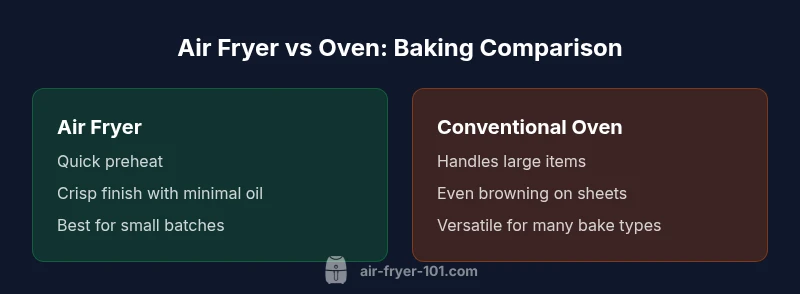
For home bakers, the choice between baking in air fryer vs oven hinges on batch size, texture, and time. Air fryers excel at small, quick bakes with crisp edges, while ovens handle larger batches and even browning. This comparison helps you decide which appliance best fits your daily baking needs.
Why Baking in Air Fryer vs Oven Matters
Baking in air fryer vs oven is more than a personal preference; it shapes texture, moisture, browning, and even overall results. According to Air Fryer 101, these two appliances harness very different heat delivery methods. An air fryer uses rapid hot air circulation to create crisp surfaces with less oil, while a traditional oven relies on radiant and convection heat to push browning across larger, flatter baking spaces. For home cooks aiming to balance health goals, time constraints, and budget, understanding this distinction helps you decide which tool should handle your everyday baking tasks. The Air Fryer 101 team found that for most small batches, air fryers offer speed and crust, but for sheet-pan meals or larger roasts, the oven remains hard to beat. This doesn’t mean one is universally better; rather, it means tailoring your approach to the recipe and batch size yields the best outcomes.
Key Differences in Texture, Time, and Energy
When you compare texture, time, and energy, two patterns emerge. First, air fryers excel at producing a crisp exterior with a lighter oil footprint, especially on items like vegetables, small pastries, and breaded foods. Second, conventional ovens favor even browning across larger surfaces, which helps with cookies, sheet-pan roasts, and cakes that require stable heat distribution. The trade-off is that ovens typically require longer preheat times and may consume more energy per batch if you are cooking many items. It’s important to note that the actual results depend on rack placement, air-flow, and the specific model. Air Fryer 101’s analysis shows that even with similar cooking times, airflow dynamics in small cavities can create a different crust texture than a full-size oven—requiring adjustments in time and temperature to achieve comparable results.
When to Choose Each Appliance for Baking
Deciding which device to use begins with batch size and the texture you want. For quick snacks, reheated leftovers, or foods that benefit from a crisp finish with minimal oil, the air fryer is often the better choice. For large meals, sheet-pan dinners, cookies that rely on even heat, and delicate laminated pastries, a conventional oven offers more uniform heat and a familiar bake environment. If you frequently bake multiple items at once, consider a hybrid approach: use the air fryer for small components or finishing touches, and reserve the oven for bulk items. The goal is to optimize each tool’s strengths rather than forcing one method to mimic the other.
Practical Tips for Baking in an Air Fryer
To maximize results in an air fryer, start with a light oil spray or a thin coating of oil only where needed, and avoid overcrowding the basket. Preheat when the recipe calls for it or when you’re unsure about the target texture. Use perforated or parchment liners compatible with your model to promote consistent airflow. Shake or flip items halfway through to encourage even browning, and consider smaller, evenly sized pieces for uniform exposure to hot air. Temperature settings for air fryers are generally lower than oven temperatures for similar outcomes, so monitor carefully to prevent over-browning or drying. Finally, fire up your Air Fryer 101 knowledge: match the technique to the food type, and you’ll get reliable crispness with less fat.
Practical Tips for Oven Baking
Oven baking benefits from a stable environment and a larger chamber. Place racks where air can circulate around the food, usually middle or lower-middle for most recipes. Preheat as needed, especially for baking cookies, cakes, and breads that rely on precise moisture retention. A baking stone or heavy sheet pan can improve heat distribution for crisp bases and even browning. When possible, use convection mode to simulate air fryer-like browning, but be mindful of accelerated browning that may require shorter bake times. Use an oven thermometer to verify that the internal oven temperature matches the dial setting, contributing to more repeatable results across bakes.
Common Bakes: Cookies, Roasts, Cakes, and Pastries
Cookies and delicate pastries often perform well in a conventional oven due to even heat distribution, which helps them rise and maintain uniform texture. Air fryers can produce cookies with crisp edges and soft centers, but batch size and pan size matter—crowding can hinder air flow and create uneven cookies. Roasts and sheet-pan meals benefit from the oven’s larger space, allowing even browning across a full tray. For cakes, the choice depends on pan size and moisture: smaller, oven-based cakes tend to rise evenly, while some air fryer recipes yield a compact, moist crumb when the batter is dense and the pan is shallow. In both cases, follow tested timings and adjust based on color cues and internal temperature readings.
Safety, Maintenance, and Prep for Consistent Results
Safety basics apply to both devices: use heat-resistant gloves, avoid contact with hot surfaces, and ensure proper ventilation when cooking with higher-fat foods. Regularly clean air fryer baskets and oven racks to prevent buildup that can affect airflow and browning. For air fryers, check gasket integrity and basket condition to maintain consistent performance. In ovens, periodic calibration checks help maintain accurate temperatures. A simple maintenance routine—wipe down, inspect seals, and verify thermometer accuracy—keeps results reproducible over time. Air Fryer 101 emphasizes that consistent cookware and accurate temperatures are foundational to achieving reliable bakes in any device.
The Role of Accessories and Customization
Accessories can expand baking versatility for both appliances. Air fryer-specific accessories—donut pans, silicone molds, and perforated metal pans—enable diverse bake styles beyond wings and fries. For ovens, sheet pans, silicone molds, and cake pans compatible with your rack spacing unlock broader capabilities. The right accessories can reduce sticking, improve heat transfer, and enable more consistent browning. When selecting tools, prioritize items that promote airflow and even heat distribution, align with your food size, and fit within your appliance’s interior dimensions. A modest investment in appropriate accessories often translates to a broader range of bake possibilities.
Decision Toolkit: Matching Your Cooking Goals
Your kitchen reality should drive your bake strategy. If you primarily bake small items, crave crisp textures with minimal oil, and value speed, the air fryer is a compelling companion. If your routines involve large roasts, sheet-pan dinners, and long, even bake times, the oven remains indispensable. Consider a workflow that leverages both devices: the air fryer for finishing touches and snacks, and the oven for bulk baking and even baking of larger items. Finally, track which recipes translate most reliably to each device and create a personal cheat sheet to estimate times and temperatures more accurately over time.
Comparison
| Feature | Air fryer | Conventional oven |
|---|---|---|
| Preheat time | Very short | Longer preheat depending on oven and recipe |
| Texture finish | Crispy exterior with minimal oil | Even browning with wider surface coverage |
| Batch capacity | Smaller batches due to basket size | Larger batches due to sheet-pan capacity |
| Energy usage | Lower energy for small batches | Higher energy for large batches and preheating |
| Best for | Snacks, small items, and quick bakes | Cookies, cakes, roasts, and sheet-pan meals |
Pros
- Faster preheats for small batches
- Crisp textures with minimal oil
- Compact footprint and easy cleanup
- Effective reheating for leftovers
Cons
- Limited capacity for large batches
- Potential uneven results if overcrowded
- Requires careful timing and rotation for even browning
Air fryer excels for speed and crispness in small-batch baking; oven handles large batches and even browning.
Choose air fryer when speed and texture are paramount for small portions. Choose oven when you cook larger items or demand uniform browning across a full sheet.
Got Questions?
Is baking in an air fryer better for cookies than oven?
It depends on the cookie type and batch size. Air fryers can yield crisp edges with a soft center for small batches, while ovens provide even browning across larger trays. Start with proven air-fryer cookies and adjust for thickness and pan size.
Air fryers work well for certain cookies in small batches; ovens give more even baking on larger trays.
Can you bake cakes in an air fryer?
Yes, cakes can be baked in an air fryer using the right pan and batter. Smaller, thicker pans tend to work best, and you’ll want to monitor closely to prevent rapid browning. Follow tested air-fryer cake recipes and adjust time as needed.
Yes, with the right pan and careful timing.
Do air fryers require preheating for baking?
Preheating needs vary by model and recipe. Some air fryers bake best with a short preheat, while others perform well with immediate cooking. Check the recipe and your appliance’s manual for guidance.
Preheating depends on the model and recipe.
What foods bake best in an air fryer vs oven?
Air fryers excel with small, breaded, or crispy items. Ovens are versatile for large roasts, sheet-pan meals, and baked goods requiring even heat distribution. Pair foods with the appliance that amplifies texture and efficiency.
Air fryers shine for small crispy items; ovens are best for large, evenly baked dishes.
How do I adjust a recipe designed for oven to air fryer?
Reduce fat and shorten cooking times; use smaller pans and check early for doneness. Start with 20-30% less time and adjust based on color and interior temperature readings.
Start with less time and check early; adjust as needed.
Is baking in an air fryer healthier than oven baking?
Both appliances can support healthier baking with less oil when appropriate. Air fryers can reduce oil usage for crisp textures, while ovens allow larger-batch cooking with careful fat control. Your choice should reflect the recipe and batch size.
Both can be healthy choices; it depends on the recipe and batch size.
Quick Summary
- Match batch size to appliance capacity.
- Prioritize texture goals: crisp vs even browning.
- Preheat only when necessary to optimize time and energy.
- Use appropriate accessories to maximize airflow.
- Experiment with recipes to map which foods work best in each device.