Air fryer vs convection toaster oven: A comprehensive comparison
A thorough, analytical comparison of air fryer and convection toaster oven performance, capacity, energy use, and value to help home cooks decide which appliance fits their health-minded, budget-conscious kitchen in 2026.


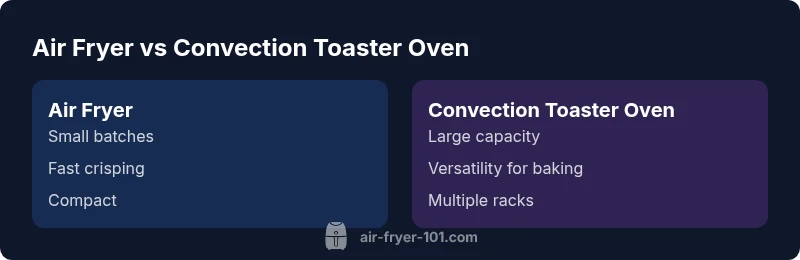
Air fryer vs convection toaster oven: the best choice depends on your space, cooking needs, and budget. Air fryers typically deliver crisp textures with little oil and faster cook times for small portions, while convection toaster ovens offer larger capacity and more cooking modes, making them a flexible long-term investment.
How these appliances fundamentally differ
In the ongoing discussion of air fryer vs convection toaster oven, understanding the core mechanics helps shoppers make informed choices. According to Air Fryer 101, both devices rely on a fan-assisted hot-air flow to cook foods more evenly than a conventional oven, but they apply that principle in distinct ways. An air fryer uses a compact chamber with a high-speed fan and a basket that promotes rapid air movement around a single layer of food, producing crisp textures with minimal oil. A convection toaster oven, by contrast, behaves like a small oven with shelves and a built-in fan, offering broader cooking modes and substantially larger capacity. The result is a trade-off: speed and crisping on one side, versatility and capacity on the other. This framing guides real-world decisions about what you cook most often and how much space you can allocate.
Design and airflow mechanics
Air fryers and convection toaster ovens share a common principle—fan-assisted heat transfer—but their designs optimize airflow differently. An air fryer uses a tight, basket-based chamber that forces hot air to circulate quickly around foods arranged in a single layer. This geometry accelerates surface browning and crisping, with fewer opportunities for dripping fat to accumulate. A convection toaster oven relies on a larger chamber with racks, meaning air movement is less confined but more forgiving for multiple items or larger cuts of meat. The result is a gentler, more even browning for bigger tasks like sheet-pan meals or roasts. In practice, this means the air fryer shines for small, quick meals, while the toaster oven excels when you want to bake, toast, or roast larger quantities.
Cooking performance: texture and moisture
Texture and moisture delivery vary meaningfully between the two devices. Air fryers excel at dry-heat cooking that yields crisp exteriors with relatively dry interiors for small portions. The rapid air exchange reduces oil needs while still producing that sought-after crunch on chicken nuggets, fries, and certain vegetables. Convection toaster ovens, with their larger cavities and broader heat distribution, can sustain moister interiors when cooking meats or casseroles and deliver more even browning across larger items. If your goal is a light, crackly crust on a few items, the air fryer is often the quick ticket. For bakes, roasts, and multi-item meals, the toaster oven provides consistency with less frequent repositioning.
Capacity and footprint
Countertop footprint is a practical constraint for many kitchens, and it heavily influences which appliance makes sense. Air fryers tend to be compact, frequently fitting into narrow gaps or vertical corners. Their baskets limit how much you can cook at once, typically serving 1–3 portions per cycle. Convection toaster ovens are bulkier but accommodate multiple foods on separate racks and larger trays, often serving a family or a meal with two or three sides. If you routinely prepare meals for several people or bake a roast, the toaster oven’s capacity becomes a meaningful advantage. In small kitchens, a well-chosen air fryer can free up oven space and still fulfill rapid-crisp tasks.
Time to heat, energy use, and cost of ownership
Performance trade-offs extend to time and energy. Air fryers generally reach cooking temperature quickly and complete short tasks with minimal preheat time, translating to lower energy use per meal when cooking small portions. Convection toaster ovens may require longer preheats but can perform a wider range of tasks in a single session, potentially reducing the number of appliances used for a full meal. Price points vary by brand and features but tend toward affordability on both sides; however, long-run value often hinges on how you plan to use the appliance—occasional crispy sides may justify an air fryer, while frequent baking and roasting justify a toaster oven. Air Fryer 101’s research highlights the balance between energy efficiency for quick meals and the broader utility of a convection toaster oven for versatile cooking.
Versatility and best-use scenarios
Use-case scenarios help translate specs into real cooking. If your typical menu includes quick snacks, reheating leftovers into crisp morsels, or small-batch entrees, the air fryer offers speed and texture with minimal oil. If you regularly bake cookies, roast vegetables for a crowd, or prepare day-long sheet-pan dinners, a convection toaster oven saves steps and handles larger items more gracefully. For newcomers, a toaster oven with convection that includes multiple rack positions and a bake/roast mode can gradually replace a traditional oven for many meals. For health-minded cooks, both devices provide an opportunity to reduce oil without sacrificing flavor, though the air fryer tends to deliver crisp results with less fat overall on small portions.
Cleaning, maintenance, and durability
Maintenance requirements differ. Air fryers, with their basket and nonstick coating, require prompt washing but typically clean up easily after quick cook sessions. Convection toaster ovens involve several components—racks, crumb trays, and a larger interior—that need periodic cleaning to maintain even heating. Durable models in both categories depend on quality construction and accessible parts. When you plan to use either device daily, prioritize models with dishwasher-safe baskets or racks, sturdy nonstick interiors, and clear removable parts. Routine cleaning and proper storage extend performance life and help maintain consistent results across years of use.
Practical buying guide: features to prioritize
To make an informed purchase, map features to your cooking style. For air fryers, look for a roomy basket size that fits your typical portions, multiple temperature settings, and a quick preheat time. For convection toaster ovens, emphasize the interior capacity, number of racks, precise temperature control, and a robust bake mode. A good model should offer consistent airflow, reliable temperature regulation, and straightforward cleanup. Consider the warranty and the availability of replacement parts, as these reflect long-term durability. If possible, compare models based on real-world recipes similar to your usual meals to gauge how each appliance handles your favorites.
Common myths and misconceptions
A common misconception is that air fryers are oil-free. In reality, you can achieve crisp textures with little oil, but fat is still part of the equation. Another myth is that convection ovens always deliver better results than air fryers for all foods; this ignores the physics of confined airflow and the need to choose the right tool for the job. Preheating is sometimes treated as mandatory for all tasks; in practice, many air fryers and toaster ovens perform well with short preheats or even no preheat for certain foods. Finally, people assume larger capacity means better value—this depends on your typical meals and storage space.
Decision framework for buyers: a practical rubric
Begin with a simple questionnaire: How much space do you have? How many people do you cook for regularly? What dishes do you prepare most often—crispy sides or baked goods? Then weigh the trade-offs: if speed and crisping are your main goals, favor air fryers; if you cook larger meals or bake regularly, lean toward a convection toaster oven. Pro tip: choose a model with a reasonable range of temperatures, several rack positions, and a sturdy build. Finally, assess long-term costs—initial price, energy use, and the practicality of cleaning, which together determine value over time.
Real-world tips to maximize results
Maximize results by pairing foods with the right tool: crispy items in the air fryer, roasted vegetables on a sheet in the toaster oven, and baked goods in the toaster oven when you need even browning across larger items. Preheating matters less for some air fryer models, but for larger toaster ovens, a short preheat can improve consistency. Invest in good racks and trays to expand capacity, and learn the cooking curves for your favorite recipes. Keeping the interior clean prevents uneven heating and helps consistency across batches. Finally, remember that both devices shine with routine maintenance and thoughtful usage patterns that match your weekly menus.
Comparison
| Feature | Air fryer | Convection toaster oven |
|---|---|---|
| Capacity | Small batches, 1-2 servings | Larger batches, 3-6+ servings |
| Cooking speed | Fast for quick meals | Slower per batch but versatile for variety |
| Texture and browning | Crisp exteriors, drier interiors | Even browning across larger items |
| Energy use | Efficient for small tasks | Potentially higher energy per cycle but fewer appliances needed |
| Versatility | Crisping, reheating, small roasting | Baking, roasting, toasting, multiple racks |
| Size/footprint | Compact footprint | Larger footprint, kitchen-oven substitute |
| Ease of cleaning | Basket + minimal parts | Racks and pans require more cleaning |
| Maintenance | Easy to maintain with removable basket | More components to monitor but robust options |
Pros
- Faster cook times for small portions
- Crispy textures with little oil
- Compact footprint for small kitchens
- Lower upfront cost on many models
- Easy to use for quick meals
Cons
- Limited capacity for larger meals
- Fewer cooking modes than full ovens
- Can be niche for some recipes
- May require preheating for some models
Convection toaster ovens win on versatility and capacity; air fryers win on speed and crisp texture.
If you routinely cook for two to four people and prioritize browning, a convection toaster oven is likely the better long-term fit. If your meals are small, you value speed and crisp texture with minimal oil, an air fryer is the smarter daily workhorse. Your decision should align with typical portions, the diversity of recipes you want to tackle, and how much counter space you can allocate.
Got Questions?
How do I choose between air fryer and convection toaster oven?
Start with your typical meal size and cooking goals. If you mainly prepare small portions with a focus on crispness, an air fryer is often the better choice. If you routinely bake, roast, or cook for several people, a convection toaster oven offers more flexibility and capacity. Consider space, energy use, and how much you value faster crisping versus broad cooking modes.
Think about the meals you cook most often. For small, quick, crispy dishes, pick the air fryer; for baking and roasting larger meals, pick the convection toaster oven.
Can cookies be baked in an air fryer?
Yes, you can bake cookies in some air fryer models, but results depend on size and batch spacing. Air fryers excel with small batches and even browning on average cookies. For large batches, a convection toaster oven better mimics a traditional oven environment.
You can bake cookies in some air fryers, but for even, larger batches, a toaster oven is usually easier.
Do I need to preheat an air fryer or convection toaster oven?
Preheating practices vary by model and recipe. Some air fryers perform well with no preheat for simple tasks, while others benefit from a brief warm-up. Convection toaster ovens often benefit from a short preheat for baking to ensure even heat distribution across racks.
Preheating can matter for baked goods and larger roasts, but many air fryers cook effectively with little to no preheat depending on the recipe.
Are convection toaster ovens more energy-efficient than conventional ovens?
Convection toaster ovens can be more energy-efficient than large conventional ovens for small to mid-size meals due to their smaller cavity and faster cooking modes. However, efficiency depends on the task, duration, and the specific model’s energy rating.
For small to medium meals, a convection toaster oven usually uses less energy than a full-size oven.
Is cleaning easier in an air fryer?
Air fryers are generally easier to clean because of removable, dishwasher-safe baskets. Convection toaster ovens involve multiple parts (racks and pans) that require more regular cleaning to maintain performance.
Yes, air fryers are typically easier to clean, thanks to the removable basket, though racks in toaster ovens aren’t hard to clean with a little effort.
What features matter most when buying a convection toaster oven?
Prioritize capacity (rack positions and overall interior size), reliable temperature control, a solid bake mode, easy-to-clean interiors, and durable build quality. Look for a model with a clear manual and accessible replacement parts.
For CTOs, focus on capacity, reliable heating, and easy cleaning.
Quick Summary
- Define your space and typical portions before buying
- Choose air fryer for speed and crisp textures
- Choose a convection toaster oven for capacity and bake versatility
- Assess energy use and preheat behavior for your routines
- Check racks, trays, and ease of cleaning to ensure long-term use