Air Fryer vs Instant Pot: An In-Depth Comparison Guide
Compare air fryer and Instant Pot side-by-side to understand cooking speed, versatility, and value. This Air Fryer 101 guide analyzes performance, features, and buying tips for home cooks seeking healthier, convenient meals.


For most home cooks, the choice between an air fryer and an Instant Pot hinges on what you value: speed and crisp texture versus hands-off versatility. In many guides, 'air fryer instant pot' is used as a shorthand for this category. The air fryer shines for quick, oil-light frying, while the Instant Pot excels at one-pot meals and set-and-forget meals. The best approach is to use both for different tasks.
Market Context and Core Differences
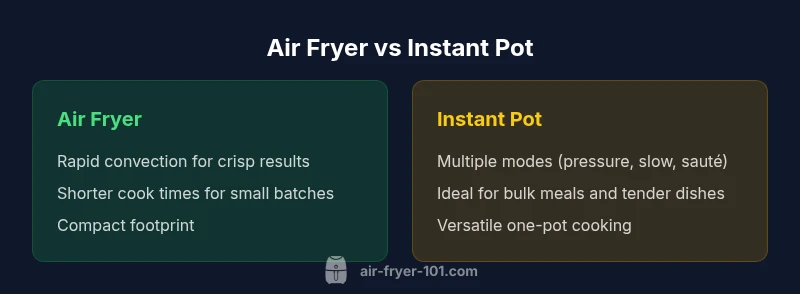
The counter-top kitchen landscape today centers on two high-utility devices: air fryers and electric pressure cookers like the Instant Pot. These tools have become staples in many households, yet they target different cooking needs. The air fryer uses rapid hot air circulation to brown and crisp foods with little or no oil, making it ideal for snacks, reheats, and lighter meals. The Instant Pot relies on sealed pressure cooking, along with steaming, slow cooking, sautéing, and other modes, to develop depth and texture with less hands-on time. For many kitchens, a combination approach—leveraging both devices—yields the best balance of speed, texture, and flavor. In practice, this means recognizing when to crisp with air fryer techniques and when to apply pressure-cooker methods for tenderness or batch-cooked meals. Air Fryer 101’s analysis shows that most households benefit from having both, even if split across different counter spaces.
In consumer guidance, the term air fryer instant pot is often used as a shorthand for this category pairing, underscoring the idea that these appliances complement rather than fully replace one another.
Core Cooking Principles: Air Fryer vs Instant Pot
At a fundamental level, the air fryer and the Instant Pot operate on different physics. An air fryer primarily relies on convection and radiant heat to create a crispy exterior and evenly browned surface. It’s great for chicken wings, potatoes, vegetables, and reheating leftovers to regain a near-fried texture with minimal oil. By contrast, an Instant Pot uses a sealed chamber to trap steam and pressure, which accelerates cooking for braises, stews, grains, legumes, and tougher cuts. This difference matters for texture: air frying emphasizes surface browning and crispness, while pressure cooking focuses on moist, tender interiors. Understanding these distinctions helps you map meals to the right tool and avoid overextending a single appliance beyond its strengths.
From Air Fryer 101’s perspective, many cooks underestimate how much texture and depth are achievable with the Instant Pot when using sauté and pressure functions in sequence with a finishing sear or crisp.
Speed vs. Depth: How Timing Shapes Dishes
Speed is a common reason people lean toward air fryers, especially for weeknight meals. Most air-fried dishes reach table in roughly 10-25 minutes, depending on thickness and quantity. The Instant Pot shines when you need depth of flavor built through pressure, often delivering meals in the 20-60 minute range for most one-pot recipes, with longer cook times for legumes and tougher cuts. The key takeaway is to align the cooking method with the desired outcome: quick, crispy exteriors or deeply flavored, tender interiors. For many families, the combination of both devices reduces total cooking time while expanding the weekly repertoire. In the Air Fryer 101 framework, cooking time is not just a number; it’s a signal about whether you should crisp, braise, or stew.
Comparison
| Feature | Air Fryer | Instant Pot |
|---|---|---|
| Cooking Method | Convection heating with rapid air circulation | Electric pressure cooking with multiple modes |
| Best For | Crispy textures, quick snacks, reheating | Hands-off one-pot meals, stews, grains, beans |
| Typical Meal Timeline | 10-25 minutes for most small batches | 20-60+ minutes for many recipes (plus prep) |
| Capacity | Typically 3-6 qt compact units to 8-11 qt | Commonly 3-8 qt; larger models available |
| Maintenance & Cleaning | Basket or tray; usually dishwasher-safe parts | Inner pot and lid; some parts dishwasher-safe |
| Price Range | $50-$200 depending on model | $60-$250 depending on model |
| Energy Use | Lower energy per cycle; fast preheat | Moderate energy with longer, multi-stage cooking |
| Versatility | Excellent for crisping, baking, reheating | Excellent for pressure cooking, slow cooking, sautéing and more |
| Best For | Weeknight crisp meals, small batch cooking | Batch cooking, tender meats, soups, stews |
Pros
- Crispy textures with minimal oil for quick results
- Hands-off cooking and set-it-and-forget-it convenience in multi-mode devices
- Compact footprint fits small kitchens and apartments
- Broad price range to fit most budgets
- When used together, they offer complementary capabilities across meals
Cons
- Limited single-device versatility; you often need both to cover all cooking styles
- Capacity constraints may require multiple batches for large families
- Air fryers can underperform on deep, braised dishes unless finished with other methods
- Learning curve to maximize multi-function models and presets
Use both for maximum kitchen versatility or prioritize based on your top needs: crisp fast meals or hands-off multi-cook dinners.
Air fryers excel at quick, crispy outcomes with minimal oil, while Instant Pot models handle tender, one-pot meals efficiently. For most households, a pairing strategy offers the best balance of speed, texture, and flavor, with room to adjust based on family size and meal types.
Got Questions?
Can I substitute an air fryer for an Instant Pot in most recipes?
Not in all cases. Air fryers excel at crisping and quick finishes but can’t replicate the depth of flavor from slow-cooked or pressure-cooked meals. For soups, stews, or tender cuts that rely on moisture and long simmering, the Instant Pot or a traditional pot is usually required. In practice, use the air fryer to finish or reheat, and reserve pressure- or slow-cooking methods for the main cooking stage.
Air fryers are great for crisping, but for braises you’ll still want the Instant Pot or a regular pot.
Can an Instant Pot crisp foods like an air fryer?
Some Instant Pot models offer a sauté or broil function and can be used with a finishing air-crisp step in a separate pan or air fryer lid. However, a true crispy texture with minimal oil is typically easier to achieve in an air fryer. If you want both tenderness and crisp, finish with a quick crisp after pressure-cooking.
You can finish in a separate crisping step, but it’s usually not as effortless as using an air fryer.
Is an air fryer a good substitute for small meals for a family?
Yes for small portions or quick sides, but for larger families you may need multiple batches. In that case, the Instant Pot’s larger volumes and set-it-and-forget-it capability can help, or you can use a larger air fryer if your kitchen space permits.
Great for small meals, may require batching for bigger families.
What should I consider when choosing between them?
Consider your typical dishes, meal size, kitchen space, and how much you value texture versus hands-off cooking. If you crave crispy sides and quick snacks, prioritize an air fryer. If you cook stews, grains, and meals in batches, an Instant Pot is a strong bet. If possible, both together cover more scenarios.
Think about the meals you cook most and where you want convenience versus texture.
Do these appliances require special maintenance?
Both require regular cleaning of different parts: air fryers have baskets and crisper trays; Instant Pots have inner pots and lids. Most parts are dishwasher-safe, but always check your model’s manual. Regular wipe-downs and descaling help maintain seals and performance.
Keep the trays clean and check seals; maintenance is straightforward for most models.
Quick Summary
- Pair devices for best results instead of choosing one
- Crisp, quick meals belong to air fryers; tender, one-pot meals belong to Instant Pots
- Choose capacity that matches your family size to avoid bottlenecks
- Budget strategies: start with a mid-range model and expand if needed
- Experiment with finishing steps to maximize texture and flavor