How to Know When Air Fryer Is Ready
Learn practical signs, preheat cues, and model-specific tips to determine when your air fryer is ready. This step-by-step guide boosts safety, efficiency, and cooking results for home cooks.


To know when your air fryer is ready, start with a preheat cycle as recommended by the model, listen for a beep, and check the display for a ready indicator. Allow the basket to sit for a moment after preheating, then test with a small item. This saves time and ensures even cooking.
Understanding What Readiness Really Means for an Air Fryer
Readiness in an air fryer is a confluence of preparation cues that signal the unit is up to speed for cooking. In practice, readiness means the appliance has reached its target internal temperature, the preheat cycle has completed, and the user can confidently begin cooking without waiting further or risking uneven results. According to Air Fryer 101, established readiness cues combine practical indicators like a preheat beep, a clearly lit display, and consistent air circulation that you can feel when you wave your hand near the exhaust. For home cooks, this translates into a reliable start time for every dish, whether you’re roasting vegetables or reheating leftovers. The key is to understand which signals your specific model uses and to practice a brief readiness routine that you can repeat with every batch.
In this article and across Air Fryer 101’s guidance, readiness is treated as a repeatable step in your cooking workflow, not a one-off guess. You’ll learn to read the model’s indicators, anticipate heat distribution, and use a tiny test batch to confirm that your air fryer is truly ready. This approach reduces the risk of undercooked centers, overcooked exteriors, and wasted ingredients, while improving consistency across meals.
Preheating: The Indirect Readiness Signal
Preheating is the most common first signal that your air fryer is gearing up for cooking. Even models with fast-cook settings benefit from a brief warm-up period, which stabilizes the cooking chamber and helps ensure even heat distribution. The preheat phase also makes it easier to see whether the heating elements are functioning smoothly, which reduces the chance of hotspots. Depending on the model, preheating might involve a dedicated preheat button, a timed cycle, or an automatic warm-up integrated into the start function. You should expect a short wait — typically a few minutes — followed by an audible cue or a visible indicator on the control panel letting you know the unit is ready for airflow and cooking. If your model lacks a visual timer, listen for the fan to settle into a steady rhythm, which is another good readiness cue.
Air Fryer 101’s research shows that preheat consistency varies by wattage and design, but the underlying principle remains the same: a stable temperature and steady airflow are what you’re after before you begin cooking. When you’re new to a model, start with a standard preheat cycle and then calibrate based on your observed results for best outcomes.
Visual Cues: Lights, Displays, and Airflow Feedback
The visual cues your air fryer provides are the quickest way to gauge readiness without trial and error. Most units display a status icon or text such as Ready, On, or a green light once preheating is complete. In some models, the countdown timer reaches zero, the display shows a specific readiness symbol, or a color-coded light confirms that the cooking chamber has stabilized. You may also notice subtle cues like reduced fan noise and a steady, unobstructed airflow around the door or basket. Consistency in these cues across multiple uses is a strong signal that your air fryer’s interior is at a reliable temperature for cooking. If you notice the display flicker, a dim light, or an irregular fan sound, pause and recheck the power supply or perform a brief reset according to the manual.
In practice, combine the visual signal with the audible cues for a reliable readiness check. The combination of a completed preheat indicator and a confident airflow pattern is the best shorthand for “ready to cook.”
Acoustic Cues: Beeps, Tones, and Model Nuances
Beep patterns are a frequently overlooked readiness signal. Many air fryers emit a single tone when preheating completes, followed by a pair of beeps when you press start or insert food. Some models use a continuous tone if there’s a fault, while others may give a chime only after the door is closed or the basket is properly seated. Because beep patterns vary by model, it’s worth spending a few minutes with your manual to memorize your unit’s specific cues. A reliable approach is to perform a quick preheat, listen for the end beep, and then perform a light test on a tiny batch to confirm readiness before cooking a full recipe.
Air Fryer 101’s testing suggests that you should not rely on a single cue alone. Instead, listen for the combination of a completed preheat beep and a stable operational sound during the next minute, which reduces uncertainty and improves your first batch success.
Temperature and Time Management: Using Thermometers and Timers
A thermometer can be a valuable ally in confirming readiness. If your air fryer provides an internal temperature readout, monitor it during the preheat phase to verify the target range your recipe calls for. For models without a built-in thermometer, a high-quality oven-safe thermometer placed near the air outlet (where safe to do so) can give you a feel for when heat stabilizes. Timers are essential to prevent overcooking or undercooking, especially when you’re cooking foods of varying thickness or density. When the preheat completes, set the intended time for the first batch, and be prepared to adjust for batch size and item type in subsequent rounds. Keeping notes about how long different foods take on different models will help you tailor readiness for future cooks.
In practice, pairing temperature checks with accurate timing helps you create a predictable cooking rhythm that you can reproduce easily.
Hands-on Test: Tiny Batch to Confirm Readiness
Before committing to a full recipe, run a tiny test batch with a food item that represents the cooking load (e.g., a couple of potato wedges or a single nugget). This quick check confirms even heat distribution and helps you evaluate whether your preheat was sufficient for the food type. If you notice uneven browning, adjust the load or flip the items halfway through the initial cook. A tiny batch reduces waste and gives you actionable feedback without sacrificing your main dish. Air Fryer 101 recommends documenting the results of each test batch to build a ready-to-cook routine tailored to your model and favorite foods.
Keep the test batch simple and repeatable so you can compare results over time and across different recipes.
Readiness Across Models: Why It Differs and What to Do
Model-to-model variation is the biggest reason readiness can feel confusing. Some units require preheating for every cycle, while others only preheat when a recipe calls for it. Differences in wattage, basket design, and airflow can also affect how quickly the chamber stabilizes. The practical takeaway is to start with the textbook model recommendations, observe the cues your unit provides, and then build a small, repeatable readiness routine that you can apply to any dish. If you switch models, repeat the preheat and tiny-batch test steps before cooking your first batch to calibrate expectations. With time, you’ll develop a mental model of your own unit’s readiness indicators for various foods, temperatures, and batch sizes.
Common Pitfalls and How to Avoid Them
Common mistakes include skipping preheating, overcrowding the basket, and neglecting to listen for cues or use a timer. Overcrowding creates uneven heat and longer cook times, which can masquerade as a readiness issue. Not accounting for food thickness or moisture level can also lead to inconsistent results. To avoid these, reserve a moment for a quick readiness check each time you cook, use a tiny test batch when trying a new recipe, and adjust your times and temperatures based on actual results rather than assumptions. Keeping a simple log for your most-used foods and models helps you identify patterns and maintain consistency over time.
In addition, be sure to handle the basket and accessories with heat-resistant gloves, and always verify that the unit is placed on a heat-safe surface away from walls and flammable objects. Regularly inspect seals and door gaskets for wear that could affect heat retention and distribution.
Ready, Set, Cook: Creating a Ready Checklist You Can Rely On
By creating a short readiness checklist you can repeat for every cook, you’ll reduce decision fatigue and improve outcomes. A practical checklist might include: power on and select preheat; wait for the completion indicator; perform a quick glance check of the interior for even heat cues; run a tiny test batch; and adjust for batch size or recipe. Over time, you’ll memorize the cues your particular model uses and reference your notes for consistent results. Air Fryer 101’s approach emphasizes a blend of objective signals (indicators, beeps) and subjective checks (visual cues and feel) to determine readiness reliably.
Summary of Readiness: A Quick Recap for Home Cooks
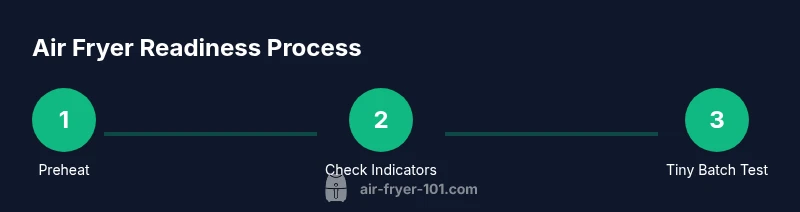
Readiness is not a single moment but a short sequence: preheat, indicators confirm, audible cues signal completion, and a tiny test batch validates that the unit is truly ready for your recipe. By following model-specific cues and keeping a ready-check routine, you’ll ensure better browning, even cooking, and more predictable results while minimizing waste. With practice, you’ll be able to gauge readiness almost instinctively, saving you time and increasing confidence in your air frying skills.
Tools & Materials
- Air fryer unit(Ensure it is clean and properly assembled)
- Food thermometer or instant-read thermometer(To verify internal temperatures when needed)
- Timer or smartphone timer(For precise waiting periods)
- Small test food item (e.g., a couple of potato wedges)(To verify readiness without wasting ingredients)
- Non-metal tongs or silicone spatula(Safe basket handling and turning)
- Heat-resistant gloves(Protect hands during preheat and testing)
Steps
Estimated time: about twenty five minutes
- 1
Power up and select preheat
Turn on the air fryer and choose the preheat function if available, or set a short warm-up period per your model. This step initiates the heating elements and stabilizes the air chamber.
Tip: Consult the manual for your exact preheat option; some models auto-preheat when you start a cycle. - 2
Wait for preheat completion
Allow the unit to reach its target temperature and listen for the completion cue, such as a beep or a steady display. Do not skip to cooking until you’ve clearly observed the readiness signal.
Tip: If your model uses a countdown, note the final minute visually to avoid rushing. - 3
Inspect visual indicators
Check the control panel display and any indicator lights. A consistent, bright indicator often means the chamber is ready and airflow is stable.
Tip: If the display is flickering, perform a reset and re-check the indicators. - 4
Conduct a tiny test batch
Place a small number of food pieces in the basket and run a brief test cook. This confirms that heat is even and the food will brown correctly.
Tip: Center items and avoid overcrowding to prevent uneven heating. - 5
Adjust for batch size
Based on the test, adapt time or temperature for your intended batch. Smaller batches usually require less time, while thicker pieces may need more.
Tip: Log adjustments so you can reproduce consistent results next time. - 6
Document cues for future readiness
Record the indicators you relied on for readiness and how long each batch typically takes on this model.
Tip: Create a simple one-page checklist you keep near the air fryer.
Got Questions?
Is preheating always required for every recipe?
Not always. Some recipes tolerate no preheat, while others benefit from a short warm-up, depending on the model and food type.
Preheating depends on the model and the recipe. Some recipes don’t need preheating, but many do for even cooking.
What should I do if the readiness indicator doesn’t light up?
Check power supply, door seal, and any faulty sensors. If needed, reset the unit and consult the manual. If issues persist, contact support.
If the indicator won’t light, first check the power and door seal, then reset. If it still won’t work, consult the manual or support.
How long should preheat take on most models?
Preheat length varies by model and wattage. Start with the recommended cycle and observe the indicators to determine the best duration for your foods.
Preheat time varies by model. Start with the standard cycle and watch the indicators to learn the right duration.
Can I skip the test batch if I’m cooking a familiar dish?
It’s safer to test with a tiny batch when trying a new model or recipe, even if you’re cooking a familiar dish. This helps avoid surprises.
Even for familiar dishes, try a tiny test batch on a new model to ensure reliable results.
Do readiness cues differ between air fryer models?
Yes. Cues like beep patterns, lights, and display messages vary. Always review your model’s manual for exact signals.
Cues differ by model. Check your manual for the exact signals used by your air fryer.
How can I maintain consistent readiness across multiple air fryers?
Document each unit’s cues and create a standard readiness checklist. Calibrate timings based on results across different units.
Create a standard readiness checklist and calibrate timings so you get consistent results on different units.
What safety steps should I follow when testing readiness?
Always use heat-resistant gloves, avoid touching hot surfaces, and keep children away during preheat and testing.
Wear heat-resistant gloves and keep kids away during preheat and testing.
Watch Video
Quick Summary
- Preheat according to model guidance.
- Watch indicators and listen for beeps.
- Test with a small batch before cooking full portions.
- Document model-specific readiness cues for consistency.