Air Fryer to Convection Oven Conversion: A Practical Guide
Learn how to adapt air fryer recipes for convection ovens with expert tips, best practices, and a step-by-step plan from Air Fryer 101. Includes safety notes, tool recommendations, and troubleshooting for reliable results.


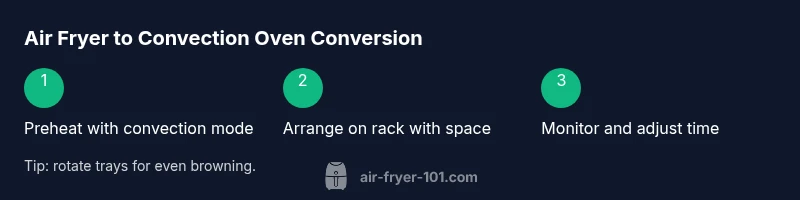
Converting air fryer results to a convection oven starts with using the oven's convection setting and proper placement. Preheat, adjust food layout to allow air flow, and monitor doneness closely; expect slightly longer bake times, but similar crispness. This quick guide outlines a reliable conversion.
What converting air fryer results means
Air fryer to convection oven conversion is about achieving similar crispiness and browning in a standard convection oven. The goal is to adapt recipes written for a compact countertop unit to a full-size oven while preserving texture and speed. According to Air Fryer 101, many cooks find that a convection oven can produce near identical results when airflow is optimized and temperature and time are adjusted modestly. Start with understanding that convection ovens rely on a fan to circulate hot air, which can brown foods more evenly than a traditional bake. This means you can cook larger batches, but you may also need to give foods space on the pan and avoid overcrowding. The Air Fryer 101 team emphasizes planning for air flow: use racks, rotate trays, and avoid stacking pieces. With these principles, you can reuse many air fryer recipes in a kitchen oven without sacrificing texture.
Why convection ovens matter for the conversion
A convection oven uses a built-in fan to circulate hot air, creating a similar dry heat environment as an air fryer. This means that foods can achieve a crispy exterior with less oil when air movement is optimized. The technique hinges on airflow, temperature control, and pan arrangement. Air Fryer 101 analysis shows that consistent air flow is the primary driver of browning and texture. When you translate a recipe from air fryer to convection oven, you’re essentially scaling for volume and access to larger trays while maintaining the same surface contact with the hot air. Expect the first attempt to be a learning curve, especially with more delicate items, but you can dial in results with careful monitoring and small adjustments.
Key adjustments for temps and times
In most cases you’ll want to start with a modest temperature reduction and extend the cook time slightly, but the exact delta depends on the food and the oven. Instead of a strict rule, use a baseline of the conventional recipe and observe the browning and interior doneness. The goal is to recreate the crisp exterior without overcooking the interior. Air Fryer 101 recommends checking for doneness at the 2/3 mark of the suggested time and adjusting in small increments. For quick fixes, flip or rotate items halfway through to promote even browning and avoid soggy spots. These steps help you achieve reliable results across a wide range of dishes.
How to prep foods for convection ovens
Preparation matters as much as the oven settings. Dry foods thoroughly before cooking to maximize browning, and pat proteins dry to reduce moisture; moisture is the enemy of crispness. Line a rimmed sheet with parchment or a silicone mat to prevent sticking and facilitate cleanup. Use a wire rack above the sheet when possible to increase air exposure on all sides. Group items with similar thickness and avoid overcrowding; give each piece space to breathe. If you’re cooking multiple items at once, place heavier items on the lower rack and lighter, more delicate items on top to optimize air circulation.
Equipment and setup tips for best results
To mimic an air fryer’s rapid air movement, you’ll want an oven rack setup that keeps food elevated above any drips and maintains air contact around each piece. A simple configuration is a wire rack on a rimmed baking sheet, with parchment underneath. An oven thermometer helps verify that your oven stays near the target temperature, since home ovens can vary from the dial. Always preheat with the convection setting enabled to ensure the fan and heat are both ready when you start. Tongs or a spatula are handy for quick flips without losing heat. For larger batches, use multiple racks and rotate them halfway through cooking to equalize browning.
Recipes and food types: proteins, veggies, and frozen items
Proteins: skin-on chicken thighs or pork cutlets respond well to convection when the skin is dry and the surface is exposed to air. Veggies: carrot rounds, broccoli florets, and Brussels sprouts benefit from a light coating of oil and a single layer on the rack for even browning. Frozen items: many frozen snacks cook well in a convection oven, but you may need a longer cook time and a quick toss mid-way. In every case, start with the air fryer recipe’s temp, then adjust based on how the food browns and how the interior cooks. Remember that smaller pieces finish faster, while larger pieces may require extra minutes and more airflow.
Troubleshooting common issues and how to fix them
If foods aren’t browning enough, increase the air flow by raising the rack or using more racks that aren’t crowded. If foods burn on the edges but are undercooked in the center, reduce the temperature slightly and extend the time, then check sooner on the next attempt. Sticking can be reduced with parchment or silicone mats, but avoid too much oil as it can smoke in a hot oven. If you notice soggy bottoms, ensure even spacing and rotate trays. These strategies help you troubleshoot most common convection oven damages to crisp finish when adapting air fryer recipes.
Quick-start conversion checklist
- Confirm your oven supports a true convection setting.
- Preheat with convection mode enabled.
- Gather a rimmed sheet, a wire rack, parchment or a non-stick mat, and a thermometer.
- Use a single layer and avoid crowding to optimize airflow.
- Start with the original time and temperature, then adjust in small increments after checking several pieces.
- Flip or rotate halfway through cooking for even browning.
- Let foods rest briefly to re-crisp before serving.
Safety and maintenance considerations
Always use oven-safe cookware and avoid plastic that could melt under high heat. Keep the oven and racks clean to prevent smoke and ensure accurate temperatures. Use heat-resistant mitts, as convection ovens heat faster and hotter in some zones. Regularly calibrate your oven with an external thermometer to avoid temperature drift that could affect timing and texture. Maintain the exterior, racks, and drip trays to prevent grease buildup.
Real-world example: converting a popular air fryer recipe
Take a classic air fryer fried chicken recipe. Start on the convection setting, preheat, and place pieces on a wire rack over a parchment-lined sheet. Begin with the same surface temperature as the air fryer recipe but monitor doneness earlier. Flip the pieces halfway through to promote even browning and check with a thermometer. If the coating browns too quickly, lower the temperature slightly and extend the cook time until the interior reaches a safe temperature. This approach yields a satisfying crisp exterior with juicy interior, similar to the air fryer result.
Tools & Materials
- Convection oven or range with convection setting(Ensure it has a true convection setting (fan + exhaust).)
- Rimmed baking sheet(Line with parchment or silicone mat for easy cleanup.)
- Wire cooling rack(Elevates food to maximize air flow around all sides.)
- Parchment paper or silicone bake mat(Optional; helps with clean-up and sticking prevention.)
- Oven thermometer(Verify oven temperature matches dial setting.)
- Tongs or spatula(For flipping and safe handling without losing heat.)
- Meat thermometer(Optional for checking proteins’ internal doneness.)
Steps
Estimated time: 30-60 minutes
- 1
Gather gear and preheat
Collect your convection oven, rimmed sheet, wire rack, parchment, and thermometer. Preheat the oven on the convection setting to your target temperature while you prep ingredients so you start cooking immediately.
Tip: Preheating reduces warm-up time and helps foods brown consistently. - 2
Prep and season the food
Pat ingredients dry, season evenly, and coat lightly with oil if the recipe calls for it. Dry surfaces promote browning, while excess moisture can steam and soften textures.
Tip: Evenly coat with a light oil spray to boost crispness without greasy layers. - 3
Arrange for airflow
Place items on the wire rack over the sheet in a single layer, with space between pieces. Avoid stacking or overcrowding to maintain air circulation and even browning.
Tip: If making multiple trays, swap their positions halfway through cooking. - 4
Cook and monitor
Start with the original time and temperature from the air fryer recipe, then check for doneness 2/3 of the way through. Use a thermometer for proteins and look for a crisp exterior.
Tip: Open the oven as little as possible to keep airflow steady. - 5
Adjust as needed
If browning is slow or interiors aren’t done, extend time in small increments and/or raise airflow by removing a rack or increasing surface area. Recheck frequently.
Tip: Small iterative tweaks lead to reliable results across ingredients. - 6
Finish and rest
Once done, remove from the oven and let rest briefly to re-crisp. A light rest improves texture and helps juices redistribute after high-heat cooking.
Tip: Resting for 3–5 minutes can enhance texture without cooling off the crisp exterior.
Got Questions?
Can I use any convection oven to replace an air fryer?
Yes, a standard convection oven can replace an air fryer for many recipes. Use convection mode, preheat, and arrange food on a rack to maximize airflow. Expect slightly longer total cook times but similar browning.
Yes. A convection oven can replace an air fryer for many recipes. Preheat, keep air flowing with a rack, and monitor doneness as times may be a bit longer.
Should I preheat the oven when converting from air fryer?
Yes. Preheating helps establish the air flow and consistent temperatures, yielding crisper exteriors similar to air fryers.
Yes, preheat the oven to ensure consistent airflow and browning.
How do I know when the converted dish is done?
Use a combination of time checks and internal temperature checks for proteins. Look for a browned exterior and an interior that reaches a safe temperature.
Check both browning and internal temp to confirm it's done safely.
Can I cook frozen air fryer items in a convection oven?
Yes, many frozen items work well. You may need a longer cook time and more airflow; keep an eye on doneness as you go.
Absolutely, just watch for doneness and adjust time accordingly.
What about vegetables and delicate foods?
Cut vegetables evenly, space them on a rack, and monitor closely as delicate items can burn quickly if overexposed to heat.
Slice evenly, give space, and keep an eye on delicate foods.
Is this method safer or more efficient than air frying?
Convection ovens offer versatility and batch capacity, but air fryers can be faster for small portions. Always monitor for smoke or overheating in any appliance.
Versatile but not necessarily faster; monitor for safety and doneness.
Watch Video
Quick Summary
- Adapt air fryer recipes to convection ovens by optimizing airflow and spacing.
- Preheat, monitor doneness, and adjust time rather than relying on exact numbers.
- Use racks and parchment to maximize browning and simplify cleanup.
- Test with small batches, then scale once results are consistent.