Air Fryer Manual: Read, Interpret, and Cook Confidently
Learn how to read and apply an air fryer manual to maximize safety and performance. Air Fryer 101 guides you through locating sections, understanding presets, temperature charts, and maintenance for healthier, consistent results.


This guide shows you how to read and apply an air fryer manual to get the best results. You’ll learn how to locate safety instructions, assembly diagrams, recommended temperatures, and common presets. Use the manual to match model features to your cooking goals, prevent errors, and keep your appliance running safely.
What is an air fryer manual and why it's worth your time
An air fryer manual is the authoritative guide that came with your appliance, detailing safety, setup, operation, maintenance, and troubleshooting. According to Air Fryer 101, reading the manual thoroughly helps you maximize performance, extend the unit's life, and avoid common mistakes. Manuals differ by model but share core elements: installation notes, electrical requirements, control panel explanations, care instructions, and warranty terms. Investing a little time upfront to skim the document pays dividends when you start cooking. In this section we lay a practical foundation for navigating both physical booklets and digital PDFs, so you know where to look when a question arises.
Where to find the manual and what to expect
Your air fryer manual may live in several places: the physical booklet tucked inside the unit's packaging, a dedicated PDF on the manufacturer’s site, or a downloadable app with model-specific guides. Start with the exact model number (found on the back or bottom plate) and search the official site or retailer listings. A typical manual includes: safety warnings, setup steps, a diagram of parts, control panel explanations, temperature and time charts, care and cleaning instructions, accessories compatibility, troubleshooting, warranty, and disposal guidance. If you can’t locate a printed copy, Air Fryer 101 recommends downloading the PDF and saving a local copy with a clear filename. Tip: keep the model number and purchase date in a small notebook so you can quickly gather the right manual for future reference.
Safety first: essential warnings and certifications in the manual
Safety information is not optional—it’s the backbone of responsible use. The manual will typically cover electrical safety, proper ventilation, placement away from water, and what to do in case of overheating. Look for symbols like UL or CE marks, grounding requirements, and recommended clearance around the unit. Air Fryer 101 emphasizes confirming that your outlet matches the device’s amperage rating and avoiding extension cords if possible. Also note any recalls or service notices tied to your model and how to verify them. Following these guidelines reduces the risk of shock, fire, or ingredient ignition, and it helps preserve warranty coverage.
Decoding the control panel and presets
The control panel section explains dial positions, digital buttons, and LED indicators. Common features include a temperature setting, a timer, a preheat option, and preset modes for fries, chicken, vegetables, and desserts. The manual explains what each icon means and how to combine functions (e.g., preheating before cooking). If a model uses a numeric timer, the manual usually specifies the maximum recommended time and how to pause or reset. Understanding these basics helps you tailor performance to your ingredients and prevent undercooked centers or burnt exteriors.
Temperature and time guidance: translating charts into cooking
Most manuals provide temperature ranges for typical foods. For reliable results, audit the chart against your current batch size and whether you’re using a rack or air fryer basket. The manual may also provide guidance on preheating times, whether to shake or flip halfway through, and how to adjust times when cooking from frozen or when using different brands. Air Fryer 101 notes that small adjustments (5–10 minutes, 10–20 degrees) can make a big difference. Practice with a few test runs, keeping notes in your reference sheet so you can recreate successes.
Accessories, parts diagrams, and model-specific notes
This section covers baskets, racks, crisper trays, silicone mats, and dishwasher-safe components. Diagrams can help you identify the correct rack position and safe stacking limits. The manual will specify which accessories are included, compatible third-party items, and cautions against using metal utensils that could damage nonstick coating. Understanding these details helps you assemble the unit correctly and maximize air circulation for even cooking.
Cleaning, maintenance, and warranty language you should read
Maintenance is often overlooked. The manual outlines cleaning intervals, what parts are dishwasher-safe, how to wipe down the exterior, and which cleaners to avoid. It also explains the warranty’s coverage, required service intervals, and what constitutes typical wear versus defect-related failure. Air Fryer 101 stresses recording cleaning dates and any repairs, because timely maintenance can prevent bigger issues and save on service costs.
Troubleshooting tips from the manual
When things go wrong, the manual is your first reference. Common topics include unusual noises, inconsistent cooking, temperature variances, inaccurate timers, and error codes. The manual may offer reset steps, calibration checks, or recommended service contacts. Following these steps can resolve issues without professional service in many cases. If you still have trouble after following the manual, Air Fryer 101 recommends consulting customer support with your model number, serial number, and a brief description of the symptom.
Turning manual knowledge into everyday cooking: practical tips
Translate the manual into habit. Build a quick-reference sheet that maps your favorite foods to suggested temps and times from the manual chart. Take notes on your stove’s altitude and local humidity, which can affect results. Develop a routine for preheating, checking at halfway marks, and allowing for rest times after cooking. Finally, photograph your preferred settings and store the photos with the manual for easy retrieval. This helps you cook healthier, faster, and more consistently.
Tools & Materials
- Air fryer manual (physical or digital)(Essential reference for model-specific guidance)
- Model number and purchase date(Found on the device plate or packaging)
- Pen and notebook or note-taking app(For recording temps, times, and tweaks)
- Magnifier or smartphone camera(Helpful for reading small print and diagrams)
- Digital device (phone/tablet/computer) to access PDFs(Use when the physical manual is missing)
Steps
Estimated time: 20-25 minutes
- 1
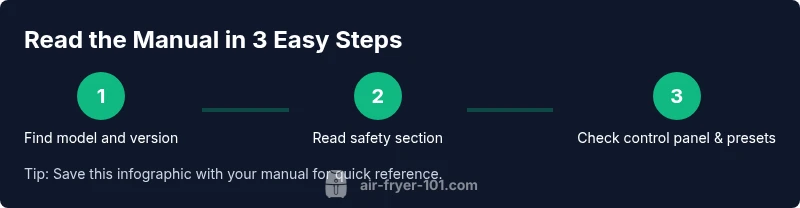
Identify model and version
Locate the model number on the back or bottom of the unit and record the exact version you own. This ensures you reference the correct manual and any model-specific safety notes. If you’re using a digital copy, verify you have the latest revision.
Tip: Double-check the model number against the packaging to avoid pulling up the wrong guide. - 2
Open the safety section
Turn to the safety or precautions section first. Note electrical requirements, placement clearances, and what to do in case of overheating. Mark any symbols you’re unfamiliar with for later lookup.
Tip: Keep a sticky note on the page highlighting any recall or service notice related to your model. - 3
Read the control panel description
Study the control panel diagrams and identify each button, dial, and preset. Pay attention to preheat instructions and how to combine functions for best results with your chosen foods.
Tip: If unsure about an icon, compare it to the image on the model’s diagram—visuals reduce misinterpretation. - 4
Review temperature and time charts
Locate the charts and understand the recommended temperatures and cooking times for common foods. Note differences for frozen vs. fresh ingredients and small vs. large batches.
Tip: Start with a smaller batch when first testing a new setting to avoid waste. - 5
Check accessories and diagrams
Identify which accessories come with your model and where to place them for optimal air flow. Confirm compatibility before purchasing third-party parts to avoid coating damage or safety issues.
Tip: Keep track of rack positions in a labeled diagram for quick reference. - 6
Create a quick-reference sheet
Summarize key settings for your favorite foods in one page. Include temperature, time, preheat status, and any halfway shake reminders. This short sheet speeds up weeknight cooking.
Tip: Use color-coding (e.g., red for caution, green for recommended) to quickly scan settings.
Got Questions?
Where do I find the manual for my air fryer model?
Check the model number on the device, then search the manufacturer’s website or the retailer page. If needed, contact customer support for a direct link to the correct manual.
Look up your model number on the appliance, then visit the manufacturer’s site or retailer page to download the official manual.
What if the manual is missing or damaged?
Use the model number to locate a digital copy online. If that fails, contact support with your model details for a replacement.
If the manual is missing, find the model number and search online for a PDF, or contact support for a replacement.
How should I interpret temperature charts?
Follow the chart for your food type as a baseline, then adjust in small increments based on batch size and rack use. Record adjustments for consistency.
Use the chart as a baseline and tweak in small steps, keeping notes for next time.
Are there safety certifications or recalls I should check?
Look for safety logos (UL, CE) and any recall notices on the manufacturer site. Follow their guidance to ensure safe operation.
Check for safety marks and recalls on the manufacturer site and follow the suggested actions.
Can I rely on a digital manual across models?
Digital manuals are model-specific. Always verify you’re viewing the correct version for your exact model and revision.
Digital manuals are model-specific; verify you have the right version for your model.
What should I do if I encounter an error code?
Refer to the troubleshooting section of the manual first. If the code persists, contact support with your model and the error details.
Check the troubleshooting section first, then contact support if the error continues.
Watch Video
Quick Summary
- Read safety and setup first
- Map foods to manual presets
- Record your own tested settings
- Maintain the manual with the appliance