What Air Fryer Setting for Chicken Breast: The Complete Guide
Master the right air fryer setting for chicken breast with temperature, timing, and moisture tips. This expert guide from Air Fryer 101 covers boneless and bone-in cuts, safety temps, rest times, and troubleshooting.


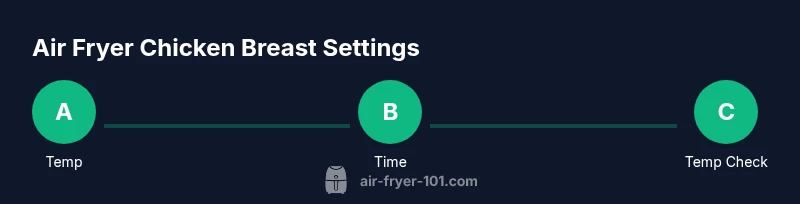
According to Air Fryer 101, the fastest way to cook juicy chicken breasts is to use the air fry setting at a high convection temperature and monitor with a thermometer. For boneless, skinless breasts, start around 360-375°F (182-190°C) and cook 9-12 minutes, flipping once. Aim for 165°F internal and rest briefly.
What setting to use for chicken breast in an air fryer
If you ask what air fryer setting for chicken breast will yield the most reliable results, the short answer is to start with the air fry function at a high convection temperature. This setting is designed to mimic a hot, circulating-air environment that browns the exterior while cooking the interior evenly. For boneless, skinless breasts, begin at about 360-375°F (182-190°C). If you’re working with thicker cuts, bone-in pieces, or larger portions, a slightly lower temperature around 350-365°F (177-185°C) can help prevent over-browning while the interior finishes cooking. Regardless of the temperature, always verify doneness with a thermometer—aim for an internal temperature of 165°F (74°C). To maximize browning, pat the chicken dry, lightly oil or spray the surface, and arrange pieces in a single layer with space between them so air can circulate freely.
How the main settings map to outcomes
Air fryers offer several preset options (air fry, roast, bake, etc.). When cooking chicken breast, you’ll primarily rely on the convection heat from the air fry setting. A higher temperature for a shorter time tends to yield juicier centers and crispier exteriors, while lower temperatures with longer times can result in less browning and more even texture across thicker cuts. If your model includes a roast or chicken setting, those can work similarly, but the key is how air movement and temperature interact with the meat. For consistent results, stick to a single main setting and adjust only by time rather than toggling between modes mid-cook. Remember, the goal is a stable internal temperature with a nicely browned surface that is still juicy inside.
The science of chicken breast: temp and texture
Chicken breast is lean and prone to drying if overcooked. The protein matrix contracts as heat rises, squeezing out moisture. A reliable internal temperature of 165°F (74°C) is considered safe and preserves juiciness when the outside has taken on a desirable color. The surface browns due to Maillard reactions, which are enhanced by small amounts of oil and a dry surface. Therefore, patting dry and using a light oil spray helps achieve a golden crust without greasing the entire surface. Temperature stability matters more than a single precise time, especially with variable breast thickness across different purchases.
Size, thickness, and portioning guide
Boneless chicken breasts can vary in thickness from thin cutlets to full, thick fillets. For best results in the air fryer, portion the meat so each piece is roughly even in thickness, ideally under 1 inch (2.5 cm). If you have pieces that are 1 to 1.5 inches thick, you’ll need to account for additional cook time. Use a ruler or a quick visual check to divide large breasts into uniform portions, or gently pound thicker pieces to an even thickness of about 3/4 inch (2 cm). With uniform thickness, the hot air penetrates evenly, reducing the risk of overcooking the exterior while the center remains underdone.
Baseline technique for boneless, skinless chicken breasts
A solid baseline starts with dry, seasoned chicken placed in a single layer. Salt and pepper, plus a favorite dry rub or simple paprika, garlic powder, and a touch of olive oil, can boost flavor and browning. Preheat the air fryer (if required by your model) to the target temperature. Lightly oil the surface or spray to help with browning. Place breasts in the basket, ensuring space between pieces. Start with 9-12 minutes for 1/2-inch thickness, then check internal temperature and flip once at the halfway mark. If pieces are thicker, add 2-4 minutes as needed for even doneness.
Adjusting times for thickness and cut type
Thickness controls cook duration. Thin cutlets (about 1/4 inch) may finish in as little as 6-8 minutes, while standard boneless breasts (about 1/2 inch) often need 9-12 minutes. Thick breast fillets or bone-in portions require longer, typically 12-16 minutes, with a mid-cook flip to promote even browning. Always use a meat thermometer to confirm 165°F. If you’re unsure about doneness, add 2-3 minutes and recheck. Consistency in thickness is the easiest way to predict timing.
Preheating and air flow optimization
Preheating helps some air fryer models reach a stable cooking temperature quickly, but not all require it. If your device recommends preheating, do so for 2-5 minutes before adding the chicken. Air flow is essential; avoid crowding the basket. Place pieces in a single layer with at least 1/2 inch of space between them to allow hot air to circulate. If you notice steam pooling or soggy surfaces, rearrange or cook in smaller batches. A light coating of oil on the surface also improves browning without making the meat greasy.
Seasoning, moisture retention, and browning
Season generously on all sides to help flavor development. Pat dry before applying salt or spices to ensure they adhere. A light oil spray or a brushed paint of olive oil improves browning and moisture retention—too much oil can cause excess splatter or sogginess. For extra flavor, consider a short marinade (15-30 minutes) or a spice blend with dried herbs like thyme or oregano. Avoid heavy sauces during the cook because they can hinder browning; instead, add sauces after the chicken is cooked.
Resting, slicing, and serving tips
Resting after cooking allows juices to redisperse, yielding a juicier slice. Transfer the chicken to a clean plate and let it rest for 3-5 minutes before slicing. If cutting into strips for salads or bowls, slice against the grain to maximize tenderness. Serve with a squeeze of lemon, a dash of pepper, or a light dipping sauce. For meal prep, portion into containers and refrigerate within two hours of cooking to preserve texture and flavor. Reheat in the air fryer at a lower temperature to avoid drying out.
Tools & Materials
- Air fryer(Ensure it’s clean and functional; preheat if your model requires it)
- Meat thermometer(Prefer instant-read; check at the thickest part)
- Cooking spray or light oil(Use sparingly to aid browning)
- Boneless skinless chicken breasts(Patted dry; uniform thickness if possible)
- Salt, pepper, and preferred seasonings(Simple blends work well; avoid heavy sauces during cook)
- Tongs or silicone spatula(For safe, even turning without tearing meat)
- Optional marinade or dried herbs(Adds flavor; not required for default result)
Steps
Estimated time: Total time: 25-40 minutes
- 1
Gather ingredients and preheat
Collect all ingredients and position the air fryer near the prep area. If your model requires preheating, do so for 2-5 minutes at the target temperature before adding the chicken.
Tip: Preheating helps achieve a quick surface crust and even cooking. - 2
Prepare the chicken
Pat the chicken dry with paper towels, trim any excess fat, and lightly pat dry again. This reduces surface moisture and promotes browning.
Tip: A dry surface improves browning and flavor development. - 3
Season the meat
Season generously on all sides with salt, pepper, and your chosen spices. A light drizzle of oil or spray helps with browning without making it greasy.
Tip: Season evenly and avoid clumping salt on one side. - 4
Arrange in a single layer
Place the chicken pieces in a single layer in the basket, giving at least 1/2 inch of space between pieces to ensure air can circulate.
Tip: Overcrowding leads to uneven cooking and soggy surfaces. - 5
Cook to the first color
Insert the basket and set the timer to the initial cook window (9-12 minutes for standard boneless breasts). If your model has a rotate or flip option, plan to turn halfway through.
Tip: A shallow initial cook helps set a crust before finishing inside. - 6
Flip halfway
Open the air fryer and flip the pieces to promote even browning on both sides.
Tip: Flipping at the midpoint yields uniform texture. - 7
Check internal temperature
Use a thermometer to verify the thickest part reaches 165°F (74°C). If below, continue cooking in 1-2 minute intervals while checking.
Tip: Avoid relying on time alone; temperature is the actual safety measure. - 8
Rest and slice
Remove the chicken and let it rest 3-5 minutes before slicing to retain juices.
Tip: Resting makes the meat juicier and easier to cut.
Got Questions?
What setting is best for chicken breasts in an air fryer?
Use the air fry/convection setting at 360-375°F for boneless breasts and adjust to 350-365°F for thicker or bone-in cuts. Cook until the internal temperature reaches 165°F.
Use the air fry setting around 360 to 375 degrees for boneless breasts, and check they reach 165 degrees internally.
Can I cook frozen chicken breasts in an air fryer?
Yes, you can cook frozen chicken breasts, but you’ll need to increase time by several minutes and monitor internal temperature closely to reach 165°F.
You can cook frozen breasts, just expect longer cooking and verify they hit 165 degrees.
Should I preheat the air fryer for chicken breast?
Preheating depends on your model. If recommended, preheat for 2-5 minutes at the cooking temperature to achieve quicker browning and even cooking.
Preheat if your model asks you to; otherwise you can go straight to cooking.
How do I tell if chicken breast is done without a thermometer?
Relying solely on color isn’t reliable. Use a thermometer when possible; if unavailable, cut into the center to check that there’s no pink and juices run clear, but this is less precise.
If you don’t have a thermometer, check for no pink and clear juices, but use a thermometer when available.
Can I cook bone-in chicken breasts in the air fryer?
Bone-in breasts require more time and sometimes lower temperatures to avoid drying the meat. Expect longer cook times and verify 165°F interior.
Bone-in pieces take longer; check internal temperature carefully.
How can I keep chicken breast juicy after cooking?
Dry surfaces, proper seasoning, and rest help; avoid overcooking. Target 165°F, rest 3-5 minutes, and slice against the grain.
Cook to 165 degrees, rest, and slice against the grain for juiciness.
Watch Video
Quick Summary
- Start with 360-375°F for boneless chicken breasts.
- Cook 9-12 minutes, flip halfway, and verify 165°F.
- Pat dry and use light oil for browning.
- Rest for 3-5 minutes before slicing.