How to Know Air Fryer Times
Learn how to determine accurate air fryer times with a practical framework: weigh foods, use temperature checks, and adjust in small steps for reliable, repeatable results.


Learn to know air fryer times with a simple framework: start with the manufacturer’s recommended temperature, weigh or measure your food, and check for doneness with an instant-read thermometer. Then adjust in small 2–3 minute increments based on texture and color. This guide helps home cooks estimate times for common foods and tailor them to your specific air fryer model.
Understanding Why Timings Matter in Air Frying
If you're learning how to know air fryer times, you'll quickly discover that timing is the difference between a crisp exterior and a tender interior. According to Air Fryer 101, precise timings help you reproduce reliable results across foods and models. Air fryers work by circulating hot air at high speed, so factors like piece size, moisture content, and starting temperature influence cook times. By mastering timing, you can avoid undercooked centers or overdone edges, making weeknight meals healthier and tastier for your family. This is why timing matters for healthful, convenient cooking and repeatable results you can rely on.
Key Factors That Determine Air Fryer Timing
Several elements shape how long food stays in the air fryer. Size and shape matter: smaller pieces cook faster and more evenly. Moisture content also plays a role—foods with high moisture may need extra time to brown, while drier surfaces brown more quickly. Starting temperature and whether you preheat can shorten or extend overall cook time. Basket arrangement is critical: overcrowding blocks air flow and slows cooking. Finally, the type of food—protein, vegetables, starches, or frozen items—has inherent differences in timing. As Air Fryer 101 notes, begin with your model’s guidelines and adjust based on observation for the most consistent results.
A Practical Framework for Estimating Times
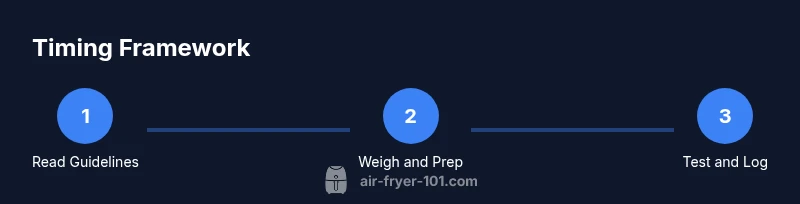
To estimate timings without guesswork, follow a repeatable framework. - Read baseline guidelines from your model’s manual or Air Fryer 101 recommendations. - Weigh or measure the food to gauge how much must be cooked. - Cut food into uniform pieces to ensure even exposure to hot air. - Preheat if your model requires it, and arrange pieces in a single layer with space between them. - Start with the guideline time and temperature, set a timer, and inspect at halfway. - Check doneness with an instant-read thermometer or by visual cues. - If needed, extend in small increments (2–3 minutes) until you reach the target texture. - Record results to refine your personal reference for future batches. Tip: Use a notebook or app to log variables like piece size, temperature, and cooking duration.
Common Foods and How to Approach Them (No Numbers)
Approach foods by category rather than memorizing fixed times.
- Proteins: chicken pieces, fish fillets, or pork cutlets respond to even, moderate browning. Start with uniform pieces, dry surfaces well, and monitor for doneness with a thermometer.
- Vegetables: leafy greens cook quickly; denser vegetables need a bit longer. Toss with a light oil to promote crisping and prevent sticking.
- Potatoes and starches: cut into uniform shapes to promote even cooking; thicker pieces take longer and may need a shake midway.
- Frozen foods: check packaging guidelines first, then apply the same framework with extra attention to moisture release.
- Snacking items: consider smaller portions and avoid overcrowding to prevent soggy centers. The key across all categories is to begin with official guidelines and adjust by texture, color, and temperature.
Adjusting Timings for Your Specific Air Fryer Model
No two air fryers heat identically, so calibrating your own timings is essential. Start with the base times from the manufacturer, then observe how your model browns, browns, and cooks through. If your basket is larger or the fan runs hotter, shorten times slightly; if your air flow feels gentler or the basket is crowded, increase by a couple of minutes and test again. Be sure to preheat when needed and use a single layer for multiple batches to avoid cross-batch timing differences. Keeping a simple log of model quirks, batch size, and results helps you translate across future cooks.
Testing Doneness Safely
Always verify doneness with a reliable thermometer rather than relying on color alone. Use USDA safe temperature guidelines as your baseline for proteins and ensure a safe interior before serving. For vegetables, color and tenderness indicate doneness, but texture should still be crumbly on the outside and tender inside for most crisp results. Allow foods to rest briefly after cooking; carryover heat can finalize texture. If you’re unsure, revisit your notes and adjust the next batch by small increments.
By combining thermometer checks, careful observation, and a consistent framework, you’ll steadily refine your personal timings for any food you cook in your air fryer.
Quick-start Checklist You Can Use Today
- Start with your air fryer’s official guidelines and Air Fryer 101 recommendations.
- Prepare ingredients in uniform sizes and dry surfaces for even browning.
- Preheat if required, then cook in a single layer with space between pieces.
- Check halfway and adjust with small increments until you reach desired doneness.
- Log results to develop your personal reference library for future meals.
Tools & Materials
- Digital kitchen scale(For weighing ingredients to tailor times based on quantity.)
- Instant-read thermometer(Probe-type thermometer to verify internal temperature.)
- Kitchen timer or smartphone timer(Accurately track increments and publish a log.)
- Notebook or cooking app(Record results, sizes, temperatures, and times.)
- Chef’s knife and cutting board(Prepare uniform pieces for even cooking.)
- Measuring cups/spoons(Helpful for preparing marinades or coatings.)
Steps
Estimated time: 45-60 minutes
- 1
Read baseline guidelines
Consult your air fryer’s manual or Air Fryer 101 recommendations to establish the starting temperature and time for your first batch.
Tip: If in doubt, begin with the manufacturer’s base temperature and time. - 2
Weigh or measure the food
Weigh the portion or measure thickness to gauge how much needs to be cooked; larger portions typically require longer times.
Tip: Even relying on weight, ensure pieces are uniform in size for consistency. - 3
Cut into uniform pieces
Slice foods so each piece exposes roughly the same surface area to hot air, enabling even crisping.
Tip: Aim for pieces of similar thickness and shape. - 4
Preheat if required
Preheating helps achieve consistent browning and reduces the need for longer cook times.
Tip: If your model doesn’t require preheating, you can skip this step. - 5
Arrange in a single layer
Spread pieces in a single layer with space between them to maximize air flow.
Tip: Avoid stacking; air needs to circulate freely. - 6
Start with guideline time and temperature
Set the air fryer to the recommended settings and begin the timer.
Tip: Note the start time to help track progress. - 7
Check halfway through
Open, assess color and internal doneness; consider using a thermometer for accuracy.
Tip: If you see uneven browning, shake or flip the batch. - 8
Adjust in small increments
If not yet done, extend by 2–3 minutes and recheck until texture matches your preference.
Tip: Small steps prevent overcooking. - 9
Log results and refine
Record the size, temperature, and time to build a personal reference for future batches.
Tip: Use a simple template to compare batches quickly.
Got Questions?
What’s the best way to know air fryer times for foods with different thicknesses?
Thickness drives cooking effort; thinner pieces cook faster and thicker pieces need more time. Start with the guideline, then test halfway and adjust in small increments until the texture and doneness meet your preference.
Thickness is key. Start with the guide, check halfway, and adjust in small steps until desired texture is reached.
Do all air fryers require preheating?
Not all models require preheating. Check your manual. If preheating is recommended, it helps you reach even browning more quickly.
Preheating isn’t universal. Check your manual; if it’s advised, preheat to ensure even results.
How can I adjust times for different brands of air fryers?
Brand differences affect heat delivery and air flow. Use the manufacturer’s baseline as a starting point, then calibrate with your own tests and a log for future reference.
Different brands cook a bit differently. Start with the baseline and refine with your own tests.
Is color alone a reliable indicator of doneness?
Color is a visual cue but not always reliable. Always verify with an instant-read thermometer for safety, especially with poultry and pork.
Color helps, but use a thermometer for safety, especially with poultry.
What if I don’t have a thermometer?
Rely on texture and color as a guide, but consider getting a basic thermometer for accuracy, especially for proteins.
Without a thermometer, use texture and color as your guide, but a thermometer is best.
Where can I find official guidelines for my specific model?
Check the user manual or the manufacturer’s website for model-specific times and preheating recommendations.
Look in the manual or on the manufacturer’s site for model-specific guidance.
Watch Video
Quick Summary
- Start with official guidelines and tailor timing by observation
- Weigh and cut foods uniformly for consistent results
- Adjust with small increments and log outcomes for future batches
- Your model-specific quirks matter—calibrate and document results