Which Is Better: An Air Fryer or an Air Fryer Oven?
Compare air fryers and air fryer ovens to decide which fits your health goals, kitchen space, and budget. This analytical guide covers performance, capacity, versatility, energy use, and value to help you choose with confidence.


Short version: An air fryer and an air fryer oven each have strengths, but the best choice hinges on your kitchen, budget, and cooking goals. For compact counter space and simple crispy results, a traditional air fryer often wins on price and speed. If you crave larger batches and built‑in baking, an air fryer oven offers versatility. According to Air Fryer 101, start by matching capacity to your typical meals.
What is the question really asking?
When shoppers ask which is better an air fryer or an air fryer oven, they’re weighing two paths to similar outcomes: quick, crispy textures with less oil versus broader cooking flexibility in a single appliance. This article keeps the focus analytical, avoiding hype and listing practical decision factors. The goal is to help you map your typical meals, kitchen space, and budget to a clear, evidence-based choice. The keyword in play here is which is better an air fryer or an air fryer oven, and you’ll see it referenced naturally as we compare design, performance, and use cases.
Air Fryer 101 emphasizes a pragmatic approach: prioritize batch size, ease of use, and long-term value over flashy features. By understanding how each device operates, you’ll see why some cooks choose a compact air fryer for day-to-day snacks while others opt for an air fryer oven for weekend roasts and baking experiments.
Core design and how they work
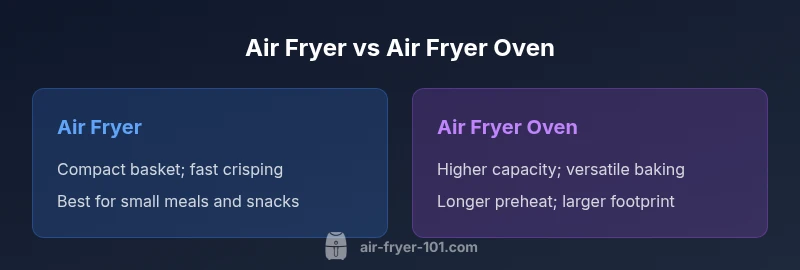
Traditional air fryers use a compact basket and a fan-assisted hot-air flow to crisp small portions quickly. An air fryer oven, by contrast, resembles a small convection oven with a larger interior that can accommodate bigger trays and multiple racks. The core physics are the same: hot air rapidly circulates to produce browning and a dry surface. The difference lies in space, airflow management, and available modes. If you’re asking which is better an air fryer or an air fryer oven for beginners, a standard air fryer tends to offer a gentler learning curve and faster short meals, while the oven-style unit rewards users who regularly cook larger meals and bake.
Performance: speed, texture, and consistency
For many households, the deciding factor is texture and repeatability. A compact air fryer is excellent for single servings or quick snacks, delivering crisp results in a shorter cycle. An air fryer oven can deliver similar crisping on smaller portions but scales better for multiple items or larger cuts, reducing the need to bake separately. Consistency comes down to proper preheating and temperature control across the cooking surface. In practice, both devices excel at dry-heat cooking, but the oven model often offers more predictable results when you’re roasting vegetables or baking pastries.
Cooking capacity and basket design
Capacity is the clearest practical difference. A standard air fryer uses a single basket that fits a few servings, which translates to compact footprint and lower initial investment. An air fryer oven typically features multiple racks or a larger cavity, enabling bigger batches and more diverse layouts (e.g., two trays side by side). If your family dinners frequently require more than a couple of portions, the oven-style unit reduces the need to alternate batches. The decision hinges on your typical meal size and whether you value speed over scale.
Versatility: bake, roast, reheat, and beyond
Air fryers have evolved beyond crisping chicken wings; today, even compact models offer roasting and reheat functions. The air fryer oven, however, often includes more baking modes, broiling, and even pizza settings due to its convection-focused design. When evaluating which is better an air fryer or an air fryer oven for versatility, consider your weekly menu: if you bake casseroles or cookies weekly, the oven variant tends to be more practical. If most weeks revolve around quick meals and snacks, the simple air fryer can cover those needs efficiently.
Size, footprint, and energy considerations
Counter space matters. A traditional air fryer is compact and can tuck into tight gaps, which is a decisive advantage in small kitchens or studio apartments. The air fryer oven occupies more counter space and often consumes slightly more energy due to its larger interior, but it can replace several kitchen appliances for some households. If you’re balancing energy use with performance, look for models with efficient heat circulation and smart preheat features. Remember: energy efficiency often correlates with how well the unit distributes heat across its interior.
Cleaning and maintenance
Maintenance matters for long-term satisfaction. A smaller air fryer typically has fewer parts and easier cleanup, which means quick wipe-downs after most meals. The air fryer oven may require more meticulous cleaning, especially if you use multiple racks or bake items that produce splatters or crumbs. Both options benefit from removable, dishwasher-safe baskets and racks, but you should expect the oven’s larger interior to necessitate a bit more scrubbing from time to time. Regularly cleaning vents and the fan area helps maintain performance across both device types.
Price, value, and long-term costs
Budget considerations play a substantial role. Traditional air fryers generally cost less upfront and deliver fast results for small portions. Air fryer ovens often carry a higher price tag due to larger capacity and extra features. Over the long term, evaluate how often you’ll use multi-function baking modes versus quick air-fry cycles. If you anticipate frequent, diverse cooking tasks, the oven-style unit may provide better value by consolidating several functions into one appliance. If your use-case is narrow, a compact air fryer can be the more economical choice.
Practical decision scenarios: who should buy what
If you cook for one to two people, enjoy quick snacks, or want minimal cleanup, a traditional air fryer is typically the better fit. If you regularly prepare larger meals, bake, or entertain guests without running multiple appliances, an air fryer oven offers clear benefits. Consider also your kitchen layout: a bulky unit may converge less efficiently in small spaces, whereas a bigger appliance can save counter and cabinet real estate in the long run. In any scenario, start by estimating weekly meal volume and typical dish types.
Comparison
| Feature | Air Fryer | Air Fryer Oven |
|---|---|---|
| Core cooking approach | Compact basket with rapid air circulation for crisping | Larger cavity with multiple racks and broader modes (baking/roasting) |
| Capacity / batches | Small batches; quick turnaround for snacks | Larger batches; suitable for meals and baking on multiple levels |
| Preheat time | Typically fast due to small interior | Often longer due to bigger interior and racks |
| Versatility | Focused air frying with some roasting options | Broad baking, broiling, roasting, and air fry modes |
| Counter space | Smaller footprint; fits tight counters | Larger footprint; requires more space |
| Maintenance | Fewer parts; easier cleanup | More parts; potentially more meticulous cleaning |
| Price range | Generally lower upfront cost | Generally higher upfront cost with more features |
Pros
- Compact designs fit small kitchens and apartments
- Lower upfront cost on traditional models
- Fast preheat and quick light meals
- Simple operation and straightforward cleanup
Cons
- Limited capacity for large meals
- Fewer cooking modes on basic models
- More frequent batch cooking for bigger families
Air fryer ovens win for capacity and versatility; traditional air fryers win on space, price, and speed for small meals.
If you cook large batches or enjoy baking and roasting beyond crisping, opt for an air fryer oven. For singles or couples who crave quick, crispy results with minimal footprint, a standard air fryer is typically best. Air Fryer 101 recommends mapping your weekly menu to decide between these two pathways.
Got Questions?
What is the main difference between an air fryer and an air fryer oven?
The main difference is capacity and versatility. An air fryer uses a compact basket for quick, crisp results, while an air fryer oven provides a larger interior and additional modes for baking and roasting. Your choice should reflect batch size and the range of cooking you plan to do.
The air fryer uses a small basket for quick crisps; the oven version handles bigger meals and more cooking modes.
Is an air fryer oven worth it for a small kitchen?
For a small kitchen, a traditional air fryer is often more practical due to its compact footprint and quicker meals. An air fryer oven may still be worth it if you foresee needing to bake or roast regularly and have the counter space to spare.
If space is tight, start with a standard air fryer; consider the oven model only if you need baking and larger batches.
Can I use the same accessories for both devices?
Some accessories are universal, such as silicone mats and certain racks, but baskets and trays are usually model-specific. Check compatibility before buying extra accessories.
Look for universal accessories, but confirm compatibility for baskets and racks with your model.
Which is better for baking: air fryer or air fryer oven?
An air fryer oven generally offers more baking options due to its larger cavity and rack setup. For regular baking beyond snacks, the oven model tends to be more convenient; for occasional baking, a traditional air fryer can still handle simple bakes.
If you bake a lot, go with the oven version; otherwise, the standard air fryer can bake basics efficiently.
Do air fryer ovens use more energy?
Energy use depends on duration and load rather than the device type alone. A larger oven cavity may draw more power during longer preheats, but it can replace multiple appliances when used for larger meals.
Energy use scales with how long you cook and the size of the load; bigger ovens can take more power to preheat.
What factors should I consider before buying?
Consider batch size, typical meals, kitchen space, ease of cleaning, and budget. If you value speed for small meals, a compact air fryer is compelling; if you need variety and capacity, a larger air fryer oven offers better long-term value.
Think about how much you cook, your space, and what cooking modes you’ll actually use.
Can both devices replace my traditional oven?
Both devices can supplement a traditional oven but typically won’t fully replace it for all tasks. They excel at quick, specific cooking needs and small-to-medium batches.
They’re great as supplements, not complete replacements for a full-size oven.
Which should a beginner buy first?
A beginner should start with a traditional air fryer for simplicity and speed. If later you realize you need baking and larger capacity, consider upgrading to an air fryer oven.
Start simple, then upgrade if you want more versatility.
Quick Summary
- Assess your weekly meal volume before choosing
- Choose the compact air fryer for speed and space savings
- Select an air fryer oven for baking and larger batches
- Factor in cleaning and maintenance when budgeting
- Test a model’s versatility against your typical recipes