Ninja Air Fryer 8 Qt vs 10 Qt: Side-by-Side Guide for Shoppers
In-depth, objective comparison of Ninja air fryer 8 qt vs 10 qt to help home cooks decide which size fits space, cooking style, and budget.


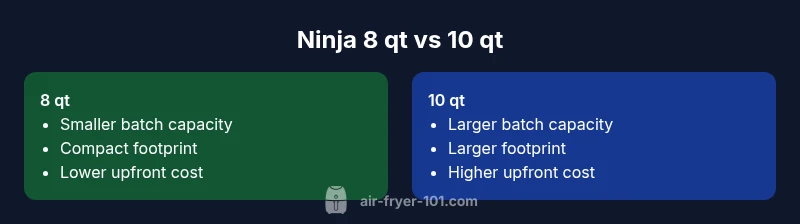
Both Ninja air fryer 8 qt and 10 qt models deliver crisp, oil-light results for a wide range of dishes. The major difference is capacity and footprint: the 10 qt handles larger batches for bigger households or entertaining, while the 8 qt fits tighter spaces and faster weeknight meals. If space and budget are constrained, the 8 qt offers strong versatility; if you regularly cook for more people, the 10 qt adds meaningful batch capacity.
Ninja air fryer 8 qt vs 10 qt: size matters in practice
When shoppers compare the Ninja air fryer 8 qt vs 10 qt, the most visible difference is how much food you can handle in a single cycle. Both sizes leverage the same core technology—rapid hot air, a compact cooking chamber, and a simple control interface. According to Air Fryer 101, understanding how capacity translates to real cooking scenarios helps buyers align a size with their typical meals and weekly routine. The goal is to choose a model that minimizes the number of batches without sacrificing the ability to cook favorite foods with consistent results.
For many kitchens, the decision comes down to an everyday balance between space on the counter and the practicality of batch cooking. If your typical meals involve a single or double serving of proteins or vegetables, the 8 qt generally provides ample headroom for variety without crowding the countertop. If you routinely prepare meals for four or more, the 10 qt can reduce the number of cycles needed per day while enabling bigger batch reheats.
Capacity and batch sizing: what you actually cook
Capacity is more than a number; it shapes how you plan meals. The 8 qt is well suited for quick weeknight dinners, snacks, and side dishes that don’t require large pan-space, while the 10 qt shines when you want to sear a larger protein at once or batch-roast multiple trays. In practice, most households discover that the 8 qt handles daily meals with room to toss in a couple of sides, whereas the 10 qt makes it easier to cook larger items—like a whole tray of fries or a sizable chicken piece—in one go. For families, consider your typical batch size and whether you value fewer cooking cycles over a larger interior.
Footprint and kitchen fit: does size matter on the counter?
The physical footprint of the two models reflects their capacity. The 8 qt model usually has a smaller footprint and lighter weight, making it easier to store and move when needed. The 10 qt, while offering more interior space, requires more counter or storage real estate. If countertop space is at a premium, the 8 qt reduces the daily friction of scraping and stowing after use. If cabinet or shelf space is abundant, the 10 qt’s extra capacity can be a selling point for households that routinely cook sizable meals.
Performance fundamentals: airflow, temperature range, and consistency
Core performance tends to be similar across sizes because Ninja typically uses the same heating element and fan arrangement. The main difference is how the air circulates around more or less food, which can subtly influence browning and evenness when you load full trays. In practice, the 8 qt can deliver even browning for typical portions, while the 10 qt may benefit from separating foods into two batches during very crowded cooks. Users who rely on consistent results for a small menu will feel comfortable with either size, while those who value maximum single-batch throughput may lean toward the 10 qt.
Accessories and compatibility: what comes in the box and what fits
Both sizes share common accessory ecosystems, such as crisper plates and baking pans designed for countertop use. The main compatibility consideration is tray space: the 10 qt often accommodates larger or extra trays, which can be a practical boost for batch roasting. However, ensure the accessories you already own or plan to buy align with the interior dimensions. In most cases, you’ll find that Ninja’s standard accessories work across both sizes, with the main difference being how many items you can place inside at once.
Cleaning, maintenance, and durability by size
Maintenance patterns are similar for both sizes: wipe the exterior, wash removable accessories, and avoid soaking the unit’s interior. The 8 qt interior is quicker to reach and easier to dry after washing, while the 10 qt interior may take a bit longer due to its larger cavity. In either case, routine cleaning reduces staining and keeps airflow unobstructed. Visually inspect seals and gaskets periodically, but both sizes are designed for long-term kitchen use when cleaned promptly after cooking.
Use-case scenarios by household size and lifestyle
If you cook for one to two people, the 8 qt usually fits the majority of weeknight staples with room for an additional side or two. For families, roommates, or those who frequently entertain, the 10 qt can simplify meal prep by allowing larger portions in a single cycle. If you travel often for meals or have limited storage, the 8 qt’s more compact form may be advantageous. Both sizes deliver practical versatility, so your final choice should reflect your typical meals, available space, and budget constraints.
Energy use and cost implications in everyday cooking
From an energy perspective, both sizes offer similar efficiency profiles because they rely on rapid air heating rather than long oven preheats. In practice, the volume difference affects how often you pass food through the chamber in a day. A smaller kitchen that uses shorter cycles may benefit more from the 8 qt’s brisk turnaround, while a larger household may justify the 10 qt to reduce total cooking time across multiple dishes. Overall, energy impact aligns with batch count rather than a large, single-size discrepancy.
Price ranges and value context for Ninja air fryers
Price is a practical criterion that varies by retailer and promotions. In general, the 8 qt models sit at a lower upfront cost, reflecting their smaller footprint and capacity; the 10 qt commands a premium due to larger capacity and potential batch-handling benefits. When evaluating value, consider how often you need to cook for multiple people and whether the occasional larger batch justifies the higher initial investment. The best value balances space, usage frequency, and long-term utility.
Common myths and misperceptions about size differences
A common misconception is that bigger models always deliver better results. In reality, the quality of cooking comes from how you use the appliance, not only its interior volume. Another myth is that the 10 qt guarantees faster meals; in fact, batch planning and timing often determine overall throughput. Finally, some buyers assume you must own multiple units to cover all cooking scenarios—an 8 qt can cover most weekday needs, while the 10 qt serves special occasions or larger batches.
Step-by-step decision guide: choosing the right size for you
- List your typical meals and batch sizes. 2) Measure available counter and storage space. 3) Consider how often you entertain or cook for guests. 4) Compare the price difference against your expected usage. 5) Review accessory compatibility and warranty terms. This approach helps translate abstract capacity numbers into real-world outcomes, making the decision process clearer and less risky.
Real-world cooking tips for each size: maximizing results
For the 8 qt, plan for quick turnovers and couple-friendly meals—season food in smaller batches, pre-portion sides, and use the fan-off technique for delicate items. For the 10 qt, consider batch roasting multiple trays side by side, stagger loading for even browning, and use two-stage cooking for denser proteins. Both sizes benefit from lightly oiling trays and avoiding overcrowding to maintain crisp texture.
Comparison
| Feature | Ninja air fryer 8 qt | Ninja air fryer 10 qt |
|---|---|---|
| Capacity per load | 8 qt capacity for smaller meals | 10 qt capacity for larger batches |
| Footprint | Compact footprint for tight spaces | Larger footprint to accommodate bigger loads |
| Best use case | Small households, apartment living, quick meals | Families, entertaining, batch cooking |
| Maintenance ease | Easier access for cleaning due to smaller interior | More interior to clean but same accessory system |
| Price/value context | Lower upfront cost with solid versatility | Higher upfront cost with potential batch efficiency |
Pros
- Compact footprint fits in small kitchens
- Lower upfront cost relative to larger capacity
- Faster batch turnover for daily meals
- Easier to store when not in use
Cons
- Limited batch capacity for larger families
- Requires more frequent batches for big meals
- Potentially less ideal for very large roasts or sheets
- Slightly less interior room for very large items
10 qt for large households; 8 qt for compact spaces
Choose 8 qt if space and budget are priorities. Choose 10 qt if you regularly cook for more people or want fewer batches per day.
Got Questions?
What is the main difference between the 8 qt and 10 qt Ninja air fryer?
The 8 qt and 10 qt share core features, but capacity and footprint differ. The 8 qt is smaller and typically fits tight spaces, while the 10 qt offers more interior space for larger batches. Both deliver crisp results with minimal oil.
The main difference is capacity and space: 8 qt is compact, 10 qt is larger but still delivers same crisp results.
Which size is better for a family of four?
For a family of four, the 10 qt is generally more convenient because it can handle larger batches in a single cycle, reducing the number of rounds you run. If kitchen space is a bigger constraint, evaluate your typical meals first.
For a family of four, the 10 qt is usually more convenient for larger batches.
Do both sizes share the same features and controls?
Yes, both sizes typically share the same control interface and core air-fry technology. The main differences are capacity, interior space, and how many items you can fit at once.
Both sizes use the same controls and technology; the difference is capacity.
Can I use the same accessories with both sizes?
Most Ninja accessories are compatible across sizes, though you’ll want to confirm tray and basket dimensions to ensure proper fit and optimal airflow for the size you choose.
Accessories usually fit both sizes, just check tray dimensions.
Is the 8 qt easier to store in small kitchens?
Generally yes. The 8 qt’s smaller footprint makes it easier to tuck away when not in use, freeing counter space for other tasks.
Yes, the 8 qt is easier to store in small kitchens.
Should I expect the 10 qt to cook faster for larger meals?
Not necessarily. Cooking speed depends more on batch size and airflow than overall unit size. The 10 qt may reduce batch counts, but a large roast still requires careful placement for even browning.
The 10 qt may cut batch counts, but timing depends on how you load it.
Quick Summary
- Assess counter and storage space before buying
- Match batch size to household size
- Expect similar core performance in both sizes
- Weigh price and future cooking needs to decide
- Consider accessory compatibility when upgrading