8 qt vs 10 qt Air Fryer: Which Size Is Right for You?
Compare 8 qt and 10 qt air fryers to determine which size fits your family, budget, and kitchen countertop. Air Fryer 101 provides a practical, analytical guide for choosing the right capacity.


For most households, the 8 qt air fryer is the better everyday choice due to its compact footprint and quick preheat, while the 10 qt model shines for families that cook in batches or feed 5+ people. Overall, pick based on countertop space, meal size, and how often you batch-cook in your kitchen daily.
Why size matters for everyday cooking
According to Air Fryer 101, the choice between an 8 qt and a 10 qt air fryer isn’t just about capacity. It’s about how you use your appliance, how many mouths you feed, and how much counter real estate you’re willing to allocate. The 8 qt model typically fits compact kitchens, studio apartments, and single- or dual-person households because of its smaller footprint and quicker preheat. The 10 qt version, by contrast, targets families and bulk cooks who routinely prepare larger portions in a single batch. In this comparison, I’ll break down practical implications—space, performance, and long-term value—so you can choose with confidence. Air Fryer 101’s approach blends real-world testing with guidance that translates across brands and price tiers.
Capacity in daily practice: how much you really cook
Capacity isn’t just a number on the box; it translates into meals. An 8 qt basket typically accommodates a family dinner for two to four when you’re cooking proteins and sides in one go, while a 10 qt basket can handle larger batches suitable for a big family or meal-prep sessions. Visualize your standard week: weekday dinners, weekend batch cook days, and any batch-free nights. If you consistently batch cook or entertain, the 10 qt can reduce the number of cycles needed, saving time and energy. If you mostly cook for a small household, the 8 qt minimizes waste and keeps your kitchen nimble.
Footprint, storage, and countertop workflow
A practical kitchen setup begins with measuring your available space. An 8 qt unit typically measures roughly a couple of inches less in width and height, making it simpler to tuck under cabinets or store in a small cabinet when not in use. A 10 qt unit, with its larger basket, usually occupies more horizontal space and may demand a more robust shelf or deeper countertop clearance. Think about door swing, whether you need to leave the unit on the counter for daily use, and how you’ll align cords with outlets and heat vents. A larger footprint can complicate daily workflow if space is already tight.
Performance: heating, airflow, and consistency
Different sizes don’t just scale linearly; they influence heat distribution and airflow dynamics. In practice, an 8 qt air fryer often heats quickly and yields crisp results in smaller batches due to shorter paths for hot air to circulate. The 10 qt model can offer comparable crispness at larger batch sizes but may require slightly longer preheat times or multi-tier loading to avoid crowding the basket. Recipe adaptation matters: you’ll want to avoid overcrowding, rotate contents during cooking, and adjust times when moving from a small batch to a large batch. Both sizes benefit from shaking or flipping foods partway through cooking for even browning.
Preheating, cook times, and recipe adjustments
Preheating times for the 8 qt and 10 qt are usually within a few minutes of each other, but real differences appear when you load more food. With heavy loads in the 10 qt, some recipes benefit from a two-step approach: preheat, then add additional batchCook steps with shorter intervals to prevent steaming. For many common items—frozen fries, chicken tenders, vegetables—the delta in cook times between sizes is small if you maintain proper spacing. When adapting a 10 qt recipe for an 8 qt, you’ll typically reduce the batch size by about one-third and monitor doneness closely the first few times to calibrate time and temperature for your model.
Cleaning and maintenance: ease vs. effort
Maintenance is straightforward for both sizes, but the larger basket in a 10 qt model means more surface area to clean and a bigger interior cavity to scrub. If you frequently cook for crowds or use heavier sauces, you may notice more residue and spatter on the sides of a 10 qt interior. Regular care—washing the basket promptly after use, drying completely, and inspecting the gasket and airflow vents—helps maintain performance. An 8 qt unit, with its smaller footprint, can feel easier to wipe down and store, which is a practical advantage for tight kitchens.
Price, value, and long-term considerations
Price varies by brand, features, and warranty length, but the general pattern is that 8 qt models sit at a lower upfront price point while 10 qt units carry a premium due to larger capacity and sometimes additional features. If you’re budgeting for a single appliance that will serve a small household for years, the 8 qt offers excellent value with lower ongoing space costs. If you anticipate frequent batch cooking or family meals that require bigger portions, investing in a 10 qt can reduce the number of cooking cycles and speed up meal prep on busy days. Consider whether the extra volume justifies the higher price and footprint in your kitchen.
Real-world use cases: when each size shines
The 8 qt shines for apartments, dorm rooms, or couples who value speed, ease, and storage. The 10 qt shines for families, meal-preppers, or hosts who want to produce multiple items in one go. In shared kitchens or open-plan spaces, the 8 qt’s compact footprint may preserve counter space for other tasks, while in a kitchen used for weekly meal prep, the 10 qt’s larger capacity can transform routine cooking into a more efficient process.
How to choose: a practical decision framework
Use a simple framework: (1) Map your typical weekly meals and batch frequency; (2) Measure your counter space, including how wires and doors will clear; (3) Consider noise and footprint in your kitchen’s layout; (4) Compare price ranges and warranty length; (5) If possible, borrow or test models from friends or retailers to verify fit and performance. The interplay of these factors will usually point you toward the 8 qt for small households or the 10 qt for batch-focused cooks; the decision boils down to space, appetite for bulk cooking, and budget.
Comparison
| Feature | 8 qt air fryer | 10 qt air fryer |
|---|---|---|
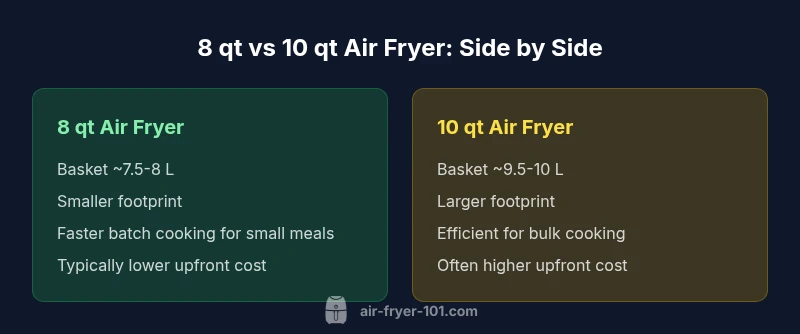
| Capacity | ~7.5-8 L basket | ~9.5-10 L basket |
| Footprint (width x height) | Smaller footprint; easier to tuck under cabinets | Larger footprint; requires more counter space |
| Power range (W) | ~1400-1500 W | ~1700-1800 W |
| Best for | Small households, apartments, quick weekday meals | Large families, batch cooking, weekly meal prep |
| Preheat behavior | Typically faster due to smaller cavity | Similar preheat but larger batch can take longer to heat evenly |
| Typical price range | Lower upfront cost (brand-dependent) | Higher upfront cost (brand-dependent) |
Pros
- Better space efficiency for small kitchens
- Faster preheat and cook times for small batches
- Lower upfront cost on average
- Easier to store and maneuver in compact kitchens
- Sufficient capacity for most single- and double-serving meals
Cons
- Smaller batch capacity requiring more batches for large meals
- 10 qt may be bulky for tiny countertops
- Potential price delta may not justify if you rarely batch cook
- Cleaning larger basket means more surface area to scrub
- Might not fit under shallow upper cabinets in some kitchens
8 qt air fryers are generally the better everyday choice for most households; 10 qt excels for batch cooking and larger meals.
For daily meals in small to mid-sized households, the 8 qt provides a solid balance of space, speed, and cost. If your routine includes cooking large batches or hosting, the 10 qt offers more capacity and fewer cooking cycles, at the expense of footprint and price. Air Fryer 101's verdict is to match size to meal patterns and kitchen layout, not just appetite.
Got Questions?
What is the practical capacity difference between 8 qt and 10 qt air fryers?
The 8 qt basket generally holds enough for everyday meals for 1-4 people, while the 10 qt basket accommodates larger batches for bigger families or batch cooking. Real-world results depend on what you’re cooking and how you arrange items in the basket.
The 8 qt fits daily meals for small households; the 10 qt helps if you cook in bulk.
Are 8 qt and 10 qt models interchangeable for recipes?
Most recipes can be adapted to either size with minor adjustments to batch size and cooking time. Avoid overcrowding and consider adjusting air circulation by shaking or stirring halfway through cooking.
Recipes mostly translate; just avoid crowding and adjust time as needed.
Will a 10 qt take longer to cook than an 8 qt?
Cooking times depend on batch size and how well items are spaced. Larger batches can require slightly longer preheating and total cook time, but even results are achievable with proper layout and occasional batch rotation.
Larger batches may take a bit longer, but you can manage with proper spacing.
Is cleaning easier on an 8 qt due to its smaller size?
Cleaning is similar in method for both sizes, but the 8 qt’s smaller interior is typically quicker to wipe and dry. The 10 qt basket has more surface area, which can take a bit longer to clean.
Both clean the same way; the 8 qt is a bit quicker to wipe down.
What factors influence price differences between sizes?
Prices vary by brand, features, and warranty. In general, larger capacity models may cost more upfront, but the value depends on how often you batch cook and the overall space you’re willing to allocate.
Price mostly depends on brand and batch-cooking needs.
Which size is better for countertop space?
If space is tight, the 8 qt is usually the safer choice due to its smaller footprint. In a larger kitchen with room for a bulkier unit, the 10 qt can be practical for batch cooking without sacrificing other counter tasks.
8 qt fits tighter spaces; 10 qt works when you have room for bigger batches.
Quick Summary
- Prioritize counter space to decide size
- 8 qt fits small kitchens with quick sessions
- 10 qt reduces batch-cook cycles for large meals
- Expect higher upfront cost with larger capacity
- Regular cleaning is important for both sizes