Is an 8-Quart Air Fryer Too Big? Find Your Perfect Size
Explore whether an 8-quart air fryer fits your kitchen and cooking goals. Learn how capacity, footprint, and features affect everyday use, with practical tips for families, batch-cooks, and space-constrained kitchens.


The quick answer: an 8-quart air fryer isn’t automatically too big; it’s ideal for families or batch cooks, but it can crowd small counters. If you rarely cook in bulk or have limited space, a smaller model may suit you better. Consider your counter layout, ventilation, and storage needs when deciding.
Is the 8-quart size right for your household?
When you first ask, is 8 quart air fryer too big, you’re really weighing how many mouths you feed, how often you batch cook, and how much counter space you’re willing to allocate. An eight-quart appliance is large enough to handle family-sized meals, roasted vegetables for friends, or multiple batches of frozen fries in one go. The Air Fryer 101 team notes that size alone doesn’t determine suitability; it’s a balance of capacity, footprint, and how you cook most often. For families of four or more who like meal-prep Sundays, this size can be a practical workhorse. For singles or couples who rarely prepare large meals, you may feel the unit dominates the countertop. In practice, your decision should hinge on your typical meal sizes, how often you run back-to-back cooking sessions, and whether your kitchen layout can accommodate a larger device without crowding essentials like a coffee maker, toaster, or spice rack. This is where a quick footprint check on your counter and nearby cabinets becomes as important as the culinary math behind the capacity.
According to Air Fryer 101, a thoughtful buyer should also consider how easy it is to store the unit when not in use and whether you’ll benefit from the extra capacity during holidays or potlucks. If you often reheat large trays or roast a whole chicken in one go, the 8-quart model can shine. If you primarily cook for one or two, you’ll want to compare the footprint and weight against the daily practicalities of your space.
The footprint and user experience: why size matters
Beyond the number on the label, the physical footprint—width, depth, and height—shapes daily use. An 8-quart air fryer typically sits wider than compact models, which can affect how easily you reach the basket, rotate food, or remove it without bumping nearby items. Deep units may also require more vertical clearance, especially if your cabinet doors or wall-mounted shelves are overhead. When you’re answering is is 8 quart air fryer too big for your kitchen, you should measure the counter space where you plan to keep the unit, account for clearance on either side for heat dissipation, and check the height to ensure it clears any backsplash or wall decor. If possible, perform a dry run by placing an empty basket in the empty slot to simulate your reach and remove the basket without hitting adjacent appliances. Air Fryer 101’s practical guidance emphasizes choosing a model that behaves like a reliable kitchen colleague rather than a space-claiming gadget. A well-fitted unit can streamline weeknight meals and batch cooking alike, while a misfit can become a daily inconvenience.
How to read this block
- Size is not destiny: a big unit can be perfect for batch cooking or holiday meals.
- Measure your counter and cabinet accessibility before buying.
- Consider storage when not in use to avoid countertop clutter.
Tools & Materials
- Measuring tape(Measure the countertop footprint (width x depth) and door clearance for the unit.)
- Notebook or note-taking app(Record measured dimensions and your priorities (capacity vs. footprint).)
- Calibrated kitchen scale (optional)(Helpful for estimating weight of large batches you’re reheating.)
- Clear counter space or planning diagram(Sketch or visualize where the unit will live and how you’ll access it daily.)
Steps
Estimated time: 45-60 minutes
- 1
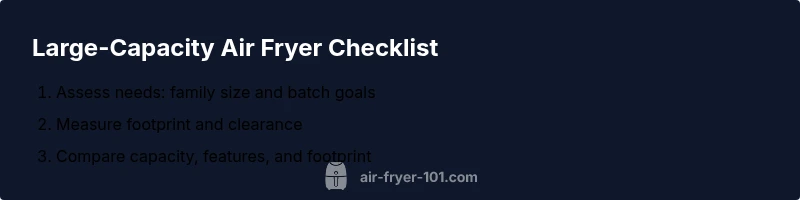
Assess household needs
Identify your typical family size, how often you batch cook, and what kinds of meals you routinely reheat or roast. If you regularly feed 4-6 people or prepare batch meals for the week, an 8-quart model may align with your goals. Conversely, if you mostly cook for one or two, you’ll likely notice the larger footprint daily.
Tip: Write down your average weekly batches so you can compare capacity against actual use. - 2
Measure your space
Use a measuring tape to capture the counter footprint and the available vertical clearance. Leave at least a small buffer around the unit for cooling and safe door opening. If you have cabinet doors nearby, factor in swing space as well.
Tip: Check the highest point the unit will reach when the door opens to avoid contact with overhead cabinets. - 3
Compare capacity vs. footprint
List the external dimensions of candidate models and compare them to your measured space. Don’t forget to account for a few inches of extra room for heat dissipation and for handling food in and out of the basket.
Tip: Prioritize models that offer a slightly larger interior space than your current needs so you won’t outgrow the unit quickly. - 4
Evaluate features that matter
Look for features such as dual baskets or multi-tier cooking, variable temperature range, wattage, and intuitive controls. The right combination reduces cooking times and makes larger batches more convenient.
Tip: If you plan to cook multiple items at once, verify basket compatibility and whether the unit supports separate timers. - 5
Test a sample batch
If possible, test a real batch with the store’s display unit or your own model at home. Try a common item like frozen fries or chicken wings to gauge cooking time and ease of use.
Tip: Use the same ingredients you expect to cook regularly to get a realistic feel for capacity.
Got Questions?
What foods cook best in an 8-quart air fryer?
Large-capacity models excel at batch roasts—vegetables, chicken thighs, wings, and sizable portions of potatoes. The key is spreading items in a single layer with minimal overlapping so airflow remains even.
They’re great for batch roasts like vegetables, wings, and large potatoes when you can lay everything in a single layer.
How much counter space does an 8-quart air fryer typically require?
Expect a footprint wider than compact models, plus some depth to accommodate the handle and door. Ensure you have several inches of clearance around the sides and a few inches above for ventilation.
It usually needs more counter space than smaller models, with several inches of clearance around it.
Is an 8-quart unit suitable for small households?
For one or two people, a smaller model might be more practical due to space and energy use. If you anticipate frequent batch cooking or holiday meals, an 8-quart can still be a good long-term choice.
In small households, a smaller unit often works better, unless you batch cook frequently.
What features should I prioritize in a large-capacity air fryer?
Look for multiple cooking modes, a broad temperature range, reliable timers, and convenient basket design (preferably dishwasher-safe). Dual baskets or multi-tier options can improve throughput.
Prioritize versatile modes, easy cleaning, and dual baskets if you cook a lot at once.
Can I replace an oven with an 8-quart air fryer for most meals?
An 8-quart air fryer can handle many side dishes and small meals, but it won’t fully replace a conventional oven for large casseroles or multi-sheet cooking. Use it as a complementary tool for speed and efficiency.
You can replace some simple dishes, but not all oven tasks with an 8-quart air fryer.
How do I decide between a larger model and two smaller units?
Two smaller units offer flexibility and standby capacity but require more counter space. A single large unit simplifies storage and reduces clutter but may limit versatility if you cook different foods simultaneously.
Two smaller units give flexibility but take more space; one large unit is simpler but less versatile.
Watch Video
Quick Summary
- Assess both capacity and footprint before buying.
- Measure counter space and clearance for safe use.
- Choose features that match your batch-cooking goals.
- Test a batch to confirm real-world fit and ease of use.