Air Fryers vs Oven: How They Work — An Analytical Comparison
Compare how air fryers work versus traditional ovens, focusing on airflow, heat sources, speed, energy use, and cleaning to help you choose the right appliance for healthier, faster meals.


For most home cooks, air fryers deliver crisp results quickly with less oil, while ovens offer bigger capacity and more versatile cooking. The best pick depends on space, budget, and planned dishes. This comparison explains how air fryers work vs oven, focusing on airflow, heat source, efficiency, and maintenance.
How do air fryers work vs oven: Core Principles
At their core, air fryers and ovens move heat to the food, but they do so in different ways that affect texture, speed, and results. According to Air Fryer 101, the essential distinction lies in how air is heated and circulated: air fryers use a compact chamber with a high-velocity fan to rapidly circulate hot air, producing a crispy exterior with little oil. Ovens rely on larger heating elements and the convection system to distribute heat, which can produce a thorough, even cook but often with less dramatic surface crisp. This article explores how these mechanisms translate to real cooking, including what they can do well, where they fall short, and how to decide which tool to use for different meals. The Air Fryer 101 team found that most modern air fryers reach peak temperatures quickly and focus heat toward the surface, which is ideal for small batches, appetizers, and reheating. By contrast, conventional ovens excel when you need to cook multiple items at once or larger roasts, though preheating and heat distribution can vary depending on the model. Understanding these differences helps home cooks optimize texture, flavor, and nutrition without guessing. Readers should note that while air fryers can substitute for many quick tasks, they are not a universal replacement for all oven-based cooking, especially for large families or dishes requiring deep simmering or long braises.
Air fryer fundamentals: convection, airflow, and heat source
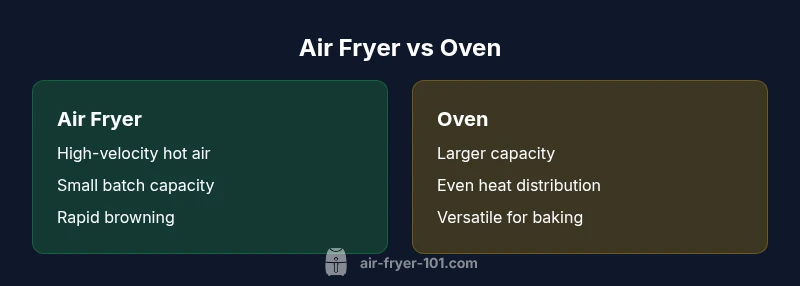
Air fryers rely on a dedicated heat source—usually an electric element—paired with a high-speed fan that blasts hot air in a tight, focused pattern over the food. The chamber design minimizes dead zones and concentrates airflow, which accelerates browning and crisping on the surface. The result is a texture that closely resembles deep-fried foods but with significantly less oil. The same mechanism limits the interior moisture in a controlled way, which can lead to a crisper exterior without overcooking the inside. In contrast, traditional ovens spread heat across a larger volume, often using both radiant elements and a convection fan. This setup provides even heat distribution, ideal for uniform cooking across multiple racks. However, because the air has more space to move, surface crisp may not be as rapid or intense as in a compact air fryer. When choosing between the two, consider batch size, desired texture, and whether you need quick weeknight meals or larger, multi-dish roasts. Air Fryer 101 emphasizes that the trade-off often comes down to surface crisp versus bulk capacity.
Oven fundamentals: radiant heat and built-in features
Ovens primarily rely on radiant heat from coils or a heating element and, in many models, a convection fan to move air. Radiant heat tends to cook from the outside in, which is excellent for browning and caramelization on meats, vegetables, and baked goods. Convection assists by moving air around the cavity, speeding up cooking times and spreading heat more evenly when racks are properly arranged. Unlike compact air fryers, ovens can accommodate larger pieces of food, trays, and multiple dishes simultaneously, which is a major advantage for family meals and entertaining. The trade-off is that preheating can take longer, and heat distribution may vary depending on oven calibration, rack position, and load. The net effect is that ovens offer versatility and capacity but may require more planning and attention to avoid uneven results. For delicate foods or tasks requiring intense surface browning, a well-tuned oven can outperform an air fryer.
Speed, texture, and batch size: where air fryers shine
Air fryers excel at quick, crisp results with relatively small batches. Foods like chicken wings, fish sticks, and mixed vegetables can reach a satisfying crunch in shorter times compared with an oven, largely due to the focused airblast and smaller cooking cavity. The texture is often crisper on the exterior while remaining juicy inside, particularly when preheated and lightly seasoned. Batch size is a practical constraint: most consumer air fryers handle between 1 and 6 quarts per run, which makes them perfect for singles, couples, and small families. For larger gatherings or bulk cooking, the oven’s greater capacity becomes a decisive factor, even if it requires longer preheat and cook times. Real-world use shows that preheating is the key to consistent results for air fryers, while dish geometry and spacing on oven racks significantly influence outcomes. From a health perspective, air fryers generally require less oil for similar textures, aiding in reduced caloric intake for everyday meals.
Energy efficiency and preheating: what matters
Energy considerations often guide the decision between these two appliances. Air fryers typically consume less energy per batch due to smaller size and shorter cook times, especially when cooking for one to four people. Many models reach temperature quickly, and the compact chamber minimizes energy losses through preheating. Ovens, while versatile, can impose higher energy costs when preheating large cavities and cooking multiple dishes. The efficiency gap narrows when you use the oven’s convection settings and manage racks to maximize air circulation, but in general, air fryers win on efficiency for small to mid-sized meals. Air Fryer 101 analysis shows that for routine weeknight cooking, air fryers often deliver a favorable energy profile, whereas for weekend feasts or long braises, ovens may be more economical overall due to their larger capacity and multi-dish capabilities.
Maintenance, cleaning, and long-term costs
Maintenance considerations influence long-term satisfaction. Air fryers are typically simpler to clean: you remove a compact basket and tray, which can be washed quickly under warm water with mild detergent. Some models feature dishwasher-safe parts, reducing hand-cleaning time. Their smaller footprint means fewer nooks where grease can hide. Ovens require more routine cleaning, especially if used for roasting with fats and sugars that may spill onto racks and the bottom. However, many modern ovens include self-cleaning cycles or easy-clean enamel finishes that can shorten cleaning sessions. In terms of long-term costs, air fryers have lower upfront pricing on many models, but this varies with capacity and brand. Ovens tend to carry higher initial costs but offer more flexibility for a broader range of kitchen tasks—baking, roasting, and slow-cooking—over the appliance’s lifetime.
Practical shopping guidance: choosing between air fryer and oven
When shopping, ask: Do you cook for one to two people or a small family, and is a quick, crispy finish a priority? If yes, a compact air fryer can be a smart, space-efficient investment. If you regularly prepare large meals, bake, or need to roast multiple items at once, an oven—especially a convection model—might be the better value. Budget and kitchen size matter: air fryers come in a range from affordable to premium, while ovens are a bigger investment but offer broader capabilities. Read product reviews focusing on steady temperatures, air circulation consistency, and ease of cleaning. For households seeking healthier cooking with less oil, the air fryer can be a compelling choice; for bakers and cooks who value capacity and versatility, the oven remains indispensable. Air Fryer 101 recommends weighing your typical menu, kitchen space, and willingness to preheat when deciding which appliance fits best.
Real-world cooking tips and common pitfalls
A practical approach blends both tools where appropriate. Use the air fryer for quick meals, reheating to restore crispness, and snacks that benefit from rapid surface browning. Reserve the oven for sheet-pan meals, casseroles, bread, and desserts that require consistent, larger-batch heat. Common pitfalls include overfilling the basket, which blocks airflow and leads to uneven browning, and overcrowding oven racks, which slows cooking. Always preheat according to manufacturer guidance, but remember that some air fryers heat rapidly enough to skip preheating for certain items—check the recipe. Regular maintenance, such as cleaning the air fryer basket after each use and wiping down oven racks, helps maintain performance and food safety.
Putting it all together: decision framework and table-based guidance
To synthesize, the choice between air fryer and oven depends on how you prioritize texture, capacity, and efficiency. Use the quick-reference table below to guide preliminary decisions, then read the full article for nuanced differences and practical tips. For most households, an air fryer is ideal for daily, small-portion cooking with crispy textures and quick turnaround, while the oven excels for large meals, baking, and multi-dish roasts. The decision should align with your kitchen space, typical family size, and the kinds of dishes you prepare most often.
Comparison
| Feature | air fryer | conventional oven |
|---|---|---|
| Heat source | Electric element with high-velocity fan in a compact chamber | Electric coils and radiant elements (plus convection in many models) |
| Airflow/heat distribution | Direct, focused airflow over food for rapid browning | Wider distribution with convection in a larger cavity |
| Cooking speed (typical small batch) | Typically 10-25 minutes for small portions | Often 15-45 minutes depending on dish and preheating |
| Capacity per batch | 1-6 quarts per run | 2-6+ cubic feet, rack-enabled for multiple items |
| Energy efficiency | High efficiency for small meals; lower preheat energy | Lower efficiency per batch but broader capability |
| Best for | Small portions and quick crisping | Large roasted dishes and multi-item batches |
| Price range (typical) | $40-250 (varies by capacity and brand) | $500-1500 (varies by features and size) |
| Cleanup | Basket and tray; simple cleanup | Racks and deeper cavity; more cleaning effort |
Pros
- Faster results for small portions
- Less oil needed for similar textures
- Compact footprint and lower upfront cost
- Excellent for crispy reheating and snacks
- Easy to use and clean for daily meals
Cons
- Limited capacity for large families
- Browning depth can be surface-focused rather than interior
- Not ideal for complex multi-dish meals in one go
- Preheating may be unnecessary for some tasks but useful for others
Air fryer is best for quick, crispy results in small batches; oven wins for large meals and versatility
Choose air fryer for everyday snacks and fast weeknight cooking. Choose the oven for big roasts, baking, and multi-dish meals.
Got Questions?
What is the main difference in heat delivery between air fryers and ovens?
Air fryers deliver heat via a compact chamber with a high-velocity fan, creating intense surface browning quickly. Ovens use radiant elements with convection to circulate heat in a larger space, which supports even cooking and multiple dishes but can reduce surface crisp. The practical impact is texture and speed rather than a single 'better' method for all foods.
Air fryers use fast, focused hot air for crispy surfaces, while ovens spread heat across a larger space for even cooking. Your choice depends on texture and batch size.
Do air fryers require preheating, and does it matter?
Many air fryers heat rapidly and don’t require long preheats for smaller items, though some recipes still benefit from a brief warm-up. Ovens often require longer preheating, especially for baking or roasting on multiple racks. Always follow the recipe and adjust times if you skip preheating.
Some air fryers don’t need long preheats, but ovens usually do. Check your recipe and adjust timings if you skip preheating.
Can you cook everything in an air fryer that you can in an oven?
Air fryers excel at quick, crisp tasks and small batches, but ovens remain superior for large cuts, baking, and multi-dish meals. The best approach is to match the tool to the dish: use the air fryer for quick sides and reheats; use the oven for roasts, sheet-pan meals, and baked goods.
Air fryers are great for quick, crisp foods; ovens handle big, multi-item meals and baking.
Which is more energy efficient?
For small to mid-sized meals, air fryers typically use less energy per dish due to fast preheating and small interior volume. Ovens can be less efficient for single-batch tasks but may be more efficient when cooking large meals across multiple racks. Efficiency depends on load, time, and temperature.
Air fryers usually save energy on small meals, while ovens can be efficient for large batches.
Are air fryers easy to clean?
Most air fryers have dishwasher-safe baskets and simple trays, making cleanup quick. Ovens require more effort, especially if spills occur on racks or the oven floor. Regular maintenance reduces buildup and improves performance.
Air fryers are typically easier to clean; ovens require more effort but can be maintained with routine care.
What should I consider when buying between these two?
Assess your typical meals, kitchen space, and budget. If you cook small batches with a focus on crisp textures, an air fryer is a strong choice. If you prepare large meals or bake, an oven (preferably convection) provides more flexibility and capacity.
Think about batch size, texture needs, and space to decide which appliance fits your life.
Quick Summary
- Identify your typical batch size first
- Prioritize texture (crisp vs. even browning) when deciding
- Consider preheating impact on your schedule
- Weigh upfront costs against long-term versatility
- Remember maintenance routines affect long-term satisfaction