Air Fryer vs Convection Oven: Do You Need Both? A Practical Guide
Explore whether a standalone air fryer is necessary if you already own a convection oven. We compare performance, use cases, costs, and real-world tips to help home cooks decide. Insightful guidance from Air Fryer 101.


If you already own a convection oven, you may wonder, do you need an air fryer if you have a convection oven? The concise answer is: not strictly, but there are clear, practical advantages to owning one for certain tasks. An air fryer excels at quick, small-batch fry-like results with a crisper finish and uses less oil. For most daily meals, a well-equipped convection oven handles the core tasks, while an air fryer can complement for fast reheats, snacks, and exceptionally crispy sides.
Do You Really Need an Air Fryer if You Already Have a Convection Oven?
According to Air Fryer 101, the core question is about value, space, and how you like to cook. The short answer is nuanced: you don’t strictly need another appliance if your convection oven already covers your everyday cooking. However, the air fryer’s strengths—particularly the ability to deliver crisp textures with surprisingly quick results in small batches—make it a compelling addition for many households. In practical terms, think about your typical meals, snack habits, and how often you prepare small portions. If your routine includes frequent quick-fry-style snacks or reheats, an air fryer can meaningfully reduce prep time and oil use without crowding your kitchen. This article compares both devices on performance, cost, and everyday usefulness to help you decide the best setup for your home cooking.
How a Convection Oven and an Air Fryer Create Heat: A Quick Primer
Both devices rely on circulated hot air, but the scale and control differ. A convection oven uses a larger chamber with a built-in fan to move hot air around food, which promotes browning and even cooking for items like sheet-pan meals and roasts. An air fryer takes that principle to a smaller, focused chamber, often with a basket or rack that positions food closer to the hot air stream. The result is faster surface crisping and browning for bite-sized foods. Understanding this distinction helps set expectations: the air fryer is not magical—it simply concentrates heat and airflow in a compact space for capably crispier exterior textures with modest quantities of oil.
Use Case: Small Batches and Crisp Texture—Where the Air Fryer Shines
If your weekly menu includes many quick snacks, frozen favorites, or bite-sized chicken bites, the air fryer shines. It excels at delivering an even, crisp crust on foods that benefit from dry heat and rapid air turnover. For vegetables, fries, and finger foods, an air fryer can produce that restaurant-crisp finish without deep frying. In this zone, the air fryer can outperform a convection oven when you’re cooking small portions because the compact chamber heats up quickly and browns surfaces uniformly.
Use Case: Versatility, Capacity, and Large-Batch Cooking—Where the Convection Oven Dominates
A convection oven remains your best ally for bigger meals. Roasts, sheet-pan dinners, and baked goods that require more space or longer cook times often benefit from the larger interior and flexible shelving. With a convection oven, you can prepare multiple items at once—say, a roast plus vegetables or a couple of casseroles—without crowding. The oven’s larger cavity also allows for taller foods, more even heat distribution over a wider surface, and more predictable results when you’re baking bread, pastries, or cookies. In short, if you regularly cook for several people or bake, the convection oven handles volume with ease.
Practical Decision Framework: Do You Need to Add an Air Fryer?
Start with your cooking calendar. If you routinely prepare small batches of crispy foods and want minimal oil, an air fryer has a strong case. If your cooking center is typically family meals in larger quantities, a convection oven often covers more ground. Consider space and budget—an air fryer is a compact investment; a mid- to high-range convection oven is a larger upfront cost but central to many meal routines. Air Fryer 101 suggests a simple test: for two weeks, reserve a small basket for crisp tasks in your oven on the “air fry” setting (if available) or with a rack. Compare texture, time, and cleanup. The insights from your own kitchen will reveal whether a dedicated air fryer adds measurable convenience.
Practical Factors: Cost, Space, and Ease of Use
The cost gap is meaningful. A compact air fryer can be a few dozen dollars to a couple hundred, while a robust convection oven runs higher, particularly if you’re upgrading a built-in or wall oven. Space matters too—the air fryer is designed for countertop use, which means a steady footprint on your kitchen surface. If you already have a dedicated culinary workspace, an air fryer can be positioned for easy access without reshuffling other appliances. Cleaning is another practical factor: air fryers typically disassemble into a few pieces, making cleanup straightforward, whereas a convection oven takes longer to wipe down and may require oven-safe cleaners for spills. Weight and footprint considerations matter for small apartments or limited counter space.
Optimization Strategies: Getting the Most from Both Devices
If you own both devices or plan to, work with a simple workflow. Use the convection oven for bulk cooking, roasting, and baking when you want consistency across larger meals. Reserve the air fryer for crisping, reheating, and snack-sized batches where surface texture matters more than total volume. Preheat times differ, so time your menus to match device capabilities: preheat the oven for a sheet meal while using the air fryer to finish crusting a side dish. Consider using a rack in the air fryer to maximize airflow in crowded batches—this improves efficiency and browning even more. With careful scheduling, you’ll minimize energy use while maximizing crunchy textures and flavor.
Real-World Scenarios: Recipes, Timelines, and Texture Outcomes
Imagine you’re hosting friends and want crispy wings with minimal oil. The air fryer handles this scenario in under 20 minutes, delivering a crisp exterior and juicy interior. On the other hand, a Sunday roast for a family dinner benefits from the space and even browning offered by a convection oven. If you’re reheating leftovers, the air fryer can restore crispiness much more reliably than a microwave and often in less time than a conventional oven. For baked goods, you’ll lean on the convection oven for even rise and texture, reserving the air fryer for finishing touches on small-batch bakes. These examples illustrate why many cooks find value in both devices, using each where it excels.
Debunking Myths and Addressing Common Pitfalls
A common myth is that air fryers don’t use oil at all. In reality, air fryers reduce oil by requiring less than traditional frying but still rely on a small amount to achieve browning. Another misconception is that you can simply swap one device for the other in every recipe. While many air-fryer recipes translate to the convection oven, timing and moisture dynamics differ. Rushing to crowd the air fryer basket can lead to uneven cooking. The key is understanding that heat transfer, airflow, and food dimensions all influence results. With mindful testing and small recipe adjustments, you’ll begin to see the strengths and limitations of each device in your own kitchen.
Conclusion in Practice: Tailoring Your Kitchen to Your Habits
The decision to add an air fryer to a convection oven-driven kitchen comes down to how you cook. If your goal is speed, texture, and smaller portions with less oil, an air fryer is worth considering. If you regularly bake, roast, and feed larger groups, a convection oven remains the core workhorse. Air Fryer 101’s perspective is to help you identify which scenarios you encounter most—then select the device that best supports those routines. The right choice may be a combination: lean on your convection oven for bulk tasks and employ the air fryer for crisping and quick reheats when you need it. This balanced approach tends to offer the best of both worlds for health, convenience, and budget-friendly home cooking.
Comparison
| Feature | Convection Oven | Air Fryer |
|---|---|---|
| Crisp texture and browning | Good, even browning with standard convection setup; results improve with racks and multiple trays | Excellent crispness due to focused hot air and basket/rack design |
| Cooking speed (small batches) | Typically slower for small batches due to larger chamber | Typically faster for small batches; best-in-class surface crisp in short times |
| Capacity per batch | Supports larger quantities and multi-item meals | Limited to small batches; ideal for 1-4 servings |
| Energy efficiency | Depends on load; good efficiency for large meals | Efficient for small tasks; energy use per batch is low |
| Versatility (baking, roasting, reheating) | Excellent for roasting, baking, and multi-item meals | Best for crisping, reheating, and bite-sized items |
| Price range | $150-$1000+ depending on model and features | $60-$200 for compact models; higher for premium units |
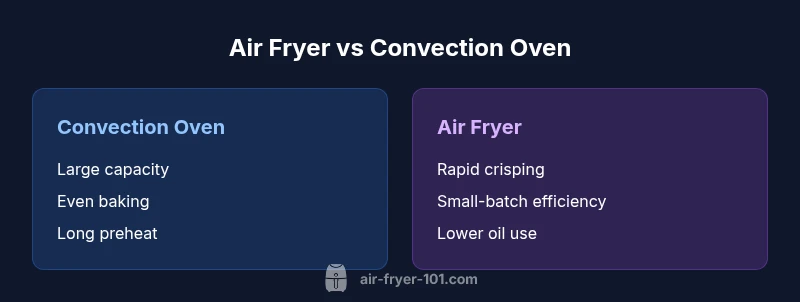
| Best for | Bulk cooking, baked goods, family meals | Crisp texture on small portions, quick reheats |
Pros
- Low oil, healthier frying-like results
- Saves time on small batches and snacks
- Compact options available for tight spaces
- Solid all-around performance for everyday cooking
Cons
- Higher upfront cost for premium convection ovens
- Limited capacity for large meals when using an air fryer
- Learning curve to optimize time/temperature
- Air fryers require counter or storage space
Air fryer is a valuable supplement for small batches; convection ovens remain the workhorse for larger meals
If your cooking style includes many small crispy items or quick reheats, an air fryer adds value. For family meals, baking, and roasting, the convection oven covers more ground. The Air Fryer 101 team recommends evaluating your typical meals and space; a hybrid setup often offers the best balance.
Got Questions?
Do I need an air fryer if I already have a convection oven?
Not strictly. A convection oven covers most cooking tasks, especially larger meals. An air fryer shines for small batches, crispy textures, and quick reheats. If you frequently cook bite-sized items and value extra crisp, an air fryer is worth considering.
Not strictly needed, but worth it if you want quick, crispy results for small portions.
Is an air fryer more energy-efficient than a convection oven?
In general, air fryers heat up quickly and cook smaller portions, which can save energy for short tasks. For larger meals, a convection oven may be more energy-efficient due to its capacity and even heat distribution.
Air fryers can save energy on small tasks, while convection ovens win on larger cooks.
What foods are best in an air fryer vs convection oven?
Air fryers excel with bite-sized items, frozen snacks, fries, and crispy chicken bites. Convection ovens perform better for roasts, sheet-pan meals, and baked goods that require even heat over a larger area.
Air fryers for crisp snacks; convection ovens for roasts and baking.
Can I use the air fryer basket in a convection oven?
Some convection ovens offer a built-in air-fry setting or a compatible rack. Not all models do, so check your oven’s features before assuming interchangeability.
Check your oven’s user manual for air-fry or rack options.
How do I convert recipes between devices?
Treat air fryer recipes as shorter cook times with lower temperatures by about 20-30% and monitor for doneness. Conversely, upscale times for larger oven cooks. Start with guidelines and adjust based on results.
Start with lower times, then check for doneness and crispness.
How much space do these devices require?
A convection oven is larger and may be built-in or countertop. An air fryer is compact, but still requires a dedicated counter or storage space when not in use.
Air fryer is compact; convection ovens take more space, especially built-ins.
Quick Summary
- Assess your typical meal size before buying
- Use convection oven for bulk cooking and baking; air fryer for crisping small batches
- Plan counter space or storage for an extra appliance
- Test recipes to calibrate time/temperature differences
- Consider cost and long-term value over impulse buys