Can You Bake Instead of Air Fryer? A Comprehensive Comparison
Explore when baking in a conventional oven can substitute for air frying. Compare texture, cook times, energy use, and best-use cases with practical tips for home cooks seeking healthier, affordable options.


Can you bake instead of using an air fryer? Yes, in many cases you can, but results vary. A conventional oven can substitute for air frying for larger batches and certain textures, while air fryers deliver faster, crispier results with less oil. Use baking when volume matters and convection helps approximate air-fryer airflow for crisper exteriors.
Can you bake instead of air fryer? When to choose the oven over the countertop appliance
You might be asking, can you bake instead of air fryer? This question surfaces frequently among home cooks aiming for healthier meals, budget-conscious kitchen planning, or limited countertop space. According to Air Fryer 101, many recipes that start in an air fryer can be adapted to a conventional oven by leveraging convection and proper rack positioning. The core idea is to match the outcome you want—crisp exterior, juicy interior, or even browning—with the oven’s larger cavity and different heat dynamics. This section sets the stage for evaluating when baking makes sense and when the dedicated air fryer remains the faster, crispier option.
The heat dynamics: how convection ovens compare to air fryers
Conventional ovens rely on radiant heat from elements and, in many models, a built-in convection fan. An air fryer is effectively a compact convection system with a higher air velocity relative to its chamber size, which accelerates moisture removal and surface browning. In practical terms, the oven’s airflow is slower and more diffused unless you use a convection setting and keep space around foods to allow for air movement. When you can optimize circulation—by using multiple racks in a convection oven, rotating trays, and avoiding overcrowding—you can approach the crisp exterior you expect from air frying, albeit often with a touch more time and attention to placement.
Texture outcomes: crispiness, browning, and juiciness
Crispiness in air frying comes from rapid hot-air contact and low moisture on the surface. In a traditional oven, achieving similar crispness depends on maximizing airflow, oil management, and surface contact. Foods that thrive in an air fryer—thin cuts, small bites, and items that benefit from an initial dry surface—can often be replicated in the oven with convection and a high oven rack. For thicker cuts or foods that rely on deep oil interaction for texture, you may notice a difference: the oven can still brown nicely but may not deliver the same dry, crackly exterior without additional steps, such as pre-drying or finishing under a broiler for a brief period.
Time and energy considerations: cook times and batch capacity
Ovens typically require longer preheat and cook times for similar batches compared to air fryers, especially for smaller portions. An oven also tends to heat up the kitchen more, which is a consideration in warm climates or small spaces. However, large batches roast more food per session, which can offset time spent on multiple air-fryer runs. Energy-wise, a conventional oven draws more power per hour, but you can cook multiple items at once and potentially reduce the total cooking sessions. Air fryers excel for quick, single-serving or small-batch crisping with minimal oil.
Food categories: what bakes well in the oven vs air fryer
Not all foods are created equal when swapping oven methods. Starchy snacks like french fries and chicken wings can adapt well to oven baking with convection, producing a crisp exterior and tender interior. Vegetables roast evenly in the oven when arranged in a single layer and turned halfway. Pastry-based items—cookies, scones, or small pastries—often fare better in a traditional oven with proper temperature control. It’s also common to reheat leftovers in the oven to restore texture more reliably than in a microwave, though timing varies by item and thickness.
How to translate air fryer recipes to oven instructions
To convert an air-fryer recipe for the oven, rely on convection when possible and preheat to a temperature that mirrors the air fryer’s heat, then adjust cooking time upward in smaller increments. Space items on a rack or two racks with breathing room, rotate trays halfway, and monitor doneness with a timer and visual cues. If your oven lacks a convection setting, consider broiling at the end to mimic a crisp finish or using a high-heat, low-moisture approach on the middle rack with a tray to catch drips. Remember that some recipes may require more oil or a shorter total cook time than a full bake, depending on the cut and moisture content.
Practical tips for better oven results that resemble air frying
- Use convection mode when available and ensure even spacing on racks.
- Preheat fully to its target temperature to minimize temperature sag during cooking.
- Lightly oil or mist foods to promote browning without excessive oil.
- Use parchment or a silicone mat to prevent sticking and promote even heat transfer.
- Flip or rotate items for uniform browning and use broil briefly at the end for crispness.
- If a recipe calls for a specific air-fryer temperature, start with a slightly lower oven setting and test for doneness sooner rather than later.
Decision framework: when to bake in the oven vs cook in an air fryer
When deciding between a bake in the oven or air frying, consider volume, texture preferences, and time sensitivity. For large batches or foods that benefit from slow browning and even roasting, the oven is a strong choice. For rapid crisping, small portions, and minimal oil, the air fryer wins. Use the oven if you need to roast a sheet-pan dinner for several people or when you want more even browning on a roast or vegetables across multiple trays. Favor the air fryer for quick, bite-sized snacks and dependable crispness with less fat.
Comparison
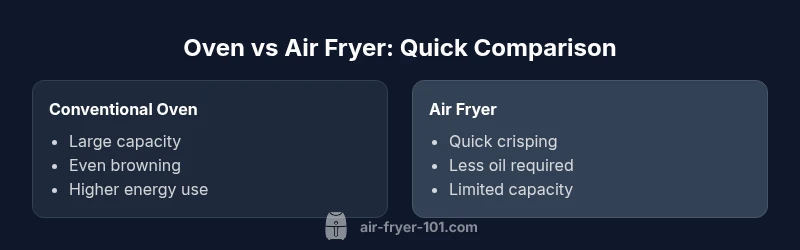
| Feature | Conventional Oven | Air Fryer |
|---|---|---|
| Texture outcome | More browning with convection; can be uneven if crowded | Crispy exterior with minimal oil; very consistent surface texture |
| Cook time (typical snacks) | Often longer due to preheat and batch size | Faster for small batches with quick crisping |
| Capacity/batch size | Large capacity; multiple racks possible | Compact; best for small batches |
| Energy use | Higher energy draw per batch but can cook more at once | Lower energy per batch; efficient for small servings |
| Maintenance/cleanup | Bigger trays; easier surface cleanup, oven racks cleaned periodically | Basket and insert require regular cleaning, but small parts are easy to reach |
| Best for | Baking, roasting, reheating in bulk | Crispy snacks, quick sides, single-serving meals |
Pros
- Supports large batches and roasting on multiple racks
- Uses familiar kitchen equipment (standard oven)
- Excellent for recipes that need even heat and browning
- No extra appliance to store if you already own an oven
- Convection setting can approximate air-fryer crispness with oil control
Cons
- Typically longer preheat and cook times
- Less consistent airflow without proper rack spacing
- Cleanup may involve heavier trays and oven racks
- Can heat up the kitchen more than a compact air fryer
Conventional oven baking is a viable substitute for many air-fryer tasks, especially for larger batches and even browning; air fryers remain superior for fast, crisp results.
If you need to cook a lot at once or prefer even browning across a crowd, the oven is a solid choice. If you crave quick, uniformly crispy bites with minimal oil, the air fryer holds the edge.
Got Questions?
Can I bake every dish in my oven to replace air frying?
Most air-fried dishes can be baked, but results vary. Crisp textures may require convection and careful air flow, while some items won't achieve the same exterior crisp without dedicated air-frying equipment.
Most dishes can be baked, but crispness will vary; convection helps, and some items won’t crisp up as much as in an air fryer.
Does baking save energy compared to air frying?
Energy use depends on batch size and duration. Ovens typically draw more power per hour, but you can cook larger quantities at once, which can offset multiple shorter sessions from an air fryer.
Energy depends on batch size; ovens use more power per hour, but you can cook more at once.
Which foods are best for oven baking instead of air frying?
Foods that benefit from even browning and larger surface areas, like roasts, sheet-pan vegetables, and larger chicken pieces, often perform well in the oven. Small, thin, or delicate items may crisp better in an air fryer.
Roasts and large veggies usually fare well in the oven; crisp, small items are often better in air fryers.
How do you convert air fryer recipes to oven times?
Start with convection if available, preheat fully, and monitor doneness with time checks and visual cues. If convection isn’t available, plan for longer bake times and possible finishing under broil for crispness.
Use convection when you can; test for doneness and finish under broil if you want extra crispness.
Is an air fryer faster for small portions?
Yes, air fryers usually cook small portions faster due to their compact size and high air flow. For larger meals, the oven’s capacity often wins in total time due to batch cooking efficiency.
Air fryers are quick for small portions, but ovens win when you’re cooking larger batches.
Can you bake and still get crispiness in a conventional oven?
Yes, with convection mode, proper spacing, light coating of oil, and finishing steps like brief broiling, you can achieve a crisp exterior similar to air frying.
Crispiness is possible with convection and finishing steps like broiling.
Quick Summary
- Assess batch size to decide between oven and air fryer
- Use convection and rack spacing to simulate air flow
- Expect longer cook times when using a traditional oven
- Crispiness benefits from surface dryness and careful finishing steps
- Consolidate cooking by batching multiple items in the oven when possible