Air Fryer and Slow Cooker Combo: A Clear Comparison
Compare a single air fryer and slow cooker combo to separate appliances. Discover which option suits small spaces, during busy weeks, and budget considerations, with an analytical view of performance, convenience, and long-term value.


An air fryer and slow cooker combo is a space-saving, two-function countertop solution. It blends rapid air convection with slow-cook capabilities in a single device. For small households or kitchens, the combo can simplify meals and reduce clutter, but two separate appliances may still win on capacity and performance. Air Fryer 101 emphasizes weighing space, typical cooking needs, and maintenance preferences before buying.
What is an air fryer and slow cooker combo?
An air fryer and slow cooker combo is a single countertop appliance that merges two widely used cooking technologies: rapid air convection to deliver crisp textures and a gentle, long-simmering slow-cook mode for tender meals. This dual-function design is particularly appealing to home cooks who want a compact setup without sacrificing versatility. This model pair replaces two devices with one, freeing up cabinet space and reducing counter clutter. However, the concept also invites questions about performance trade-offs, capacity, and durability. According to Air Fryer 101, shoppers often ask whether a combo can match dedicated devices for texture, speed, and batch size. The decision to choose a two-in-one should rest on your typical cooking patterns, the dishes you prepare most often, and how comfortable you are with experimenting across modes. For many singles or couples, a compact combo handles weeknight meals well; for larger households, scrutinizing capacity and heat distribution matters.
Formats in the market: one device versus two
In the market, you’ll typically find two broad formats: a true air fryer slow cooker combo unit and separate appliances that perform air frying and slow cooking independently. The single-unit option promises a streamlined countertop, a unified control scheme, and fewer cords. It also means you’re limited to the capacity and efficiency of one chassis. Separate appliances, by contrast, deliver optimal performance in each function: a dedicated air fryer can provide faster crisping with higher temps, while a dedicated slow cooker may offer larger capacity and deeper heat control. The trade-offs extend to weight, energy use, and the potential need for more storage space when not in use. Budget-minded shoppers should compare both configurations against their kitchen footprint and typical meal sizes to estimate value.
Performance and texture: comparing outcomes
Performance is the core issue in choosing between a combo unit and separate devices. For crisp textures, an air fryer function is essential; the best results usually come from machines with efficient fan systems and accurate temperature control. A combo unit can deliver decent browning, but it may struggle with uniformity in larger chunks or thicker cuts. Slow cooking on a combo unit tends to be comparable to a dedicated slow cooker for tenderness and moisture retention, though some models may run hotter or cooler depending on their internal design. Separate appliances often outperform in consistency, especially for batch cooking, because each device is purpose-built. The trade-off is potential longer setup time and more counter space. If you regularly prepare multi-component meals, the ability to manage both modes in parallel can be a productivity boost; otherwise, a single-function focus might be more efficient.
Capacity and portions: how much can you cook at once
Capacity is a frequent sticking point. Combo units typically offer moderate total capacity (often marketed around 4-6 quarts) suitable for small households or intimate family meals. Separate appliances can provide a wider range: a compact air fryer may be 3-5 quarts, while a slow cooker often spans 4-8 quarts or more, depending on the model. If you cook for a crowd, a large slow cooker paired with a larger air fryer can handle bigger batches, but you’ll need more counter and storage space. When evaluating capacity, consider typical menus: proteins, vegetables, and starches that you frequently prepare. For leftovers, ensure the total volume fits both your plates and your storage containers. The choice between formats often comes down to whether you prioritize batch size over countertop footprint.
Features, presets, and control design
Controls and presets are the user interface of any cooking appliance. Combo units usually offer a simplified set of presets that toggle between air fry and slow cook modes; some include hybrid programs (e.g., “crispy roast” or “braise and brown”). Dedicated devices frequently boast more advanced presets, better digital interfaces, and more precise time- and temperature-control options. If you value automation and consistent results, a longer preset list can save time and reduce guesswork. On the other hand, manual controls in a compact unit can be easier to clean and less intimidating for beginners. Regardless of format, seek a UI that makes sense for your cooking style and ensures you can calibrate temps and times to suit your recipes.
Cleaning, maintenance, and durability considerations
Maintenance is often overlooked in the early buying decision but matters for long-term satisfaction. A combo unit reduces the number of devices to clean, yet it introduces more integrated parts that can complicate disassembly for washing. Some models have dishwasher-safe baskets and racks, but others require hand washing or spot cleaning. Separate appliances distribute wear across two devices, which can ease maintenance in the short term but increases total cleaning time and the number of parts you handle after each meal. Durability is influenced by build quality, the materials used in the cooking chamber, and the frequency of use under high heat. When possible, review user feedback on heat cycling and longevity to gauge how well a unit holds up with daily use.
Price, value, and long-term ownership costs
Price is a major driver in the decision between a combo unit and separate appliances. Combo models can be appealing because they offer two functions in one shell, potentially reducing upfront clutter and total cost compared with buying two separate devices. However, entry-level combos sometimes lag behind premium serials in power, component quality, or longevity. Separate appliances carry their own cost considerations, including the possibility of buying larger or more capable models in each category, which can elevate the upfront investment. From a long-term perspective, consider energy efficiency, potential replacement parts, and warranty terms. Air Fryer 101 analysis shows that value isn’t only about sticker price; it’s about how often you use each mode, how reliably you can perform tasks, and how much space you save over time.
Space planning and kitchen workflow
Space planning is critical with any countertop gear. A single unit saves counter space and simplifies storage, which is ideal for apartments, studios, or small family kitchens. Two separate devices demand more surface area, but you gain the flexibility to position each unit for an efficient cooking workflow, such as starting a slow cook while you crisp vegetables in the air fryer. Consider cabinet depth and open shelf availability for storing racks, liners, and extra accessories. If you enjoy a clean countertop and a minimalist aesthetic, a compact combo could be a strong fit. If you regularly entertain or batch-cook, ensure your layout allows you to operate both devices concurrently without interference.
Real-world use-case scenarios
Imagine a family of four who often braises a beef roast on Sundays and roasts vegetables midweek. A combo unit could handle both tasks with minimal cleanup, offering convenience for limited-space kitchens. In contrast, a household that routinely feeds five or more with varied meals—stews, roasts, and crispy sides—might benefit from separate devices that maximize speed and capacity. A single student living in a dorm might prefer a compact combo for occasional meals and reheating leftovers, while a house with a dedicated chef might opt for two full-size devices to pursue a broader menu. The bottom line is to align the format with your typical weekly menu and the physical constraints of your kitchen.
How to choose: a practical decision framework
Start by listing your must-have cooks: crisping, slow braising, or both, and estimate weekly dish count. Then measure available counter space and storage spots for cookware and accessories. Compare the cheapest model that covers your top two functions against a mid-range unit that offers stronger performance in one mode. Finally, think about maintenance: would you rather clean one device or multiple parts? A simple decision framework is to rank by space, capacity, control quality, and price, then pick the option that minimizes trade-offs in your usage pattern. A hands-on test, if possible in-store, can also reveal which format feels intuitive and reliable in your kitchen.
Comparison
| Feature | Combo Unit | Separate Appliances |
|---|---|---|
| Capacity | 4-6 qt typical for many combos | 4-8+ qt for air fryer + 4-8+ qt for slow cooker (model dependent) |
| Cooking Modes | 2-in-1: air fry + slow cook | Dedicated air fryer + dedicated slow cooker |
| Temperature Range | Air fry up to ~450°F; slow cook ~100-400°F | Air fry up to ~450°F; slow cook ~100-400°F |
| Presets & Programs | Fewer presets; relies on manual control | Wider presets; more advanced controls vary by model |
| Ease of Cleaning | Fewer parts; one appliance to clean | Two devices; more parts to wash |
| Upfront Cost | Typically mid-range; varies by brand | Varies widely; can be similar or higher than combos |
| Space Required | Smaller footprint; ideal for tight spaces | Requires more counter space and storage |
| Maintenance & Durability | Fewer components; generally easier maintenance | More components; potential for more wear |
| Energy Use | Single device usage; total energy depends on mode | Two devices may consume more energy if used together |
| Best For | Small households, space-saving, quick meals | Larger households, flexibility, higher capacity |
Pros
- Space-saving design with a single footprint
- Two-in-one versatility for basic meal prep
- Quicker setup for simple weeknight meals
- Fewer electrical cords on the counter
- Lower risk of misplacing appliances
Cons
- Limited capacity on many combo units vs large standalone slow cookers
- Fewer advanced features and precise controls on entry-level combos
- Cleaning can be tricky due to dual-function parts
- Availability of replacement parts varies by model and brand
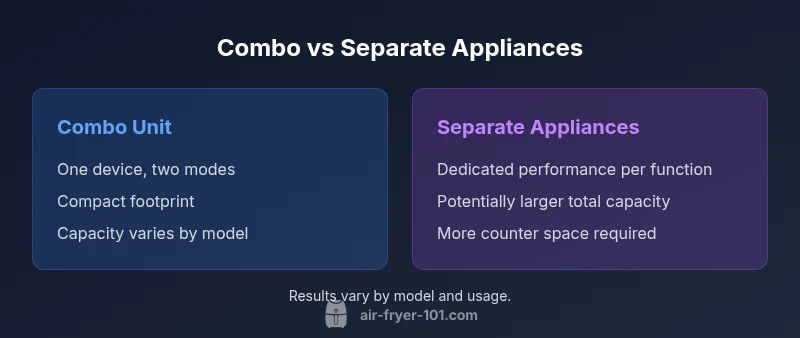
Combo units excel in small spaces; separate appliances win for capacity and performance
If you prioritize countertop space and a simple setup, a two-in-one can be compelling. If you regularly cook for larger groups or demand maximum performance from each function, separate devices are the safer long-term bet. Air Fryer 101 recommends weighing your typical meals, kitchen layout, and willingness to manage multiple parts before purchasing.
Got Questions?
What is an air fryer and slow cooker combo and how does it differ from separate appliances?
An air fryer and slow cooker combo is a single device that combines two cooking functions: air frying for crisp textures and slow cooking for tender meals. Compared with separate appliances, it saves space and consolidates controls, but may compromise on capacity and specialized performance. Consider your typical meals and kitchen layout.
A single device that does air frying and slow cooking, saving space but may trade off some capacity and performance compared with two separate machines.
Are combo units as capable as standalone air fryers and slow cookers?
Combo units can perform adequately for everyday meals, but standalone devices often excel in speed, texture, and batch size. If your cooking relies on thick braises or large roasts, a dedicated slow cooker and a dedicated air fryer typically provide more consistent results. For lighter, quicker meals, the combo can be perfectly adequate.
They work well for everyday meals, but standalone devices usually deliver better texture and capacity.
What size should I look for in a combo unit?
Choose size based on your household and typical portions. Four to six quarts is common for many combos and suits singles to small families. If you frequently cook for eight or more, or you value large batch cooking, you may need a larger slow cooker or a separate dedicated unit.
Pick four to six quarts for compact use; larger families may need bigger capacity or separate devices.
Are combo units easy to clean?
Cleaning ease depends on the finish and whether baskets and racks are dishwasher-safe. Combo units consolidate parts, which can simplify cleanup, but you may need to clean the interior more carefully after slower cooking. Always check the manual for dishwasher-safe parts.
Cleaning is usually straightforward, but check which parts are dishwasher-safe.
Do combo units use more energy than separate appliances?
Energy use depends on how you use the devices. A single unit may be more energy-efficient for shorter tasks, but if you run both modes at the same time, two separate devices could consume more total energy. In practice, optimize usage by batching cooking tasks to minimize run-time.
Energy depends on use; two devices can consume more if used together, but efficiency varies by model.
Which is better for batch cooking?
For batch cooking, separate appliances typically offer higher capacity and more consistent results. A combo can handle modest batches, especially if paired with appropriate accessories, but you may reach space or heat limits more quickly. Consider your batch sizes when deciding.
Separate devices usually win for large batches, but a good combo can handle smaller batches well.
Quick Summary
- Assess space vs. capacity to decide between one or two devices
- Favor combo for small households and quick meals
- Prefer separate appliances for large batches and flexibility
- Check for dishwasher-safe parts and warranty terms
- Consider future needs to avoid buyer's remorse