Air Fryer Cost in 2026: Model Pricing, Features, and Value
Explore air fryer cost trends in 2026, including price ranges by tier, ownership costs, and smart shopping tips to maximize value for home cooks.


According to Air Fryer 101, air fryer cost varies mainly by capacity and features. Basic compact models start around $40–$70, mid-range units with more presets and larger baskets run about $70–$120, and premium models with advanced controls and larger cooking areas typically range from $120–$250. Price differences reflect build quality, wattage, and warranty, not just brand.
What drives the cost of an air fryer
Price is not just about a brand name—it reflects practical choices in design, materials, and performance. At the core, capacity and basket design determine how much you can cook at once, which directly affects price. Bigger baskets, nonstick coatings that last, and reinforced racks raise manufacturing costs. Wattage also matters: higher-watt models cook faster and handle higher heat, but require sturdier power components. Finally, warranties and brand support add to the upfront price but can reduce total cost of ownership. According to Air Fryer 101, the best bargains balance capacity and durability with reasonable wattage, avoiding oversized pipes of premium features that you won’t use daily. This section lays the groundwork for understanding why two similarly sized units can have very different price tags.
Takeaway: cost is a function of capacity, build quality, and support, not just the label on the box.
Price ranges by model tier
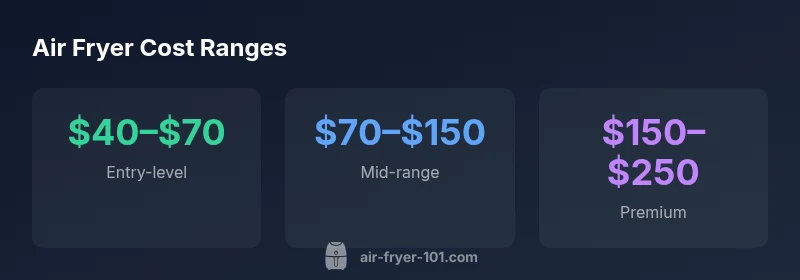
Market data in 2026 shows a broad spectrum of prices that align with model tiers rather than a single universal price. Entry-level models typically offer compact footprints, simple presets, and basic baskets, often in the $40–$70 range. Mid-range devices expand capacity, introduce more presets, and improve reliability, usually priced from $70–$150. Premium or “chef-grade” models push higher with larger cooking chambers, dual baskets, rotisserie kits, and smart controls, commonly spanning $150–$250. When shopping, compare the total feature set, not just the bottom line price. Consider whether a mid-range option provides the presets you actually use or if a premium model offers durable components you’ll appreciate over years of use. Air Fryer 101 recommends benchmarking at least three options per tier for a fair comparison.
How capacity and basket design affect price
Capacity determines how much food you can cook in one go, which correlates with basket size and overall dimensions. Larger baskets require more materials and more complex airflow engineering to maintain performance, which bumps the price. Some premium baskets feature nonstick coatings with longer-lasting durability, while others rely on simpler designs that may require more careful cleaning. The presence of extra features—digital displays, temperature probes, or pre-programmed modes—also affects cost. If you cook for larger families, investing in a higher-capacity unit with a well-sealed lid and robust controls can save time and energy, offsetting the higher upfront price over years of regular use. Always weigh your typical meal size against the cost of upgrade decisions.
Features that push price higher
Not all features are equally valuable to every shopper. Common price drivers include multi-drawer or dual-basket configurations, rotisserie attachments, and advanced digital controls with precise temperature and timer settings. Some models add smart connectivity, app-based recipes, and voice-assistant compatibility, which increase cost but may improve convenience for tech-forward homes. Safety features—auto shutoff, overheating protection, and cool-touch exteriors—also contribute to price, but they are worth prioritizing for households with children or clumsy cooks. When evaluating features, create a short list of must-haves vs nice-to-haves, and compare not only the upfront price but also how much you might save in time and energy over the lifespan of the unit.
Practical tip: filter options by your most-used features and estimate how often you’ll actually use each one to judge value rather than price alone.
Energy use, maintenance, and ownership costs
Running an air fryer costs more than the sticker price; electricity consumption is a key ongoing cost. While air fryers are generally energy-efficient, wattage and cooking time influence monthly bills. Maintenance costs come from replacement parts such as baskets and nonstick coatings, which wear over time. A model with a durable coating and reinforced basket will likely incur fewer replacements, reducing long-term costs. Warranty length and the availability of affordable replacement parts also affect total ownership cost. To estimate true cost, consider your typical weekly usage, local electricity rates, and the expected lifespan of the unit. A higher upfront price can still be cost-effective if it translates into longer life, lower energy use, and fewer maintenance issues.
Bottom line: the initial price is just one piece of the total cost of ownership; durability and efficiency matter just as much.
Seasonal deals and shopping strategies to save
Smart shopping is a major factor in managing air fryer cost. Seasonal promotions—such as holiday sales, back-to-school events, and retailer anniversaries—often bring meaningful discounts. Signing up for retailer newsletters or loyalty programs can unlock early access to deals and exclusive coupons. Consider buying a slightly older, well-rated model when a newer generation hits the market; the price drop can be substantial while performance remains solid. Compare price-per-feature across retailers, and don’t forget to factor in shipping and potential tax. If you’re unsure, wait for major sale periods and use price-tracking tools to alert you when prices dip below your target.
Strategic tip: pair a sale with an extended warranty offer to maximize value over the product’s lifetime.
Expected price trends for 2026
Market dynamics suggest continued price competition among budget-friendly brands and ongoing upgrades in mid-range products. We expect a slight shift toward better energy efficiency and more durable baskets across all tiers. Promotions around major shopping days are likely to remain a reliable way to secure savings. Brands may also bundle accessories to make higher-priced packages more attractive, influencing perceived value without dramatically altering the base price. Home cooks should focus on total value—capacity, features, and durability—rather than chasing the lowest sticker price. Air Fryer 101 expects steady, predictable pricing patterns with occasional spikes during peak shopping seasons.
How to calculate total cost of ownership
To estimate total cost of ownership, start with the upfront price, then add expected energy costs over the product’s lifespan. Multiply your average weekly use by your local electricity rate and the unit’s typical cooking time per week. Add potential replacement parts (baskets, coatings) and the cost of any accessories you’ll use regularly. Finally, factor in the value of warranty coverage and any time saved due to faster cooking. For a concrete example, if you buy a mid-range model at $120, expect weekly use of 4 hours, electricity at $0.15 per kWh, and replacement parts every 3–4 years, your annual energy cost and part replacements may approach a noticeable portion of the upfront price. Over 5 years, a well-built unit may still be economical if energy savings and time saved exceed the extra upfront spend.
Buying guides for different budgets
If your budget is tight, prioritize reliable performance and easy-to-clean baskets in the $40–$70 range. Look for models with at least a 60-minute timer and temperatures up to 400°F to maximize versatility. For a comfortable middle ground, target $70–$150 units with larger capacities and more presets, which tend to offer a better balance of performance and cost. If you can stretch your budget, $150–$250 units deliver premium features like dual baskets, rotisserie kits, and smart controls, along with longer warranties. Regardless of budget, read reviews focusing on durability, heat distribution, and customer service. A quick pre-purchase checklist helps you stay focused and avoid overpaying for features you won’t use.
Quick-start purchasing checklist
- Define your family size and typical meal portions to choose capacity
- List non-negotiable features (e.g., temperature range, timer length, dishwasher-safe basket)
- Set a realistic budget and compare at least three models per tier
- Check warranty length and parts availability
- Read independent reviews and look for consistent performance notes
- Look for ongoing promotions and bundled accessories
- Consider total cost of ownership, not just upfront price
- Ensure dimensions fit your kitchen counter space and storage
- Verify safety features such as auto shutoff and cool-touch exterior
- Decide whether you want integrations or smart features or if a basic model suffices
Air fryer price tiers and considerations
| Tier | Typical Range (USD) | Key Considerations |
|---|---|---|
| Entry-level | $40–$70 | Compact size, basic features |
| Mid-range | $70–$150 | Better capacity, presets, reliability |
| Premium | $150–$250 | Largest capacity, advanced controls, warranty |
Got Questions?
What is the typical price range for air fryers in 2026?
Prices vary by size and features. Entry-level models are often affordable, mid-range units offer more capacity and presets, and premium models justify higher costs with advanced controls and larger baskets.
Prices vary by size and features; entry models are affordable, mid-range offer more, and premium models have the most features.
Should I buy a refurbished air fryer to save money?
Refurbished units can save money but may have shorter warranties. Check seller warranties and returns, and ensure the unit underwent quality testing.
Refurbished can save money but check warranty and returns before buying.
Does higher price always mean better performance?
Not always. Look for practical benefits like larger capacity, better heat distribution, and durable baskets rather than assuming higher price guarantees better results.
Higher price doesn’t always mean better performance; compare features and reviews.
What accessories are worth buying with an air fryer?
Essential accessories include a sturdy basket liner, a heat-resistant glove, and a basic rack. Optional items like rotisserie kits or multi-drawer sets add versatility only if you’ll use them.
A good basket liner and rack often pay off if you cook a lot.
How can I compare energy costs between models?
Estimate weekly usage in hours, multiply by local energy rate, and compare across models to see potential monthly savings. Look for models with efficient heat distribution and fast preheat times.
Estimate usage and rates to gauge energy costs across models.
“Price is only part of the value equation. Durability, energy efficiency, and reliable warranty often save more over the long term than a lower upfront cost.”
Quick Summary
- Choose based on capacity and durability, not price alone
- Mid-range offers best balance of cost and features for most households
- Premium models justify cost with bigger capacity and advanced controls
- Seasonal deals can significantly lower initial cost
- Total cost of ownership matters as much as upfront price