How to Preheat an Air Fryer Without a Preheat Button
Learn how to preheat your air fryer even if there is no dedicated preheat button. Follow practical steps, safety tips, and model-agnostic guidance to achieve crisp, evenly cooked results.


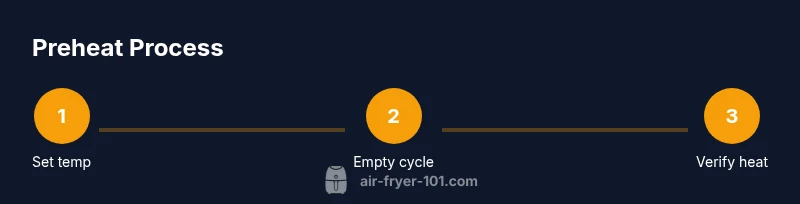
To preheat without a preheat button, set your air fryer to a typical preheat temp (360–400°F / 180–205°C) and run an empty cycle for 2–5 minutes. If your model shows a heat indicator, wait until it stabilizes; otherwise, rely on the timer. This method applies to most air fryers and reduces uneven cooking.
Why preheating matters and common myths
When you cook with an air fryer, preheating helps the hot air reach a consistent temperature quickly, resulting in even browning and crisper texture. According to Air Fryer 101, preheating is a simple trick with a big payoff for home cooks. If you are wondering how to preheat air fryer without preheat button, this guide shows practical methods that work on most models. Skipping preheat can lead to uneven cooking, longer times, and underdone interiors, especially with thicker foods. Even compact units benefit from a brief heat-up phase because the fan and heating element need to stabilize. Some myths persist: that preheating is optional, that it only matters for frozen foods, or that it wastes energy. In reality, a short preheat window aligns the internal temperature with the recipe's target, improving texture, juiciness, and overall results. We'll cover how to accomplish this safely, without a dedicated preheat button, and with equipment you likely already have in your kitchen.
For those asking how to preheat air fryer without preheat button, the core idea is simple: generate heat evenly before cooking, use a reliable time frame, and verify stability. Air Fryer 101 analysis notes that model variability exists, but the principle remains the same across brands. Remember to keep the interior clean and dry, and avoid adding food during the warm-up. This upfront effort pays dividends in texture and uniformity, especially for thicker or juicier cuts.
Tools & Materials
- Air fryer(Ensure it’s clean, plugged in, and the basket is empty before starting.)
- Timer or clock(To accurately track the preheat duration if your unit lacks a built-in timer.)
- Infrared or digital thermometer (optional)(Use to verify the interior air temperature if your model supports it.)
- Heat-resistant gloves (optional)(For safe handling when checking or loading hot components.)
- Parchment paper or silicone liner (optional)(Only if recommended by your model; do not block vents.)
- Rack or air fryer-safe tray (optional)(Helpful for evenly spacing food when starting to cook.)
Steps
Estimated time: 5-7 minutes
- 1
Power on and set a target temperature manually
On air fryers without a preheat button, turn on the unit and dial in a target preheat temperature. Common starting points are 360°F (180°C) for delicate items or up to 400°F (205°C) for thicker foods. The exact choice depends on your recipe and model limits. Ensure the basket is empty and the interior is clean to avoid flavor transfer or uneven heating.
Tip: Always consult your user manual for the model’s maximum safe temperature and recommended ranges. - 2
Start the empty cycle to begin heating
Press Start or the equivalent button to run an empty cycle for 2–4 minutes at the selected temperature. This phase allows the heating element and fan to reach stability without food obstructing airflow. Do not add food during this phase, as it can prevent even heating and skew results.
Tip: If your unit uses a timer dial, set it to 2–4 minutes and listen for a steady fan hum indicating consistent air movement. - 3
Verify heat stability if your model has indicators
Many air fryers include a heat indicator or preheat progress bar. Wait until the indicator confirms the target temperature is reached. If there’s no indicator, rely on the timer duration and the feel of consistent warmth inside the chamber.
Tip: If you’re unsure, extend the preheat by 30–60 seconds and reassess before loading. - 4
Pause briefly before loading food
After preheating, close the basket and let the unit rest for 20–30 seconds. This helps stabilize airflow and temperature, reducing the chance of a temperature drop the moment you add ingredients.
Tip: Keep the basket level when loading to avoid shifting items and blocking airflow. - 5
Load food and start cooking
Place food in a single layer with space between pieces for optimal air circulation. Begin cooking at the recipe’s lower bound and monitor doneness, then adjust time as needed for your model and batch size.
Tip: Shake or turn items halfway through to promote uniform browning and prevent sticking. - 6
Finish and cool safely
When cooking is complete, unplug and allow the unit to cool. Wipe the interior with a damp cloth once cooled to prevent residue buildup, then store accessories safely.
Tip: Regular cleaning after each use preserves performance and extends the appliance’s life.
Got Questions?
Do all air fryers require preheating?
Not all models require preheating, especially newer, high-heat units. However, preheating often yields crisper textures and more even cooking, particularly for thicker foods or recipes that rely on a quick sear.
Some models don’t need it, but most cooks get better texture with a short warm-up.
Is preheating necessary for frozen foods?
Preheating can improve exterior crispness on frozen foods by starting with a hot chamber. If you’re in a rush, you can cook from frozen, but results may vary and you might need to adjust time.
It helps, but isn’t mandatory for every frozen item.
Can I preheat with a full basket or tray?
No. A full basket blocks airflow and prevents proper preheating. Preheat with an empty basket, then load in a single layer.
Always preheat with an empty basket first.
How do I know when it’s actually preheated?
Look for a built-in heat indicator or rely on a timer based on your model’s typical preheat duration. If your unit lacks indicators, a 2–4 minute empty run is a safe benchmark.
Use either the indicator or timer to confirm heat before cooking.
Will preheating affect cooking times?
Yes. Preheating often reduces overall cooking time and helps achieve even browning. Expect a slight reduction in cook time once preheating is established.
Preheating can shave a few minutes off total cook time.
Should I preheat every time I cook, or only for certain foods?
Preheating is most beneficial for items that benefit from quick searing and even heat, like meat, potatoes, or bread. For many vegetables or reheats, a shorter preheat or skipping it may be acceptable depending on your recipe.
Choose based on the dish and paste the guidelines from your manual.
Quick Summary
- Preheat by simulating heat with a manual target and empty cycle
- 2–5 minutes of preheat is typical across many models
- Verify stability with indicators or time, then load food
- Keep the basket clean and avoid overcrowding for best results
- Regular post-use cleaning supports reliable preheating in future cooks