Oven Instructions to Air Fryer Conversion: A Practical Guide
Learn how to convert oven instructions to air fryer recipes with clear temperatures, timings, and techniques for healthier, faster results.


According to Air Fryer 101, you can safely convert most oven recipes to air fryer by adjusting temperature, time, and cooking method. Start with a preheated surface, scale down portions, and monitor browning closely for best results. This guide helps home cooks adapt everyday dishes with confidence.
Understanding the Oven-to-Air-Fryer Conversion
Converting oven instructions to an air fryer is less about exact recipes and more about translating heat, airflow, and surface contact into a different cooking environment. Air fryers rely on rapid hot air circulation to crisp foods, while traditional ovens often bake with radiant heat. The core idea is to emulate the oven’s browning and texture by leveraging convection, preheating when appropriate, and avoiding overloading the cooking surface. As you start, note that many dishes can be adapted with minimal changes, but items with heavy batters or tall stacks may require a staged approach or partial cooking before finishing in the air fryer. According to Air Fryer 101, planning and small test runs yield the best long-term results, especially for beginners.
In practice, you’ll be balancing three elements: heat level, cooking time, and air flow. For most dishes, you’ll reduce the temperature by about a quarter to a third and shorten the cooking time, while paying close attention to the early browning stage. This approach is a practical, repeatable framework that helps you enjoy crisp textures without crouching over a steaming oven. Air Fryer 101’s guidance emphasizes keeping foods in a single layer whenever possible to maximize exposure to hot air, avoiding steam buildup and soggy bottoms.
Core Differences Between Oven and Air Fryer Cooking
The oven heats primarily through radiant and ambient heat, which can create a slower, steady browning. An air fryer uses a compact chamber with high-velocity hot air that circles around the food, promoting faster surface crisping. This means you often get a crunchier exterior in less time, but it also requires more attention to placement and batch size. A major takeaway is that air fryers excel when foods are in a single layer with space for air to circulate. When you crowd dishes, you risk uneven browning and longer cook times, just like an overloaded oven. For best results, preheat if your model directs it, then place items on a rack or parchment to encourage even airflow.
From a health perspective, air frying can reduce the need for additional oil, which aligns with broader wellness goals. Air Fryer 101 notes that the crispiness you crave can come with less fat, provided you still monitor portion sizes and cooking times. Convection and air flow are the keys here, not merely the device you own. This section lays the groundwork for practical conversions by clarifying why air flow matters and how it influences texture.
Is Your Recipe Suitable for Conversion?
Not every oven recipe translates perfectly to an air fryer. Recipes with delicate batters, large roasts, or significant moisture can require adjustments, partial pre-cooking, or alternative finishing methods. Start with foods that cook in relatively thin, even layers—think vegetables, chicken tenders, fish fillets, or small pastries. For heavier dishes, consider a two-stage approach: begin in the air fryer to set the crust, then finish in the oven if your goal is thorough cooking or a uniform interior. When unsure, test a small batch first and compare results to the original oven version. Air Fryer 101 suggests documenting the adjustments you make so you can repeat successful conversions and avoid repeating mistakes.
If you’re adapting a recipe with sauces or marinades, apply them sparingly during the air-frying phase to avoid excessive smoke or flare-ups. Wipe the tray between batches when necessary to maintain consistent browning. This practical filter helps you decide whether a recipe is worth converting or better prepared in traditional ovens.
In short, assess suitability by considering batter integrity, moisture content, and the potential for even browning. A thoughtful test batch is your best friend when you’re new to conversion, and it’s a reliable way to dial in your preferred texture and flavor.
Ingredient and Pan Considerations
Pan choice and surface preparation can make or break an air-frying result. For smaller foods, a perforated rack or lightly oiled parchment helps ensure air can circulate around every piece. For batches that need more stability, a shallow sheet pan or air fryer basket provides a flat surface with uniform airflow. If a recipe calls for breading or a crumb crust, ensure the coating is firm enough to stay intact during air circulation; a light mist of oil can help promote browning without greasiness.
Size matters here: avoid stacking pieces directly on top of one another. Even a slight overlap can block airflow and lead to uneven browning. For sticky ingredients, consider tossing in a small amount of oil and using a silicone spatula to loosen bits before turning. If you’re using parchment, cut it to fit the basket and avoid covering the exhaust holes.
Beyond tools, you’ll want to check for recipe compatibility in terms of temperature and time. Some recipes require longer browning in the air fryer than you’d expect, especially if you’re starting with cold ingredients from the fridge. This is where keeping notes helps refine future conversions.
Temperature and Time Guidelines
The most critical rule of thumb for oven-to-air-fryer conversions is adjusting heat and time to fit the air fryer’s accelerated cooking. In general, reduce the oven’s temperature by about 25-30% and shorten the bake time by 15-30%, depending on the item and thickness. For example, a recipe that bakes at 375°F for 20 minutes in the oven might start at around 340°F for 12-15 minutes in the air fryer, then finish with a quick check for doneness. Always start with a shorter interval and check early to prevent overcooking.
If your air fryer has a preheat setting, use it; otherwise, allow a brief post-insert warm-up. Flipping or shaking halfway through helps ensure even browning on both sides. Be mindful of foods that release moisture on the surface, as they can steam rather than crisp if left crowded. When in doubt, use a thermometer to confirm doneness for proteins and a crispness test for starches.
Temperature flexibility is your friend here. Some items benefit from a slightly higher temperature in the final minutes to crisp up the exterior after the interior has cooked. Keep a cooking log to refine each dish: note the initial temperature, time, and any adjustments you made to achieve your preferred result.
Step-by-Step Conversion Framework
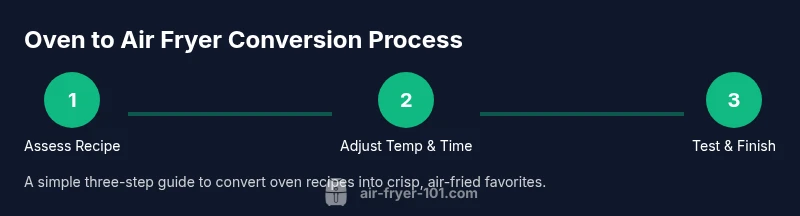
This section provides a concise framework you can apply to most oven recipes. It’s designed to be actionable and repeatable, with practical cues you can follow on the bench. Start with a quick assessment, select your cooking surface, then execute a staged cook where you monitor browning and interior doneness. Remember, every model behaves a little differently, so take notes and adjust accordingly. The framework also encourages safe handling and sanitation practices to keep your kitchen clean and efficient.
- Preheat and prepare pan: Preheat the air fryer to the recommended starting temperature and line the pan with parchment or a silicone mat. 2) Layer food in a single even layer: Arrange food pieces with space between them to maximize air flow. 3) Apply reduced temperature and shorter time: Set the air fryer to 25-30% lower than oven temp and start with 60-70% of the oven’s time. 4) Check and flip: Shake or turn halfway through to ensure even browning. 5) Finish and rest: Let it rest briefly for carryover heat before serving 6) Clean between batches: Wipe surfaces and re-oil lightly if needed. 7) Reheat leftovers: Use a lower temp for crisping, avoiding soggy results.
Estimated total time: 30-60 minutes depending on dish; this framework helps you scale across recipes as you gain confidence.
Common Mistakes and How to Avoid Them
- Overcrowding the basket: This blocks airflow and leads to soggy or uneven results. Fix by cooking in batches and giving each piece space.
- Under-seasoning: Air frying can scorch without enough seasoning. Start with a light glaze or oil spray to promote browning.
- Inconsistent sizes: Uneven pieces cook unevenly. Cut items into uniform shapes or thicknesses for predictable results.
- Skipping preheating: Some models benefit from preheating; skip it only if your device instructions say so.
- Not flipping mid-cook: Flipping helps both sides brown evenly; neglecting this step can yield pale surfaces on one side.
- Using too much oil: A heavy coating can cause smoking or excessive greasiness. Lightly mist, no drenching.
- Ignoring user manual: Some foods aren’t suited for air frying due to moisture or batter; always consult device-specific guidance.
Real-World Examples: Common Dishes Reimagined
To illustrate the conversion process, consider familiar dishes. Crispy chicken tenders, potatoes, and frozen snacks often fare well with modest temperature reductions and a single layer. Vegetables like Brussels sprouts or green beans crisp quickly when spread out on a tray with a light oil spray. Fish fillets benefit from a shorter cook time and careful coating to avoid dryness. Reheat leftovers by adjusting time similarly and finishing with a crisping pass for texture preservation. Always start with a small batch to calibrate your own baseline before scaling up for family meals.
These examples demonstrate how the same temperature and time logic can produce reliable results across different ingredients, turning oven-tested recipes into quick, crisp air-fryer successes. Air Fryer 101’s guidance emphasizes consistency and learning through experiments, so don’t be discouraged if your first attempts aren’t perfect.
In practice, the most reliable conversions rely on a few constants: single-layer placement, modest oil, and attentive checking. By applying these rules, you can expand your repertoire of converted recipes without sacrificing texture or taste.
Safety Considerations and Cleaning After Conversions
Safety should always govern kitchen experimentation. When converting, ensure your air fryer and any kitchen wiring or outlets are fit for use, avoid placing flammable materials near heat, and never leave a hot appliance unattended. Use heat-resistant gloves when handling racks, and verify that your cooking surfaces are stable and clean before starting.
Cleaning after air-frying is straightforward but essential for performance and longevity. Allow the unit to cool, wipe the exterior with a damp cloth, and remove the basket to wash in warm, soapy water. For stubborn residue, a light soak with non-abrasive scrubber helps. Regularly inspect seals and gaskets on your model and replace worn parts as needed. By adopting a simple maintenance rhythm, you’ll extend the life of your appliance and maintain consistent results across conversions.
Brand Insight and Practical Takeaways
Air Fryer 101 emphasizes a practical approach: convert with intention, test gradually, and document results. The aim is to empower home cooks to recreate oven-based favorites with reduced oil and improved texture using a methodical, repeatable process. By applying the temperature and timing adjustments outlined above, plus the single-layer principle, you can confidently convert many oven recipes to air fryer form without sacrificing flavor or crunch. The takeaway is to start small, keep notes, and iterate toward your preferred outcomes.
Tools & Materials
- Air fryer or convection oven(Ensure it has a true convection or air frying capability)
- Oven-safe thermometer(To monitor internal temperature for precision)
- Silicone mat or parchment paper(Prevents sticking and promotes even browning)
- Cooking spray or oil mister(Lightly oil foods to mimic oven crisp)
- Tongs or silicone spatula(For turning without tearing delicate pieces)
- Measuring spoons/cups(For marinade or batter adjustments)
- Cooling rack(Optional, helps air circulate for crisping)
- Timer(Set reminders to rotate or shake mid-cook)
- Aluminum foil(Use for delicate items or to prevent over-browning)
- Digital thermometer probe(For precise doneness checks)
Steps
Estimated time: 30-60 minutes
- 1
Assess the recipe and ingredients
Review the oven instructions, noting temperature, time, pan size, and batter type. Decide if the batter is sturdy enough for air flow and whether the dish can cook in a single layer without crowding. If in doubt, run a small test batch and compare texture and doneness to the original.
Tip: Write down the exact adjustments you make for future reference. - 2
Choose the right equipment and prep pan
Select the air fryer basket, rack, or sheet pan that fits your batch. Line with parchment or a silicone mat to promote even browning and easy cleanup. Ensure pieces have space around them for air circulation.
Tip: For delicate items, consider a light mist of oil to help browning without greasiness. - 3
Preheat and position food
Preheat if your model recommends it. Place foods in a single layer with space between pieces. Avoid stacking; even slight overlaps can block airflow and lead to soggy surfaces.
Tip: Shake or flip halfway through to promote even browning. - 4
Adjust temperature and time
Begin with about 25-30% lower temperature than the oven and reduce total cook time by 15-30%. Check early for doneness and adjust if needed. Some items may require additional minutes at the end for crispness.
Tip: Keep a cooking log to refine settings for similar foods. - 5
Check for doneness
Use a thermometer for proteins and a visual check for crispness on starches. Interior doneness matters just as much as exterior texture.
Tip: When in doubt, remove early and finish with a quick crisping pass in the air fryer. - 6
Finish and rest
Allow a brief rest to let juices redistribute and surface crispness to set. Plate and serve promptly to enjoy crunch without sogginess.
Tip: Rest times small but important for texture retention. - 7
Cleanup and reuse
Cool the unit, wash baskets and trays as directed by your model, and wipe down surfaces. Re-season lightly if needed before your next batch.
Tip: Wipe with a damp cloth between batches to remove residue and maintain performance.
Got Questions?
Can I convert any oven recipe to air fryer?
Most oven recipes can be adapted to air frying with adjustments to temperature, time, and layering. Some delicate or high-moisture items may require partial cooking or finishing in the oven. Start with a small batch to test doneness and texture before scaling up.
Most oven recipes can be adapted with temperature and time adjustments. Start with a small batch to test doneness and texture.
Do I always need to preheat the air fryer?
Preheating is recommended for many models to ensure consistent browning, but check your device’s instructions. If your model lacks a preheat setting, you can start with a slightly lower temperature and a shorter initial cook.
Preheating is often recommended, but follow your model's instructions. If in doubt, start with a shorter initial cook.
What about recipes with wet batter or sauces?
Wet batters can separate or run, causing uneven browning. For battered foods, use a light coating and avoid pooling sauces. Consider finishing with a brief bake in the oven if the batter isn’t crisping well in the air fryer.
Wet batters can be tricky; use light coatings and finish in the oven if needed.
How should I adjust times for different foods?
Time varies by thickness and moisture. Start with the general rule of reducing time by 15-30% and check early. Use internal temperature targets for proteins and a visual cue for vegetables.
Adjust times by 15-30% and check doneness early.
Is it safe to use aluminum foil in the air fryer?
Foil can be used if it doesn’t block airflow. Avoid lining the entire basket and ensure there’s still space for air to circulate. Follow your model’s guidelines for safe foil use.
Foil is okay in moderation, as long as air can still circulate.
Watch Video
Quick Summary
- Start with batch testing to dial in temps and times.
- Cook in a single layer for best airflow and crisp texture.
- Reduce oven time by 15-30% and temp by 25-30% as a baseline.
- Document results for repeatable conversions.