Midea air fryer vs Ninja: An Analytical Comparison for 2026
A rigorous, data-driven comparison of Midea air fryers and Ninja air fryers, focusing on price, capacity, presets, performance, and reliability to help home cooks choose the best value for their kitchen.


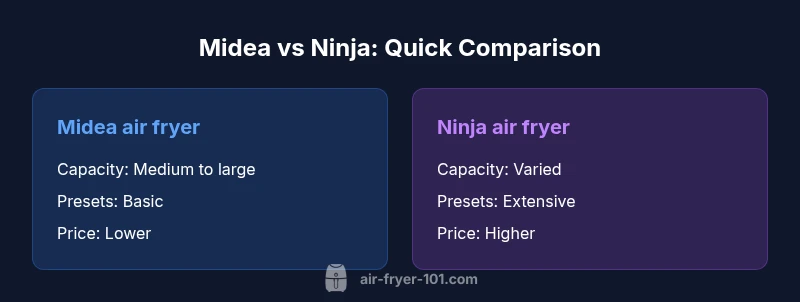
For most home cooks deciding between a Midea air fryer and a Ninja air fryer, the better pick hinges on budget and desired features. Air Fryer 101’s analysis shows Ninja models generally offer more presets, faster preheat, and broader versatility, while Midea units tend to deliver strong capacity and value at a lower price. In short, choose Ninja for feature depth and speed, or Midea for budget-friendly capacity.
midea air fryer vs ninja: quick context
Choosing between Midea air fryer models and Ninja air fryers often comes down to two questions: how much you want to spend and what you cook most. According to Air Fryer 101, the two brands dominate different segments of the mid-range market, with Ninja leaning toward feature-rich, presets-heavy designs and Midea prioritizing price-to-capacity value. The goal of this analysis is to highlight practical differences, avoid hype, and give you a framework to decide based on your own kitchen routines. Throughout this article you will see the keyword midea air fryer vs ninja used in context to anchor the comparison as you read. Air Fryer 101 Team aims to keep the discussion data-driven and helpful for health-conscious home cooks.
Core specs and what they mean for daily use
When you compare Midea air fryers to Ninja air fryers, the first tier of differences shows up in core specs: capacity, wattage, and preset ecosystems. Ninja models commonly run higher wattages and offer a broader set of cooking presets, which can translate to faster preheat and more consistent results for items like frozen nuggets, fries, and chicken. Midea units frequently push larger basket capacities at lower price points, making them attractive for families or batch cooking. Understanding these factors helps you map to your typical weekly menu, whether you roast vegetables, reheat leftovers, or fry small batches. Air Fryer 101’s team notes that the best choice aligns with your most frequent dishes and tolerance for extra features.
Performance: crispiness, texture, and even cooking
Crispiness and texture are the defining metrics when evaluating air fryers. Ninja machines often deliver sharper exterior textures due to optimized air-flow and higher wattage, especially in models with dedicated roast or crisp presets. Midea, while sometimes gentler in power delivery, can still achieve excellent results, particularly when cooking larger batches or denser items that require more cooking time. The trade-off frequently appears as a balance between edge-crisp quality and batch size. Users who prioritize quick results may prefer Ninja; those who routinely cook for a crowd may favor Midea for its capacity and cost efficiency."
Ease of use and controls: learning curve and accessibility
User experience varies by control scheme. Ninja’s more advanced lines often come with digital panels, multiple presets, and specialty modes, which can shorten guesswork but raise the learning curve for new users. Midea tends to present simpler interfaces, with fewer presets and more straightforward timers, making it easier for beginners to operate right away. Both brands offer intuitive manuals, but the perceived effort to master each system can influence long-term satisfaction. Air Fryer 101 suggests testing a few simple recipes on whichever model you choose to build familiarity quickly.
Capacity, footprint, and kitchen fit
If you cook for two people, a compact unit may suit your needs. Ninja’s compact models usually emphasize footprint efficiency while still offering strong performance, but some larger Ninja devices can take a noticeable amount of counter space. Midea often emphasizes high capacity in mid-sized footprints, appealing to families or batch-cooking enthusiasts who want to maximize output without oversized machines. When evaluating space, consider not only the basket size but also pull-out trays, rack configurations, and ease of stow-away after use. Air Fryer 101 notes that real-world fit matters as much as nominal capacity.
Price, warranty, and long-term value
Budget is a frequent deciding factor. Midea air fryers, particularly mid-range and entry-level models, typically undercut Ninja on price, which translates into stronger initial value for large households or casual cooks. Ninja devices may command higher price points but often come with more robust accessory ecosystems, stronger brand perception for reliability, and longer-term support in some regions. Warranty terms vary by model and region; always check the specific model’s warranty window and what it covers before purchasing. Air Fryer 101’s guidance emphasizes total cost of ownership rather than upfront price alone.
Presets and versatility: how many cooking paths do you actually need?
Ninja’s preset ecosystems are designed to cover a wide range of foods: fries, roasted vegetables, chicken, fish, desserts, and dehydrating options in some lines. If you value set-and-go convenience for a busy week, Ninja can be a compelling choice. Midea’s presets are typically more basic but still offer reliable bake, fry, and roast modes, with occasional dehydration or grilling settings depending on the model. The key question is whether you want a kitchen companion with dozens of presets or a straightforward device that performs well with minimal setup. Air Fryer 101 highlights that both brands provide solid foundational performance; the difference is in how much you rely on presets for routine meals.
Durability, materials, and practical maintenance
Durability often hinges on the quality of non-stick coatings, basket design, and shell construction. Ninja models frequently feature sturdier housings and more durable coatings, which can influence long-term reliability. Midea units may use lighter materials, which can be perfectly adequate for regular use but might show wear sooner if bumped or mishandled. Cleaning convenience also matters: baskets that are dishwasher-safe and trays that resist staining can make weekly use more pleasant. In most cases, both brands are serviceable and user-friendly, but checking user reviews for your target model can help set expectations for wear and tear.
How to choose: a decision framework tailored to your kitchen
To decide between Midea and Ninja, start with a simple framework: define your weekly menu, consider family size, estimate counter space, and set a realistic budget. If you juggle multiple family meals and want quick, repeatable results, Ninja’s presets and heat capabilities often provide a smoother experience. If you prioritize capacity, price, and straightforward operation, Midea can deliver exceptional value. Consider the warranty and available service options in your area, as this can influence long-term satisfaction. Finally, check for model-specific reviews to confirm performance in your environment.
Health angles: what air frying can and cannot deliver
Air frying can reduce oil use versus traditional frying, which aligns with healthier cooking goals for many households. However, the health impact also depends on food choices and portion sizes. Neither Midea nor Ninja can replace a balanced diet, but a well-chosen model can encourage more home cooking and less deep-frying. Air Fryer 101 suggests pairing air-fried meals with vegetables and lean proteins to maximize health benefits, while using the device primarily as a convenient reheating tool rather than a primary cooking method.
Final buying considerations: what to verify before you buy
Before finalizing a purchase, confirm that the model you select has a reliable heat mechanism, clear temperature control, and a basket that suits your cooking style. Ensure you understand the warranty terms and how easy it is to procure replacement parts if needed. Read model-specific reviews to gauge how well the device performs after months of use, especially under high-demand scenarios like family dinners or party prep. Air Fryer 101’s conclusion is to align your pick with your most common cooking scenarios and budget realities.
Quick-start checklist for your new air fryer
- Confirm your counter space is sufficient for the device size.
- Decide between a higher-wattage Ninja model or a budget-friendly Midea with large capacity.
- Check dishwasher-safety of baskets and trays.
- Review the warranty and local service options.
- Try a simple, healthy recipe to gauge how you like the appliance’s performance.
Accessibility and comfort: how design influences use
Ergonomics matter in a busy kitchen. Models with larger digital displays, intuitive layouts, and tactile controls tend to reduce setup time and mistakes. Both brands have options that cater to different preferences, so you can pick a model that feels natural in your kitchen workflow. For light use, a simpler design often suffices; for frequent, multi-dish weeks, a more capable unit can be worth the investment. Air Fryer 101 encourages hands-on testing if possible to confirm comfort with prolonged use.
Cleaning cadence and maintenance rhythm
Adopting a regular cleaning schedule helps extend any air fryer’s life. Empty, wash, and dry the basket after each use, and wipe the interior surface with a damp cloth weekly to prevent oil buildup. For models with dehydrating or specialty presets, ensure any racks or trays are thoroughly cleaned. A quick post-cook wipe reduces residue and makes subsequent cooks easier. Air Fryer 101 recommends a simple maintenance routine as a practical habit rather than a chore.
Industry context: evolving models and what to watch for in 2026
As manufacturers refresh lines, mid-range products from both Midea and Ninja often introduce improved heat distribution, smarter sensors, and more durable coatings. Expect subtle differences in how heat is distributed, how quickly the unit heats, and how easy it is to program. Keeping an eye on model year updates can help you catch improvements that matter most for your cooking style. Air Fryer 101’s team notes that reliable availability of spare parts is a practical consideration for longer-term ownership.
Synthesis: translating features into everyday value
The practical takeaway is that features should map to your everyday cooking routine. Ninja’s diverse presets can save time during a busy week, while Midea’s value proposition makes larger batches affordable. The best choice is the model that consistently helps you prepare more meals at home with less fuss and waste. In short, evaluate your typical week, your space, and your budget, then align with the brand that best supports that pattern.
Closing note: how to finalize your decision
After weighing capacity, features, price, and warranty, the final step is to pick a model you feel confident will fit into your routine. The decision between midea air fryer vs ninja is rarely about one feature alone; it’s about how the device complements your cooking habits and time constraints. Air Fryer 101’s verdict is to choose the model that integrates most naturally into your life, with durable build quality and dependable support.
Comparison
| Feature | Midea air fryer | Ninja air fryer |
|---|---|---|
| Price range | $60-$120 | $85-$180 |
| Capacity | 3.5-4.0 qt | 4.0-6.5 qt |
| Wattage | 850-1000 W | 1400-1550 W |
| Presets | Basic fry/bake | Extensive presets incl. dehydrating/roasting |
| Best for | Value-focused buyers | Performance-focused cooks |
| Heat distribution | Moderate to good | Excellent and even across racks |
| Preheat time | Short to moderate | Very short with smart presets |
| Ease of cleaning | Dishwasher-safe baskets common | Typically dishwasher-safe; some models require manual wipe |
| Footprint | Compact to medium | Medium to large for higher capacity |
Pros
- Typically more affordable entry options from Midea
- Larger capacity at a lower price point on many models
- Ninja offers a broader preset ecosystem for convenience
- Both brands provide reliable basic air frying performance
- Strong product availability and service in many regions
Cons
- Ninja models can be pricier for higher-end features
- Midea reliability may vary by model and batch
- Ninja presets can add a learning curve for new users
- Some budget Midea units may have shorter coating lifespans
Ninja generally excels in presets and speed; Midea delivers value and capacity.
Choose Ninja if you want feature breadth and quicker results; choose Midea if you prioritize budget, larger capacity, and straightforward operation. Your best pick balances your cooking needs with your budget, and both brands offer reliable options for typical home use.
Got Questions?
Which brand tends to offer more presets, Midea or Ninja?
Ninja generally provides a broader set of presets across its mid-to-high range. Midea tends to focus on core modes with fewer specialized presets. If you value convenience and variety, Ninja is a strong choice; if you want simpler operation, Midea may be better.
Ninja usually has more presets, while Midea tends to have simpler controls.
Is one brand more affordable upfront or overall value?
Midea models are often priced lower upfront, offering good value for larger capacities. Ninja devices tend to sit at a higher price point but justify it with more features and robust presets. Consider total cost of ownership, including potential maintenance and warranty coverage.
Midea often offers better upfront value; Ninja adds features worth the extra cost for many buyers.
Do these brands perform equally well for dehydration or baking?
Ninja lines frequently include dedicated dehydration presets and robust baking modes. Midea can perform well for baking and dehydrating on select models but may lack some of the advanced presets. If dehydration is a priority, check the exact model’s feature list.
Ninja usually has stronger dehydration presets; check the specific model for options.
Are Midea and Ninja air fryers easy to clean?
Most models from both brands feature dishwasher-safe baskets, but coatings and rack accessories can vary. Read the model’s care instructions to confirm. Regular gentle cleaning will extend basket life for both brands.
Both brands are generally easy to clean, but verify model specifics.
What warranty coverage can I expect?
Warranty terms vary by model and region, typically ranging from 1 year to extended coverage on higher-end units. Always verify the exact terms with the retailer and manufacturer for your chosen model.
Warranty length varies by model; check the exact terms before buying.
Which should I buy if I have limited counter space?
For small counters, Ninja offers compact models with strong performance, while Midea has compact options with high capacity. Compare footprint measurements and basket depth to pick the one that fits best.
If space is tight, compare model footprints and choose the smallest suitable option.
Can I rely on both brands for frequent family meals?
Both brands are popular for family use; Ninja may provide more versatility via presets, while Midea can deliver cost-effective capacity. Look for models with durable coatings and accessible replacement parts.
Both brands are reliable for family use; check model durability and parts availability.
Which brand is better for health-conscious cooking?
Both brands support oil-reduced cooking, which aligns with healthier choices. The difference lies more in how you use the device and your food choices rather than a single brand advantage.
Both support healthier cooking; the impact comes from your foods and usage.
Quick Summary
- Define your weekly cooking needs before choosing.
- Ninja works best for busy households needing presets.
- Midea offers higher capacity at lower cost, ideal for families.
- Check warranty terms and local service options.
- Read model-specific reviews to confirm performance.