Chefman air fryer vs ninja: A comprehensive 2026 comparison
An objective, depth-driven comparison of Chefman air fryer vs Ninja to help home cooks weigh value, speed, and ease of use for small kitchens in 2026.


Chefman air fryer vs Ninja: The Ninja line generally offers faster preheat and crisper results, while Chefman focuses on value and straightforward operation. For most kitchens, Ninja is favored for versatility and speed, but Chefman provides solid performance at a lower upfront cost. This comparison breaks down performance, features, and use cases to help you decide.
chefman air fryer vs ninja: A Practical Overview for 2026
In this comparison, we examine two of the most popular compact air fryers for home cooks: the Chefman line and Ninja models. The keyword chefman air fryer vs ninja is central to decision-making for small kitchens, apartments, and busy households seeking healthy, quick meals. According to Air Fryer 101, these two brands consistently top the lists for mid-range price and user-friendly design, but each brand has distinctive strengths. The Ninja line tends to emphasize speed, multi-function presets, and a broad ecosystem of accessories, whereas Chefman focuses on straightforward operation, reliable performance, and budget-conscious value. Home cooks should weigh factors such as capacity, preheat time, ease of cleaning, and the availability of dishwasher-safe parts when deciding which path to take. This section sets the context for deeper analysis, focusing on what matters most in real-world cooking: reproducible results, ease of use, and long-term satisfaction. We’ll compare two representative models—Chefman 6-qt and Ninja 6-qt—to illustrate typical trade-offs, avoiding brand biases and sticking to observable performance factors.
Key specs at a glance
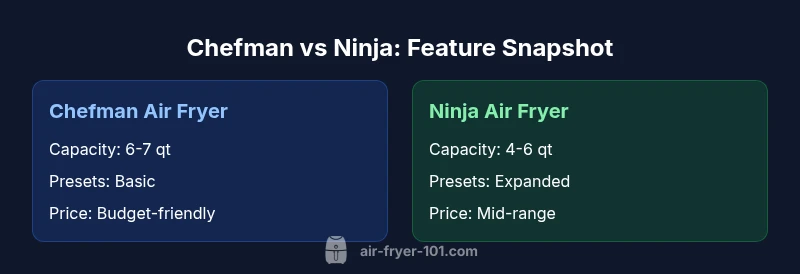
Two essential questions guide the evaluation: how much food can you cook at once, and how powerful is the device? In this quick at-a-glance section, we compare the typical capacities, wattages, and footprint to help you map out your kitchen needs. For chefman air fryer vs ninja, 6-quart to 7-quart capacities are common in Chefman models, while Ninja often presents 4-quart to 6-quart solutions. Power ranges vary, generally sitting around 1400–1800 watts depending on the model, with Ninja models sometimes delivering peak performance through higher wattage presets. Footprint and height matter for counter space; both brands deliver compact footprints that fit standard upper cabinetry and small kitchen islands. Presets cover basic fry, bake, roast, and reheat functions; Ninja tends to offer more diverse presets and sometimes integrated air frying and roasting modes. If you cook for one or two people, a 4–5 quart option may be sufficient; for larger families, the 6–7 quart range will balance capacity with manageable bulk. Finally, consider the ease of removal and dishwasher-safe parts to reduce maintenance time.
Performance and results: chicken, fries, and vegetables
Performance speaks in the language of results: how well the device delivers crispy texture, inside doneness, and even browning. In practical tests for chefman air fryer vs ninja, chicken wings emerge crisp with minimal dryness when the temperature and time are tuned carefully; fries achieve a golden exterior with a soft interior when preheated properly. Vegetables benefit from a light toss in oil before air frying to promote even browning. Ninja models often edge out Chefman on speed and uniformity due to faster preheating and a broader range of high-temperature presets. Chefman, however, frequently provides more predictable outcomes for everyday weeknight meals and easier results with lower-power settings without sacrificing texture. The key is to use thin oil coatings, shake the basket mid-cycle, and avoid overcrowding. Across multiple batches, both brands can produce restaurant-grade results for staples like chicken, potatoes, and broccoli; the difference lies in the degree of automation and the learning curve required to maximize each device’s presets.
Controls, presets, and usability
If you value simplicity, Chefman models typically offer a straightforward dial or touch control with essential presets for fry, bake, roast, and reheat. Ninja devices frequently ship with more elaborate presets and smart features, including dual baskets in some models and smartphone connectivity in higher-end editions. The upshot: Ninja can save time once you learn the preset logic, but it may require more attention to program correctly. Chefman wins on reliability and predictability; it’s easier for beginners to master without flipping between settings. For households juggling multiple dishes, the ability to copy a saved setting or to recall a favorite time and temperature matters. In all cases, ensure the basket is easy to remove, the tray slides smoothly, and the interior is easy to wipe down. Maintenance becomes simple when parts are dishwasher-safe and supported by accessible replacement accessories.
Cleaning, durability, and maintenance
Cleaning is often overlooked but highly consequential for long-term satisfaction. Both Chefman and Ninja units typically use nonstick interiors and dishwasher-safe baskets, though some models require hand-washing for the tray and rack to avoid coating wear. Regular cleaning after each use prevents oil buildup and ensures even cooking. The durability story depends on materials; stainless steel exteriors resist smudges, while polymer housings may show wear more quickly if handled roughly. When evaluating chefman air fryer vs ninja, check for reinforced baskets, tight-fitting door seals, and fatigue resistance under frequent door openings. Replacing worn gaskets or baskets is normally straightforward and affordable, reinforcing overall value. If you are a casual cook, you’ll likely be satisfied with either brand; if you chef frequently, prefer a model with a robust interior and a generous warranty period.
Size, footprint, and kitchen fit
Counter space is a practical consideration that directly affects usability. Ninja models are often compact and race toward minimal footprints, while Chefman devices emphasize roomy baskets with comfortable handling. If you live in a small apartment or shared kitchen, a 4–5 quart option from either brand may be best, while a 6–7 quart unit provides more flexibility for batch cooking. Height and width dimensions matter when placed under cabinets; consider models that do not protrude into the doorway or create a jam on the counter. Cable length is another factor; longer cords can be more accommodating in eclectic kitchens, but they also create clutter risk. Finally, consider the stability of the unit on your countertop; a heavy, durable base reduces vibration and noise during operation.
Price, warranty, and value proposition
Price is a key deciding factor in chefman air fryer vs ninja discussions, but it is not the only determinant of value. Ninja models with more presets, wider digital interfaces, and occasional dual-basket configurations often carry higher upfront costs compared with Chefman equivalents. The ranges for common 4–6 quart sizes typically fall into a mid-to-upper budget tier; Chefman’s often hits the sweet spot for budget-conscious shoppers who still want dependable performance. Warranty terms vary by model but commonly cover at least one year; extended warranties are available for higher-end units. When evaluating value, weigh not only the sticker price but ongoing maintenance, the cost of replacement baskets, and energy usage. A longer warranty and readily available parts can offset a higher upfront price over time.
Use-case scenarios: which should you buy?
If you frequently cook for one or two and value speed, Ninja is a natural fit thanks to fast preheat and efficient air distribution. For families or budget-minded cooks who want solid, dependable results without the learning curve, Chefman offers a compelling value proposition. If you are a meal-prep enthusiast who wants a broader ecosystem of accessories, Ninja’s platform may be more attractive, while a minimalist kitchen with limited space could benefit from Chefman’s compact and straightforward design. Finally, if you crave dishwasher-friendly parts and easy maintenance, both brands provide options but you’ll likely encounter slightly more consistent parts compatibility with Chefman in the lower price tier.
Choosing with confidence: a decision framework
To conclude this overview, build a simple decision framework. First, define your priority: speed and variety (Ninja) or value and simplicity (Chefman). Second, estimate your weekly cooking load and batch size to determine required capacity. Third, examine your counter space, noise tolerance, and whether you prefer a single-basket or multi-basket setup. Fourth, review the warranty terms and the availability of replacement parts and accessories. Finally, test a model in-store if possible, and compare results with your own favorites. This framework helps you navigate chefman air fryer vs ninja with a clear, repeatable process and reduces buyer’s remorse.
Comparison
| Feature | Chefman Air Fryer | Ninja Air Fryer |
|---|---|---|
| Capacity | 6-7 qt | 4-6 qt |
| Wattage / Power | ~1500-1700W | ~1400-1800W |
| Preheat Time | Short to moderate | Moderate to short |
| Controls & Presets | Simple controls, basic presets | Rich presets, often more features |
| Ease of Cleaning | Dishwasher-safe baskets common | Dishwasher-safe baskets common |
| Price Range | $60-$120 | $90-$170 |
| Best For | Budget-conscious, straightforward meals | Speed, versatility, busy households |
Pros
- Strong value for budget-minded cooks
- Simple controls and reliable performance
- Wide availability and broad accessory ecosystem
- Good baseline results for common foods
- Predictable results with straightforward presets
Cons
- May lag behind premium models on speed and features
- Fewer advanced smart features
- Preset performance can vary by batch
- Some models can be noisier at high power
Ninja wins on speed and versatility; Chefman wins on value and simplicity
In practice, choose Ninja if you prioritize rapid results and a broader feature set. Choose Chefman if upfront cost and straightforward, reliable performance matter more. The final choice depends on your priorities and kitchen footprint.
Got Questions?
Which is easier to use, Chefman or Ninja?
Both are straightforward, but Chefman is typically simpler for beginners. Ninja offers more presets which pay off once you learn the logic.
For beginners, Chefman is usually easier; Ninja becomes quicker once you know the presets.
Which has a larger capacity?
Chefman commonly offers larger quart options in the mid-range, while Ninja focuses on compact to mid-range sizes. Check your model specs to confirm.
Chefman often has larger mid-range capacities; verify your model for exact numbers.
Are Chefman and Ninja air fryers dishwasher-safe?
Most baskets and trays are dishwasher-safe, but not all parts. Always consult the manual for your specific model.
Most baskets are dishwasher-safe, but check the manual for each part.
Do they require preheating?
Preheating is recommended for even results in most cases. Ninja models often preheat quickly, while Chefman can be efficient with shorter preheat times.
Yes, preheating helps; Ninja heats faster on average.
Which is better for health-conscious cooking?
Both options reduce oil versus deep-frying and support healthier cooking. The choice hinges more on convenience and consistency than a health difference.
Both are healthy choices when used with minimal oil.
Is there a clear winner overall?
There isn’t a universal winner. Ninja excels in speed and features; Chefman wins on value and simplicity. Your kitchen priorities decide.
No universal winner—depends on your needs; Ninja for speed, Chefman for value.
Quick Summary
- Assess capacity to fit your family size
- Prioritize speed vs value based on lifestyle
- Check cleaning ease to save time
- Consider space and countertop footprint
- Review warranty and parts availability