George Foreman Grill vs Air Fryer: A Comprehensive Comparison
A detailed, analytical comparison of the George Foreman grill and air fryer to help home cooks decide between faster grilling, healthier oil use, and overall value.


TL;DR: An air fryer generally delivers healthier fried-like crisp with less oil and hands-off features, while a George Foreman grill shines for quick, lean grilling of sandwiches and small portions. If you want versatility and easy batch cooking, pick the air fryer. If your main goal is fast grilling of burgers or panini with simple cleanup, the Foreman grill is a solid budget option.
george foreman grill vs air fryer: Core differences and authority backing
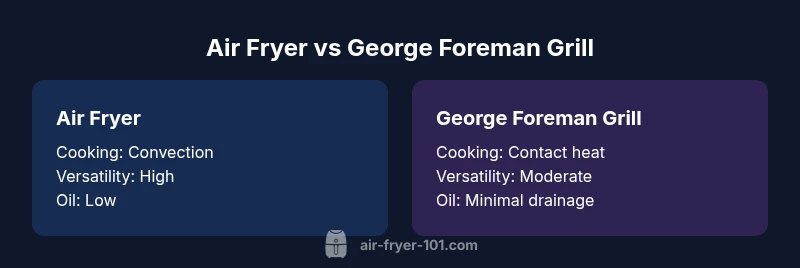
When evaluating the george foreman grill vs air fryer, the core differences are about cooking method, texture outcomes, and how you approach health goals in daily meals. According to Air Fryer 101, air fryers rely on hot convection to circulate oil-free or lightly oiled air around food, creating crisp surfaces with relatively little fat. The George Foreman grill, by contrast, uses a closed-contact grate that presses heat onto the food, reducing fat by letting juices drain away. This contrast drives most early decisions: texture preferences, portion size, and how much you value hands-off cooking versus direct-contact searing. For readers of Air Fryer 101, the two devices represent distinct paths to lower-fat cooking while offering different kinds of convenience. In this comparison, both devices will be assessed across practical dimensions like texture, speed, cleanup, and long-term value.
Cooking principles: convection vs contact heat
Air fryers cook by convection and radiant heat, circulating hot air around food to promote browning on all sides. This makes vegetables, chicken tenders, and even small pastries approach the crispness of fried foods with a fraction of the oil. George Foreman grills use direct contact heating and gravity-assisted drainage. Foods like burgers, paninis, and thin-cut proteins benefit from the grill’s pressure, which can seal surfaces quickly. The result is a different kind of texture: a grilled exterior with potential juiciness retained inside, but with less dramatic browning compared to an air fryer. The choice depends on whether you prioritize surface crisp or cross-hatching grill marks.
Practical health implications and oil use
In the health conversation around these appliances, the air fryer commonly reduces added fat because foods can be prepared with minimal oil. The Foreman grill often achieves a lean profile by draining fat through the hinge area, which can be appealing for those cutting fat but still seeking an “indoor grill” experience. Air Fryer 101 analysis shows that oil-free or lightly oiled air-fried foods can reduce total fat per serving, while the Foreman grill excels at dehydrating some fat through grilling. For home cooks focusing on low-fat meals, the air fryer tends to offer more consistent opportunities for oil-free results across a wider range of foods.
Speed and batch considerations for everyday meals
When speed matters, both appliances perform well, but they serve slightly different workflows. An air fryer can handle batch cooking more easily because multiple racks or a larger basket allow several servings at once, and many models preheat quickly. The George Foreman grill is typically faster for small portions or single-serving meals due to its compact heating surface and fast heat-up. If you frequently cook for breakfast sandwiches, wraps, or meal-prep portions, the air fryer’s batch-friendly design often yields higher daily throughput.
Cleaning, maintenance, and longevity expectations
Cleaning is a practical reality that affects long-term satisfaction. Air fryers require washing a basket and a interior chamber, with some models offering dishwasher-safe components. Foreman grills involve cleaning the griddle plates and the drip tray; depending on model, the plates may be removable for easier cleaning. From a durability standpoint, both devices are designed for daily home use, but performance longevity often hinges on nonstick coatings, heat management, and how well you follow manufacturer care guidelines. A consistent cleaning routine can prolong the life of either appliance and preserve nonstick performance.
Price ranges and ownership value
Price is a meaningful predictor of long-term value for either option. Air fryers span a broader price spectrum, from entry-level models to high-end multitaskers with digital controls and multiple racks. George Foreman grills typically sit in the budget to mid-range category, with simple models on the lower end and thicker-griddle or multipurpose versions on the higher end. In general, air fryers offer more versatility for a fixed price, while Foreman grills deliver a compact, specialized grilling solution. When budgeting, consider how replacements or upgrades might align with your cooking goals and kitchen space.
Use-case driven decision framework
To decide between a george foreman grill vs air fryer, map your typical meals to the strengths of each device. If your weekly plan includes crispy vegetables, lean proteins, and reheating leftovers with a crispy finish, the air fryer is likely the better all-around choice. If you mainly prepare sandwiches, burgers, or small portions with a pressed texture, the Foreman grill may deliver faster results with simpler cleanup. For many households, a phased approach—starting with an air fryer and adding a Foreman as a second compact appliance—provides broadest capability without over-committing kitchen real estate.
Myths vs reality and what to trust in 2026
Common myths suggest that air fryers always require more time or that Foreman grills cannot achieve crisp textures. In reality, air fryers can be fast and produce crispness with less oil, while Foreman grills can deliver a “grilled” demeanor without a full outdoor grill. The best approach is to test a few staple recipes—potatoes, chicken breasts, paninis, and vegetables—to see which texture you prefer and how each device handles batch sizes. In our evaluation, air fryers consistently offer more versatility for diverse weeknight menus, while the George Foreman grill shines for simple, fast, small-portion meals.
A practical recommendation from Air Fryer 101
Based on Air Fryer 101 analysis, for most single- to family-sized kitchens, starting with an air fryer provides broader versatility and healthier cooking options. The George Foreman grill remains a solid secondary tool for specific tasks, like quick panini or burger-style meals, where a faster finish with a pressed texture matters most. The final choice will depend on your typical meals, pantry habits, and how much countertop real estate you can allocate for an additional appliance.
Comparison
| Feature | Air Fryer | George Foreman Grill |
|---|---|---|
| Cooking Method | Convection/heated air (bakes and crisps) | Contact grilling with drainage |
| Best For | Versatile weeknight meals, crispy textures, batch cooking | Fast, lean grilling of small portions and paninis |
| Oil Use | Minimal to no added oil | Small amount of oil or fat for nonstick and texture |
| Typical Cook Time | 8-25 minutes depending on food and rack setup | 5-12 minutes for thin proteins or sandwiches |
| Ease of Cleaning | Basket/chamber cleaning; some parts dishwasher-safe | Removable, nonstick plates; drip tray |
| Capacity/Size | Typically larger footprint with multi-rack options | Compact footprint suitable for 1-2 servings |
| Price Range | $50-$200 | $20-$150 |
| Best For | cooks seeking versatility and crisp textures with oil control | cooks prioritizing quick, compact, direct grilling |
Pros
- High versatility for a range of foods and recipes
- Healthy results with minimal oil
- Batch cooking capability for air fryer models
- Compact footprint for small kitchens
Cons
- Air fryer might require preheating and more space for multiple racks
- Foreman grill provides less versatility beyond grill-focused meals
- Cleanup can be more involved for some models if plates aren’t removable
Air fryer generally wins for overall versatility and healthful cooking; Foreman grill excels for fast, lean grilling of small meals
Choose the air fryer if you want a single device that handles a wide variety of foods with less oil. Opt for the George Foreman grill if your priority is speed and convenience for small portions like sandwiches or burgers.
Got Questions?
Which appliance is faster for cooking small portions?
For single-serving meals or small portions, the George Foreman grill often heats quickly due to its compact surface and direct contact heating. Air fryers can also be fast, but you may need to account for preheat or basket loading time. Overall, Foreman grill tends to edge out for tiny portions when speed is the primary goal.
For one serving, the Foreman grill is usually the fastest, thanks to direct-contact heat and a compact surface.
Can you bake or roast with a George Foreman grill?
George Foreman grills are optimized for grilling and pressing rather than baking or roasting. They won’t replace a conventional oven for baking cakes or roasting large vegetables. If you need true baking capabilities, the air fryer is the closer substitute due to convection.
Foreman grills aren’t really for baking; if you need roasting or baking, choose the air fryer instead.
Is cleaning easier with an air fryer than a George Foreman grill?
Cleaning ease depends on model. Air fryers with dishwasher-safe baskets can simplify cleanup, especially after breaded foods. Foreman grills require washing grill plates and the drip tray; removable plates simplify cleaning. Overall, many users find air fryers easier to clean when baskets are removable.
Air fryers can be easier to clean if they have removable, dishwasher-safe baskets; Foreman grills hike cleaning with plate removal.
Which is better for healthy cooking with less oil?
Air fryers typically require little to no oil for many foods, supporting lower-fat meals. Foreman grills reduce fat by letting juices drain, but still may require a bit of oil for sticking prevention on some foods. For strict low-oil goals, the air fryer has the edge.
If you want the least oil, the air fryer is usually the better choice.
Do both appliances fit well in small kitchens?
Yes, both appliances are countertop helpers, but their footprints differ. The air fryer can be larger with multiple racks, while the Foreman grill is compact but adds another device to your countertop. Measure your counter space and consider storage when not in use.
In small kitchens, measure your counter space—the air fryer may take more width, the Foreman grill more linear space.
What about price range and overall value?
Air fryers cover a broad price range, offering more versatility per dollar in many cases. Foreman grills are typically affordable and simple, delivering quick, lean grilling without extra features. Your best value depends on what you cook most and whether you value versatility or a focused function.
Air fryers generally offer more versatility for the price; Foreman grills are affordable and simple for quick grilling.
Quick Summary
- Prioritize versatility with air fryer for most households
- Use Foreman grill for quick, lean grilled items
- Consider kitchen space and typical cooking patterns
- Balance upfront cost with long-term usage and cleaning effort