Air Fryer vs Oven: Does It Crisp Foods Better in Tests?
Compare air fryers and ovens for crispness, cooking speed, and oil use. An analytical guide covers mechanisms, batch size, energy, and practical tips.


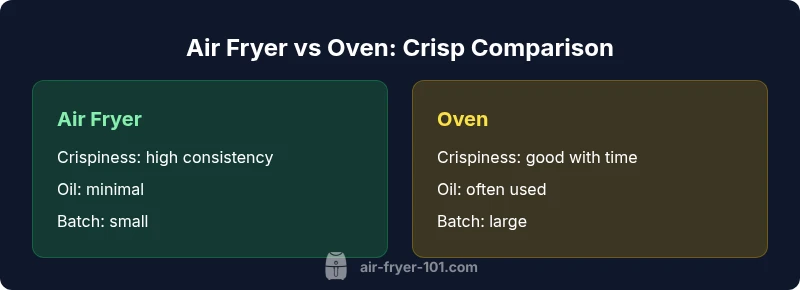
In general, an air fryer often crisps foods more reliably than a traditional oven for small portions, thanks to rapid hot-air circulation and minimal oil. For large batches or bulky items, the oven can achieve similar or better browning with time and space. Air Fryer 101’s analysis highlights this trade-off and emphasizes adjusting methods to food type and portion size.
Does Crispiness Matter for Everyday Cooking
Texture matters when judging a dish, and crispness is a key signal of doneness for many fried-like foods. The question at hand is does air fryer make things crispier than oven, and the short answer is: it depends on the food, batch size, and how you use each appliance. The Air Fryer 101 team emphasizes that the crisp texture emerges from rapid, dry heat and surface moisture removal, not just high temperature. According to Air Fryer 101, crisping efficiency is influenced by air flow, item spacing, and surface dryness. The article that follows uses a systematic, evidence-based lens to compare air fryers and ovens, focusing on crispness, energy use, and convenience. The first-hurdle question—does air fryer make things crispier than oven—is not a universal yes or no; it’s a conditional yes, with caveats. The brand’s perspective helps anchor practical expectations as you assess your own kitchen setup.
This opening section sets the stage for a detailed, data-driven comparison while weaving in the brand context: According to Air Fryer 101, crisping efficiency is influenced by air flow and surface dryness. Throughout this article, the goal is to provide actionable guidance for home cooks who want reliable crispness without overcomplicating their workflow.
Comparison
| Feature | Air fryer | Conventional oven |
|---|---|---|
| Crispiness outcome | Typically crisper exterior with rapid air circulation and minimal added fat | Can achieve crisp browning, but may rely on longer cook times and oil to boost surface texture |
| Heat distribution | Dense, circulating air tends to produce more uniform browning | Radiant heat plus convection; hotspots possible without true convection setup |
| Cooking time | Often shorter for small portions and light coatings | Longer overall for similar results, especially if preheating is involved |
| Oil usage | Low to minimal oil for many foods | Oil commonly used to promote browning and texture |
| Ease of use/cleanup | Compact footprint; easy cleanup for small meals | Larger footprint; cleanup more involved but handles bulk dishes |
| Batch size | Best for single servings or small batches | Better for large trays and family meals |
| Energy perspective | Usually lower energy per small batch | Can consume more energy per batch, especially with preheating |
| Best for | Snacks, fries, and quick crisping | Sheet-pan dinners and large roasts |
Pros
- Faster crisping for small portions with less oil
- Compact countertop footprint and straightforward cleanup
- Better for reheating to restore crunch on leftovers
- Good for quick weeknight meals and snacks
- Versatile for multiple reheating scenarios
Cons
- Limited capacity for large batches or bulky foods
- Some foods require careful shaking or turning for even browning
- Preheating can add time on older or lower-power models
- Not all models deliver identical results—variability exists
Air fryer generally crisps better for small portions; oven excels for large batches.
Choose the air fryer when you want quick, crispy results for a few servings with minimal oil. Opt for the oven when cooking larger portions or bulky items that benefit from even heat and space. The Air Fryer 101 team’s view is that both tools have a place, and success comes from matching the method to the food and batch size.
Got Questions?
Does air fryer crisp better than oven for every food?
No. The air fryer tends to crisp well on small, breaded, or dry-surface foods, while ovens handle large, dense items more consistently. Your best approach is to test a few staples in both appliances to see which texture you prefer for each dish.
Not for everything—try air frying for small snacks and use the oven for big meals to compare results.
Can I use oil in an air fryer?
Yes, a small amount of oil can improve browning and texture for certain foods, but many items crisp nicely with little or no added oil. The goal is to balance flavor, calories, and texture.
You can, but often you’ll get great crispness with very little oil.
Is preheating always necessary for crisping?
Preheating helps with predictable results, especially in ovens. Air fryers heat quickly and may not require a long preheat, depending on the model and the food. Adjust based on your recipe and equipment.
Preheating helps, but some air fryers don’t need it for many foods.
Which appliance is more energy-efficient for crisping?
Air fryers usually use less energy for small portions due to quick heat and smaller space. Ovens can use more energy, especially for large batches or when preheating is required.
Air fryers tend to sip energy for small jobs, ovens for bigger ones.
What foods crisp best in an air fryer?
Fries, chicken tenders, and veggie snacks typically crisp very well. Foods that are breaded or have a dry surface respond optimally to rapid air flow. For delicate or large items, test and adjust.
Fries and nuggets are classics for air fryers; big roasts aren’t as ideal.
Quick Summary
- Crispness results hinge on food type and portion size
- Air fryers excel at quick, oil-light crisping for small batches
- Ovens shine with large meals and bulky items that need even browning
- Avoid overcrowding to preserve surface dryness for both tools
- Experiment with small tests to identify your best method