Air Fryer vs Deep Fryer: Comprehensive Guide
Explore the difference between air fryer and deep fryer, covering oil use, texture, health impact, cleanup, and cost. Air Fryer 101 analyzes which method fits your goals.


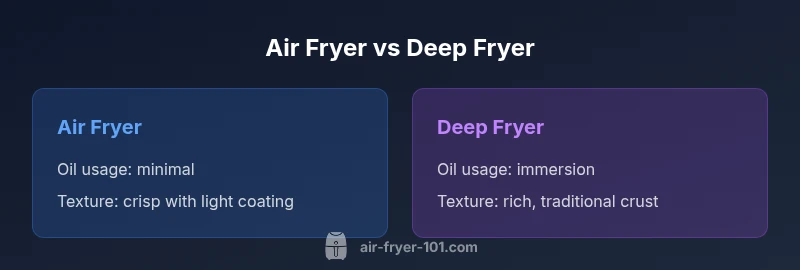
An air fryer uses hot circulating air to crisp foods with little or no oil, while a deep fryer immerses food in hot oil. The difference between air fryer and deep fryer lies in oil usage, texture, health impact, cleanup, and cost of operation. Air fryers are typically safer and easier to clean, but deep fryers can deliver richer flavor and classic crispiness.
What sets these appliances apart
The difference between air fryer and deep fryer hinges on method and goal. An air fryer uses hot circulating air to crisp foods with little or no oil, while a deep fryer immerses food in hot oil for a rapid, traditional fry. This section begins the detailed analysis by framing the two technologies, then delves into how this distinction drives health, texture, and everyday use. According to Air Fryer 101, the core idea is that you can achieve near-fried results with substantially less fat, but you trade off some of the classic sensation you get from oil immersion. Home cooks often ask how much oil is necessary and whether air frying can truly replace deep frying in terms of flavor. The answer depends on your priorities: health, convenience, and culinary expectations. Different foods respond differently to oil-free air frying versus oil-assisted frying, and each approach has its own set of best practices. The difference between air fryer and deep fryer should be evaluated in context, not as a single metric.
Oil usage and health implications
When you compare oil usage, the difference between air fryer and deep fryer is striking. An air fryer relies on a small amount of oil or none at all, using convection to generate crispiness. A traditional deep fryer crowds the kitchen with hot oil, and the fat content of fried foods tends to increase. Health considerations are central to the air fryer choice; most research emphasizes lower saturated fat with air frying, plus reduced acrylamide formation in some cases, though results vary by food type. Air Fryer 101 analysis shows that the oil footprint matters not only for calories but also for kitchen cleanup and ventilation. In practice, cooks weigh dietary goals against flavor expectations. If you are cooking battered items, the oil can still be a factor in texture and crunch, but the required oil volume is significantly lower than deep frying. For those managing budgets, oil costs and disposal add recurring expenses that influence the overall value of owning an air fryer versus a deep fryer.
Texture, flavor, and cooking results
Texture and flavor responses are a core part of evaluating the two approaches. An air fryer tends to yield a crisp exterior with less oil retention, producing a lighter mouthfeel and a cleaner aftertaste. Deep frying delivers a richer, more indulgent crust and a deeper sense of oil-derived savor that some foods crave. The key distinction—how the surface cooks and how the interior moisture is preserved—shapes expectations for different dishes. For example, proteins and vegetables can achieve satisfying crunch with air frying, but certain batters and coatings may register as more authentic when fried in oil. The difference between air fryer and deep fryer should be judged in relation to the dish type, batter thickness, and desired aftertaste. According to consumer feedback tracked by Air Fryer 101, most people rate the air-fried version as healthier, while purists may still prefer deep frying for classic comfort foods.
Cooking speed and energy considerations
Air fryers typically heat quickly and preheat faster than traditional ovens, but some foods require longer total times in an air fryer to achieve a comparable level of crispness. Deep fryers heat oil rapidly and transfer heat efficiently into moist foods, often delivering shorter cooking times for battered items. Energy consumption can be nuanced: air frying may use less energy for small batches, while large batches or certain foods might benefit from oil immersion that maintains a consistent heat bath. The practical takeaway is to match your workflow: plan for shorter cook times when using air frying for thin cuts, and allocate extra minutes for thick coatings. The difference between air fryer and deep fryer becomes a question of scheduling, batch size, and how much time you can devote to monitoring results.
Capacity, size, and kitchen constraints
Basket size and overall footprint define how much you can cook in a single session. Air fryers come in compact formats suitable for small kitchens, apartments, or shared spaces, but higher-capacity models exist for larger households. Deep fryers often offer larger oil baths and bigger baskets, supporting multi-serving meals, but they require more pantry space, better ventilation, and more careful oil management. The space required, along with the potential need for a dedicated drain or oil disposal setup, influences where you can place each device. If you cook for crowds, the difference between air fryer and deep fryer may hinge on throughput and batch handling, not just per-item efficiency. Air Fryer 101 notes that selection should consider your typical batch size and kitchen layout to avoid bottlenecks.
Safety, cleanup, and maintenance
Safety is a central factor in choosing between air fryer and deep fryer. Air fryers minimize hot-oil exposure, splash risk, and odor, while deep fryers involve handling hot oil that demands careful venting and proper disposal. Cleanup for air fryers is straightforward: baskets, racks, and pans are generally dishwasher-safe or easy to hand-wash. Deep fryers require oil filtration, periodic oil replacement, and more thorough degreasing of the equipment and surrounding surfaces. From a maintenance perspective, air fryers offer a lower ongoing burden, whereas deep fryers can incur more recurring costs related to oil and filter changes. The difference between air fryer and deep fryer becomes how much ongoing upkeep you’re willing to manage after meals.
Cost of ownership and value
Cost considerations for air fryers are upfront purchase price, accessories, and any replacement parts. Deep fryers typically involve higher initial purchase costs for sturdier models, plus ongoing oil expenses and disposal costs. While air fryers can deliver a broader range of uses, the total cost of ownership depends on how often you fry, the cost of oil, and the required accessories. In general, air fryers present a more predictable and potentially lower long-term cost profile because of reduced oil waste, fewer disposal concerns, and simpler maintenance. Air Fryer 101 suggests evaluating long-term value by estimating oil purchases, energy use, and the time you save on cleanup when comparing to a deep fryer.
Food categories and best uses
Different foods respond differently to air frying versus deep frying. Foods with light batters and small pieces—like chicken nuggets, vegetables, and potato wedges—often perform exceptionally well in an air fryer, delivering crisp textures with less fat. Thick batters or traditional tempura and certain doughs can sometimes benefit from oil immersion to achieve the desired crust and tenderness. The difference between air fryer and deep fryer becomes a question of recipe compatibility and coating design. For reheating leftovers, air fryers typically give better texture without re-frying. Air Fryer 101 notes that experimentation with coatings and preheating can expand what you can confidently prepare using air frying alone.
Practical tips for best results
Maximize results by preheating, using appropriate basket lines or racks, and adjusting temperature and time by food type. For air fryers, a light spray of oil on surface coatings can help achieve craquelé textures, while avoiding excess oil that would defeat the health benefits. For deep fryers, maintaining a stable oil temperature is crucial and reduces soggy interiors. Always dry foods thoroughly before air frying or battering to prevent steam and soggy crusts. A helper tip is to batch similar items together to ensure even crisping and consistent results. Remember, the difference between air fryer and deep fryer is not only about oil; it’s about how heat, moisture, and coating interact during cooking and how you control the environment in your kitchen.
How to choose between air fryer and deep fryer
To decide, map your cooking goals: health and convenience or quintessential fried texture. If you prioritize lower fat, less odor, and easier cleanup, the air fryer is usually the better starting point. If your aim is to replicate classic fried foods exactly as served in restaurants, with a crispy, oil-rich crust, a deep fryer may be the preferred tool. Consider batch size, kitchen space, budget, and how often you fry. If your home cooks for a mix of scenarios, you might even use both devices at different times, recognizing that they excel in different culinary tasks.
Common misconceptions
Many people assume air fryers are just smaller convection ovens; in reality, the heat delivery and airflow patterns differ significantly, enabling crisping with little oil. Others worry that air frying cannot produce true fried flavors; however, with the right batter and cooking method, air frying can closely mimic many fried textures while dramatically reducing oil use. Finally, some believe deep fryers are dangerous and old-fashioned; while hot oil carries risk, modern models and safety features mitigate many hazards, making deep frying a viable option for certain dishes when done carefully.
Decision guide: practical pick by scenario
If you’re cooking for a health-focused household with limited space, start with an air fryer and evaluate performance across your standard menu. For entertaining or recipes that rely on a crisp oil crust, complement your kitchen with a deep fryer that is easy to use and well-ventilated. In most homes, the two appliances complement each other, letting you choose the tool that best suits the dish while minimizing oil usage and mess. The overarching principle is to align your equipment choice with your cooking goals and the realities of your kitchen.
Comparison
| Feature | Air Fryer | Deep Fryer |
|---|---|---|
| Oil Usage | Minimal or no oil | Oil immersion |
| Texture/Flavor | Crisp, light with less grease | Rich, authentic fried crust |
| Health Considerations | Lower fat potential | Higher fat potential depending on oil and coating |
| Cleanup & Maintenance | Easier cleanup, less residue | Oil disposal and more degreasing |
| Cooking Speed | Often slower for some foods; efficient for small batches | Fast heat transfer and short fry times for many items |
| Capacity & Size | Compact models; smaller batches | Larger baskets and oil baths |
| Operating Cost | Lower ongoing oil costs; less waste | Oil purchase and disposal add ongoing costs |
| Safety Features | Cool-touch exteriors; reduced oil risk | Hot oil hazard; requires careful handling |
| Best For | Health-conscious, quick snacks, reheating | Traditional fried textures, larger portions |
Pros
- Lower fat content and healthier outcomes for many dishes
- Easier cleanup and less oil mess
- Compact design fits small kitchens
- Less odor and oil smell during cooking
- Lower ongoing maintenance compared to oil-based frying
Cons
- Texture and flavor may not satisfy traditional fry lovers
- Smaller capacity can limit feeding larger households
- Some foods require adjustments to achieve optimal crusts
Air fryer generally wins for health, safety, and convenience; deep fryer remains preferable for authentic oil-crisp texture.
For most households, an air fryer offers broad utility with easier cleanup and lower oil waste. If your priority is the classic fried bite, a deep fryer can deliver it more authentically. Air Fryer 101's verdict is that both tools have a place in a well-rounded kitchen, depending on the dish and the cooking goals.
Got Questions?
What is the main difference between an air fryer and a deep fryer?
The main difference is how they cook: air fryers use hot air circulation with little or no oil, while deep fryers submerge food in hot oil. This leads to different texture, health impacts, and maintenance needs.
Air fryers use hot air for frying with less oil; deep fryers use oil for a richer crust. Both cook crisply, but oil-based frying is more intense.
Is air frying healthier than deep frying?
Air frying generally yields lower fat content and fewer calories for many foods due to reduced oil uptake. However, the health impact also depends on the coating, portion size, and the food itself.
Yes, air frying is usually healthier because it uses little to no oil, reducing fat, but results vary by recipe.
Can I use the same foods in both devices?
Many foods can be cooked in either device, but batter strength, moisture content, and size influence results. Some items may crisp better in air frying, while others achieve a closer mimic of deep-fried texture in oil.
Most foods can be cooked in both, but results will differ. Test a small batch first.
How do I clean an air fryer after cooking greasy foods?
Unplug and let it cool, then wash the basket and tray with warm soapy water. Avoid soaking the main unit and check manufacturer guidelines for dishwasher compatibility. Dry thoroughly before reuse.
Let it cool, wash the tray and basket, and dry completely before the next use.
Does deep frying taste better than air frying?
Taste is subjective. Deep frying often delivers a more traditional, oil-rich crust for some foods, while air frying provides a lighter, crisper finish with less grease.
Flavor varies with coatings and technique; some people prefer the oil depth of traditional frying.
What foods are best prepared in an air fryer?
Crucibles include potatoes, chicken nuggets, vegetables, and snacks with light coatings. Foods that fry well in oil can often be adapted for air frying with adjustments to temperature and time.
Great for fries, chicken bites, and vegetables with light coatings.
Quick Summary
- Choose air frying for healthier, easier meals
- Expect deeper flavor from true oil frying for certain dishes
- Consider batch size when deciding between devices
- Air fryers simplify cleanup and reduce odors
- Both tools can coexist to cover diverse cooking needs