Air Fryer or Oven: Which Is Right for Your Kitchen in 2026
Compare air fryer vs oven to decide the best tool for your kitchen in 2026. Analyze cooking speed, capacity, energy use, and versatility to choose the right appliance for your cooking style.


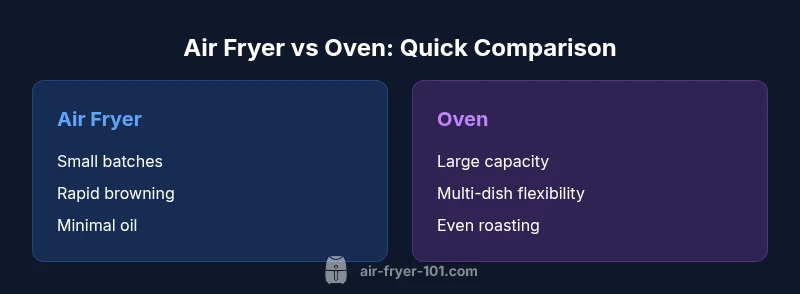
Between an air fryer and a conventional oven, most home cooks gain the clearest value by matching size to tasks. The air fryer excels at small batches, quick browning, and crisp textures, while a full-size oven handles larger quantities and versatile cooking. Air Fryer 101 analysis shows both tools fit different routines: choose air fryer for daily, small-batch cooking; choose oven for family meals or high-volume roasting.
Why the air fryer or oven question matters
Choosing between an air fryer or oven is not a one-size-fits-all decision. The debate hinges on batch size, space, and what you cook most often. The phrase air fryer or oven captures a common kitchen dilemma: do you prioritize speed and crisp texture on small meals, or do you need the oven's larger capacity and versatility for roasting, baking, and multifunction use? For many households, the right answer involves using both tools strategically rather than choosing one over the other. In this analysis, we’ll map the strengths and limitations of each approach, with practical examples, typical cooking scenarios, and budget considerations that matter for real kitchens. According to Air Fryer 101, the choice should reflect your weekly menu, available counter space, and how you balance energy use with convenience.
- The air fryer’s compact footprint makes it ideal for apartments and small kitchens.
- The conventional oven remains the backbone for batch cooking, sheet-pan meals, and baking.
- The best setup often includes both, used in tandem to optimize efficiency and texture.
This section kicks off a deeper look at the two technologies and what they mean for day-to-day cooking, convenience, and long-term value.
Key differences in cooking performance
When evaluating the core performance aspects, the comparison of air fryer vs oven centers on heating efficiency, texture, and control. An air fryer relies on a compact chamber with a high-velocity hot-air stream to brown and crisp foods with little or no added oil. This design enables faster start-to-finish times for small items like french fries, chicken nuggets, and vegetables, often delivering a crisp exterior with a moist interior. In contrast, a traditional oven offers broader heat distribution, which supports even roasting of larger cuts, sheet-pan meals, and delicate baked goods. Oven performance shines with even browning on large trays and with tasks that require consistent ambient heat, such as roasting root vegetables, baking cookies, or roasting multiple dishes simultaneously.
Texture, moisture retention, and oil use are practical ways to think about outcomes. Air fryers tend to produce drier, crisp surfaces with minimal oil, which many light-ingredient foods crave. Ovens excel at moisture retention for roasts and tall items, and they can accommodate cooking vessels of various sizes, from metal sheets to silicone molds. Consider how important texture is for your favorite dishes when weighing the trade-offs of air fryer or oven.
A second dimension is cooking speed. Small batches often finish in far shorter times in an air fryer, while larger meals or bulk-baking tasks benefit from ovens’ larger interior. Finally, consider reliability and control: both approaches offer precise temperature settings, but the oven tends to offer a wider range of temperatures and more nuanced timers, which matters for delicate bakework and long roasts.
Practical takeaway: for items that benefit from rapid browning and crisp texture in small volumes, the air fryer often wins; for bulk cooking, baking flexibility, and multi-dish coordination, the oven remains superior.
Size, space, and kitchen layout considerations
The footprint and layout considerations for air fryer or oven significantly affect usability and long-term satisfaction. An air fryer is typically a compact countertop appliance with an integrated basket. It occupies less space and can be tucked away after use, which makes it especially appealing for small kitchens, dorm rooms, or camper setups. However, capacity is inherently limited. If you regularly feed two or more people with larger meals, you may be pulling multiple batches, which can negate the time-saving benefits.
A conventional oven, by contrast, is a built-in or freestanding appliance that handles large volumes and multiple dishes at once. It scales well for families, meal-prep, and entertaining. The trade-off is bigger upfront space, a longer preheat period in some models, and a more complex cleanup depending on rack configurations, bakeware, and back-of-house design. For many households, the best configuration is a shared strategy: rely on the air fryer for quick sides and single-serving meals, and use the oven for roasting, baking, and multi-dish sheet-pan dinners.
If you are tight on counter space, consider a compact oven or a toaster oven with convection as an intermediate option. Such models can blur the line between air fryer and oven functionality, offering some crisping while maintaining higher capacity than a single compact air fryer. In all cases, ensure proper ventilation and safe placement away from heat-sensitive surfaces.
From a workflow perspective, plan your kitchen around a two-tool approach: a small air fryer for snacks and quick dinners, and a larger oven for batch cooking and baked goods. This configuration aligns with most families’ cooking rhythms and reduces the need to trade a single tool for everything.
Energy use, cost, and maintenance considerations
A practical way to compare air fryer or oven is to think in terms of energy efficiency, long-term costs, and maintenance needs. An air fryer typically uses less energy for small, quick tasks because it heats a smaller space more rapidly and often preheats faster. For households that prepare many snacks and side dishes in single-portion or double-portion batches, energy savings can accumulate over time. That said, if you frequently cook for a crowd, an oven can deliver economies of scale by cooking more food in fewer batches, potentially offsetting its higher per-cycle energy use. The overall cost balance depends on your cooking style, electricity rates, and how often you run these appliances.
Maintenance is generally straightforward for both devices. Air fryers require regular basket cleaning and occasional coating checks for gaskets and seals in some models. Ovens require periodic cleaning of racks, trays, and door seals, and may benefit from occasional calibration to maintain even temperatures. Both appliances benefit from using the right accessories and proper cookware—silicone mats, metal racks, and oven-safe trays—to minimize mess and maximize performance.
From a health and safety perspective, proper ventilation and device placement reduce heat exposure and fire risk. Cleanliness matters: accumulation of oil or food debris can affect performance and aromas. By choosing the right tool for your typical loads and maintaining a simple cleaning routine, you maximize efficiency and longevity for both air fryer or oven configurations.
Use-case scenarios and recipe ideas
To illustrate real-world differences, consider a few common use cases where the choice between an air fryer or oven shifts with the meal. For a weekday dinner featuring crispy chicken nuggets, roasted potatoes, and a quick vegetable, an air fryer may deliver crisp results quickly with minimal oil. The compact chamber concentrates heat around the food, speeding up browning and reducing overall cooking time. For a Sunday roast with multiple dishes—roasted carrots, potatoes, and a meat or poultry main—the oven’s larger interior and rack space becomes invaluable, allowing you to coordinate temps and timing across dishes.
Another practical scenario is baking. If you crave cookies, muffins, or a sheet of brownies, the oven’s large cavity and even heat distribution often yield more consistent outcomes. You can bake in batches using multiple racks and rotate trays for even cooking. When reheating leftovers, both devices work well, but the air fryer tends to re-crisp fried items or crusty components more reliably, while the oven handles casseroles and dishes that benefit from even reheating.
For health-conscious cooks, you might choose the air fryer for small sides with little oil, and the oven for larger roasts that require moisture retention and slow browning. The key is to align the dish size, desired texture, and batch quantity with the right tool. With this approach, the air fryer or oven decision becomes a practical part of weekly meal planning rather than a game of competing desires.
How to choose between models and what to buy
When selecting a model, consider a few decision factors that consistently influence satisfaction with the air fryer or oven pairing. Start with capacity and footprint: if you feed two people most nights, an air fryer with a 3-4 quart basket or a compact 5-6 quart unit is often sufficient. If you cook for a family or host guests, invest in a larger air fryer or an oven capable of accommodating large trays and multiple racks. Next, assess cookware compatibility: whether you prefer metal trays, silicone mats, or baking stones, ensure your chosen unit can work with the items you already own. Temperature control and preheat behavior are also important. Some air fryers offer precise digital controls for specific foods; meanwhile, ovens provide a broader temperature spectrum that is more forgiving for diverse recipes.
Budget should be balanced with expected use. Premium ovens offer more features and higher energy efficiency for frequent cooks; a robust mid-range air fryer can deliver significant value daily. If possible, prioritize models with easy-to-clean baskets, durable racks, and accessible replacement parts. Finally, think about your long-term plan. If you anticipate frequent upgrades or a shift in cooking habits, a modular approach—starting with a single air fryer plus a decent oven—often provides the best return on investment while keeping options open for future kitchen evolution.
Practical tips for getting the best results
To maximize performance in either setup, start with a few practical tips that apply to both the air fryer and the oven. Preheat according to the recipe and the appliance’s guidelines; preheating saves time and improves browning, especially for protein and vegetables. Use light coating with oil or aerosol spray on surfaces to promote browning without excess fat. Space items evenly to ensure consistent air exposure in an air fryer, and use racks or trays to optimize heat distribution in the oven. For crispy results, flip or rotate items if necessary to promote uniform browning. Finally, use appropriate cookware: metal trays, silicone mats, and oven-safe pans are essential for prevent sticking and to ensure safe handling.
Cleaning is part of performance. Empty and wash baskets promptly after use; wipe down interiors to remove oil residue. For ovens, periodic cleaning of racks and seals reduces heat loss and improves efficiency. By adopting a simple routine—preheat, cook, rotate, and clean—you’ll maintain peak performance and extend the life of both appliances while enjoying consistently delicious results.
Comparison
| Feature | air fryer | conventional oven |
|---|---|---|
| Size & footprint | Compact countertop unit | Full-size, built-in or freestanding |
| Crispiness & texture | Excellent for small-crisp outcomes with minimal oil | Versatile browning across many foods (roasts, cookies, sheets) |
| Cooking capacity | Typically 1-4 servings per batch | 2-6+ servings per batch depending on rack space |
| Versatility & functions | Primarily air frying and reheating | Roasting, baking, broiling, and multi-dish cooking |
| Preheat time | Shorter preheat for many models | Longer preheat for large cavities |
| Maintenance & cleaning | Easy wiping and basket cleaning; fewer parts | More racks and trays; more cleaning surface |
| Energy use | Typically efficient for small batches | Energy use scales with batch size and oven capacity |
| Best for | Small households, quick snacks, crispy sides | Families, batch cooking, baking, and multi-dish meals |
Pros
- Faster cooking for small batches
- Crispy results with minimal oil
- Compact footprint fits small kitchens
- Oven offers large capacity for bulk cooking
- No special accessories required for basic use
Cons
- Limited capacity for large meals in air fryer
- Oven can be energy-intensive for small jobs
- Air fryer may require flipping for evenly cooked larger items
- Some models lack precise temperature control for certain recipes
Air fryer wins for speed and small-batch crispiness; oven wins for capacity and versatility
Choose air fryer when you prioritize quick, crisp results for small portions. Choose oven when you regularly cook for a family, bake, or need to coordinate multiple dishes at once.
Got Questions?
Is an air fryer a good substitute for an oven?
An air fryer can substitute for several oven tasks, especially small, crispy items. It won’t match oven capacity for large trays or multi-dish meals. Use it as a supplement, not a full replacement.
An air fryer works well for small, crispy items, but it isn’t ideal for big batches or complex bakes.
Can you bake cookies in an air fryer?
Yes, you can bake cookies in some air fryers, but results vary by model and batch size. You may need to adjust time and space on the rack for even browning.
You can bake cookies in an air fryer, but test a small batch first to get the timing right.
Do air fryers use less energy than ovens?
Air fryers often use less energy for small items due to faster preheating and a smaller chamber. For large meals, ovens may be more energy-efficient overall when cooking multiple dishes at once.
Air fryers usually use less energy for small jobs; ovens may be more efficient for big meals.
What foods are best cooked in an air fryer vs oven?
Air fryers shine on items needing crisp texture with minimal oil, such as fries, nuggets, and vegetables. Ovens excel at baking, roasting, and sheet-pan meals that involve larger quantities.
Air fryers for crisp, small items; ovens for baking and bulk cooking.
Is preheating required for air fryers?
Many air fryers benefit from light preheating, especially for larger or thicker items. Check model instructions, but a short preheat can improve browning and evenness.
Preheating helps with browning; follow your unit's guidelines.
How should I choose between models if I’m on a budget?
Prioritize features that match your typical meals: a compact air fryer with reliable temp control for quick meals, and a mid-range oven with good capacity if you bake regularly. Consider future-proofing with versatile racks and trays.
Pick based on your meal patterns: quick air fryer meals or overall baking needs.
Quick Summary
- Match batch size to tool to maximize efficiency
- Air fryer for quick, crispy snacks; oven for bulk cooking
- Budget for space, energy, and cleaning needs
- Consider potential purchase as a long-term kitchen upgrade