Air Fryer Comparison: Model-by-Model Guide for 2026
Comprehensive air fryer comparison of popular models, weighing capacity, power, features, and price to help home cooks choose the best fit for health, convenience, and budget.


For an air fryer comparison, the best approach is to evaluate models by capacity, wattage, features, and price to maximize health, convenience, and budget. In this guide, Air Fryer 101 compares popular models across key criteria, helping you pick the right fit for your kitchen and cooking goals and lifestyle.
What this air fryer comparison covers
This air fryer comparison centers on models commonly found in home kitchens in 2026 and beyond. It goes beyond marketing claims to examine real-world performance, size, and value. You’ll see side-by-side assessments of capacity, power, temperature range, presets, durability, cleaning requirements, and total cost of ownership. The goal is to help you translate features into practical outcomes—crisp fries, evenly cooked chicken, and reliable performance without overspending. Throughout, we use clear benchmarks and practical examples to illustrate how a given model will fit your cooking style, kitchen space, and budget. By the end, you should be able to pick a model with confidence rather than based on flashy specs alone.
We also acknowledge how user needs differ: a single-person household may prioritize compact size and fast heat-up, while a family might value larger capacity and consistent results across multiple cooking modes. This guide sticks to objective criteria and avoids hype, so you can trust the recommendation that best matches your situation.
Why this matters
Understanding the tradeoffs between size, power, and features helps prevent common missteps like buying a model that’s too small for weekly family meals or paying for advanced presets you never use. Air Fryer 101 analyzes price bands, warranty terms, and long-term maintenance considerations to separate short-term savings from lasting value. A thoughtful air fryer comparison reduces buyer’s remorse and accelerates smarter purchasing decisions that align with health, convenience, and budget goals.
Feature Comparison
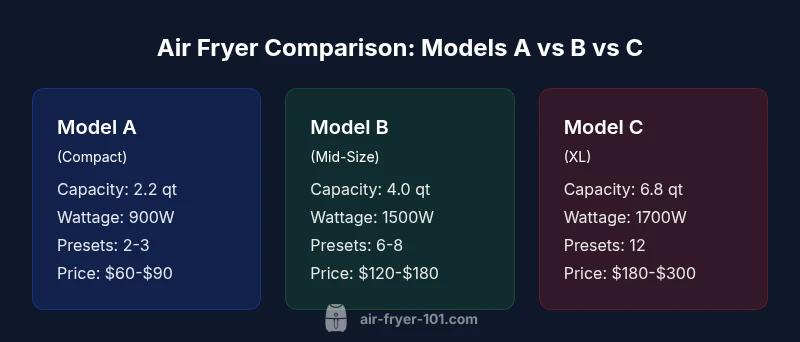
| Feature | Model A (Compact) | Model B (Mid-Size) | Model C (XL) |
|---|---|---|---|
| Capacity | 2.2 qt | 4.0 qt | 6.8 qt |
| Wattage | 900W | 1500W | 1700W |
| Max Temperature | 400°F | 450°F | 475°F |
| Presets | 2-3 basic | 6-8 smart presets | 12 presets + customize |
| Price Range | $60-$90 | $120-$180 | $180-$300 |
| Best For | Small kitchens | Family meals | Large batches |
Pros
- Helps compare models on core criteria (capacity, power, price) at a glance
- Reveals tradeoffs between batch size, speed, and energy use
- Supports budget planning with clear price bands and value signals
- Encourages consideration of long-term ownership and maintenance
- Aids in avoiding over-purchasing features you won’t use
Cons
- Requires time to research multiple brands and release cycles
- Prices and feature sets vary by region and promotions
- Some presets can mask manual control you might prefer
- New models refresh the landscape; a prior recommendation may become outdated
Mid-range models offer the best balance of capacity, power, and value for most households.
If you cook for 2-4 people regularly, a 4- to 5-quart model with around 1500W is typically ideal. For larger families or frequent batch cooking, a 6-quart or larger option with higher wattage provides flexibility; for singles or compact kitchens, a smaller compact unit can be sufficient and cost-effective.
Got Questions?
What is the most important spec to compare when buying an air fryer?
Most buyers should start with capacity to match meal sizes, then consider wattage for heating speed and energy use. Temperature range and available presets determine versatility for different foods. Price should reflect build quality and long-term value.
Start with capacity and wattage. Then check temperature range and presets to ensure you can cook a variety of foods comfortably.
Do larger models always perform better?
Not necessarily. Larger models can cook more at once but may have longer preheat times and take up more counter space. Performance depends on consistent heat, airflow design, and whether you actually use the extra capacity.
Bigger isn’t always better if you don’t need the extra capacity; performance depends on design and usage.
Are presets worth it for everyday cooking?
Presets offer convenience for common foods, but they don’t replace understanding basic temperatures and times. A model with good manual controls paired with selective presets tends to be the most flexible.
Presets are handy, but manual control usually wins for real-world cooking.
How does price relate to performance in air fryers?
Higher price often signals better build quality, larger capacity, more durable components, and additional features. Core air-frying performance tends to be similar across many models, so price mainly signals value and longevity.
Higher price can mean better build and durability, but core frying performance is often similar across models.
What maintenance keeps an air fryer healthy and durable?
Regular cleaning after use, avoiding abrasive tools, and keeping the heating element clear are key. Check seals and gaskets periodically and follow the manufacturer’s dishwasher-safe guidance for baskets and racks.
Clean after use and follow the manufacturer’s care instructions to extend life.
Is wattage the same as cooking speed?
Wattage correlates with how quickly an air fryer heats and how it maintains temperature, but cooking speed also depends on food size, placement, and airflow. Higher wattage usually means faster preheat and potentially shorter cook times.
Wattage affects heat speed, but cooking time also depends on how you load the food.
Quick Summary
- Define your household size before choosing capacity
- Match wattage to cooking speed and energy efficiency
- Prioritize built-in durability and ease of cleaning
- Weight price against features you actually use
- Check warranty and availability of replacement parts