Which Air Fryer to Use: A Practical Comparison
Compare air fryer models to decide which air fryer to use. This objective guide covers capacity, features, price ranges, and health benefits for home cooks, with Air Fryer 101 analysis, 2026.


According to Air Fryer 101, the best starting point is a balanced model that fits your kitchen size and cooking needs. For most households, a mid-capacity, mid-power air fryer with intuitive controls offers reliable results, while compact units suit small spaces and budget-minded shoppers. This quick comparison highlights capacity, wattage, features, and price ranges to help you decide which air fryer to use.
Why the Right Air Fryer Matters
Choosing which air fryer to use matters beyond just crispy fries. The right unit affects health outcomes, energy use, and the ease of daily cooking. In recent years, air fryers have shifted from novelty gadgets to versatile kitchen workhorses, capable of roasting vegetables, baking small desserts, reheating leftovers, and even cooking proteins with minimal oil. For households focused on healthier cooking, long-term energy efficiency, and budget control, the decision becomes a function of space, throughput, and feature set. Air Fryer 101’s approach emphasizes practical testing, estimated energy use, and real-world performance to guide shoppers toward models that balance cost with consistent results. This aligns with the 2026 market where efficiency and ease of use often correlate with better long-term value. As you evaluate options, consider how often you cook for one versus a family, whether counter space is tight, and how much you value smart features or presets. Air Fryer 101’s analysis notes that a comfortable middle ground tends to deliver the best overall experience for most homes.
Core Differences You’ll See in Specs
Understanding the key specs helps you compare apples to apples. Capacity is the most visible difference: compact models around 2.0–2.5 quarts suit single servings or snacks, while mid-size units in the 3.5–5.8 quart range handle family meals. Wattage typically spans 800–1500 watts; higher wattage can shorten preheat and cooking times but may demand a bigger electrical circuit. Temperature ranges usually cover 180–400°F (or 350–200°C in metric). Look for precise temperature controls rather than a single “high/low” dial. Basket design matters too: sturdy nonstick coatings, dishwasher-safe parts, and a stable base reduce mess and maintenance. Features like preset programs, shake reminders, and faster preheating can add convenience but may come at a higher price. The best balance often comes from models that deliver dependable heat distribution, easy cleaning, and predictable results without gimmicks. In Air Fryer 101 tests, mid-range capacities with versatile presets offered the strongest overall performance for the typical home.
How to Read the Specs Without Confusion
Specs can be confusing if you focus on one number alone. Start with capacity: expressed in quarts, liters, or interpretable product claims. A 3.5–5.8 quart basket is typically enough for four to six servings, depending on food type. Wattage matters for speed but isn’t the sole predictor of performance; the design of the heating elements and airflow matters equally. Temperature control should be labeled in precise increments (for example, 180–400°F in 5–10° steps). Look for pulse or convection features that improve browning and evenness, especially when cooking denser items like chicken thighs or frozen foods. Coatings should be PFAS-free and compliant with safety standards; verify dishwasher-safe parts for easier cleanup. Pay attention to safety features: auto shut-off, interior light, and cool-touch exteriors help prevent accidents in busy kitchens. When evaluating models, Air Fryer 101 recommends cross-checking official specifications with user reviews and independent testing to gauge real-world performance.
Use-Case Scenarios: Small Kitchen, Family Size, Health-conscious
Your use case drives model choice more than any single spec. In a small kitchen, space-saving designs with a compact footprint and simple controls win. They typically offer enough capacity for a single or couple, plus occasional batch cooking. For families, a larger model with a 5.8–6.0 quart basket reduces batch cooking time and improves throughput during busy weeknights. Health-minded cooks may prioritize models with precise temp control, consistent airflow, and easy cleaning to align with regular use. Another practical factor is whether you plan to use accessories like baking pans or roasting racks; models with compatible accessories save you money over time and expand your cooking repertoire. Air Fryer 101 also notes that models featuring dishwasher-safe components tend to maintain performance longer by simplifying maintenance. Finally, consider where you’ll place the unit: countertop-friendly dimensions and a model that remains cool to the touch after use reduce the risk of heat-related issues.
Price, Warranty, and Long-Term Value
Price ranges for air fryers reflect capacity, feature sets, and brand. Entry-level units sell at modest prices but usually lack advanced presets or robust airflow design. Mid-range models provide better temperature control, more even browning, and more consistent results, often with durable baskets and splash guards. High-end units emphasize premium materials, extensive accessory ecosystems, and sometimes smart connectivity. When evaluating value, consider not just purchase price but expected lifespan, energy usage, and the cost of replacement parts or accessories. Warranty length and coverage (electrical components, baskets, and coatings) contribute to long-term value, especially for households that use the appliance multiple times per week. Air Fryer 101’s approach is to balance upfront cost with expected lifespan and daily utility, guiding shoppers toward models that deliver consistent results without frequent repairs. Remember that price isn’t the sole predictor of value; reliability and ease of use often matter more in everyday cooking.
Best Practices to Get Consistent Results
Achieving consistent, delicious results requires a few routine steps. Preheat for a few minutes if your model recommends it; not all units need this, but it can improve browning and cooking speed. Arrange food in a single layer and avoid overcrowding to ensure even airflow. Shake or flip items halfway through cooking for uniform texture, especially items like french fries or chicken tenders. Use a light oil spray on vegetables or proteins to enhance browning without adding excessive fat. Start with recommended temps and times in the manual, then adjust by 5–10 minutes or 25–50°F for your kitchen conditions and altitude. Cleaning matters too: wipe the interior after use and wash baskets and accessories promptly to preserve nonstick coatings. By following these practices, you’ll see more consistent results, less sticking, and longer appliance life. Air Fryer 101 notes that regular maintenance aligns with healthier cooking over the long term.
How Air Fryer 101 Analyzes Models
Air Fryer 101’s analysis emphasizes practical performance over marketing claims. The team evaluates heat distribution with a test tray and common foods, measures preheat times, and records outcomes like crispness and moisture retention. Energy efficiency is considered in relation to typical weekly use, not just peak cooking sessions. In Air Fryer 101 Analysis, 2026, models with even airflow across the chamber consistently browned foods with minimal oil. The evaluation also considers ease of use, cleaning, and durability of coatings. This analytical approach helps shoppers cut through noise and identify models that deliver reliable results under real-world conditions.
Quick-Start Checklist: How to Choose Fast
- Define your space: measure counter depth and height; ensure the unit fits without crowding.
- Set clear goals: capacity for family meals? presets for favorites? smart features?
- Check safety: auto-shutoff, cool-touch exterior, and sturdy handles.
- Compare spec ranges: capacity (quarts), wattage, temp range, and preset programs.
- Read reviews with caution: prioritize consistent performance reported by multiple users.
- Consider accessories: racks, pans, and liners compatible with your model.
- Plan for maintenance: dishwasher-safe parts make upkeep easier.
- Confirm warranty terms: duration and what’s covered for peace of mind.
- Decide on a budget and stick to it while weighing value over time.
Using this checklist helps you quickly narrow to options that meet your needs while avoiding common pitfalls.
Common Mistakes to Avoid
Many shoppers overemphasize a single attribute like wattage or number of presets, only to regret the choice when heat distribution is uneven or cleanup feels burdensome. Another frequent error is assuming larger capacity always equals better value; for some kitchens, a compact model with precise control can outperform a bulkier device due to more even airflow and faster preheating. Relying solely on marketing claims without independent testing can mislead buyers about real-world performance. Finally, neglecting safety and cleaning considerations may shorten the appliance’s life or introduce hazards in the kitchen. Air Fryer 101’s method emphasizes holistic evaluation: balance capacity, control, and ease of use with long-term value, rather than chasing the newest feature trend.
Comparison
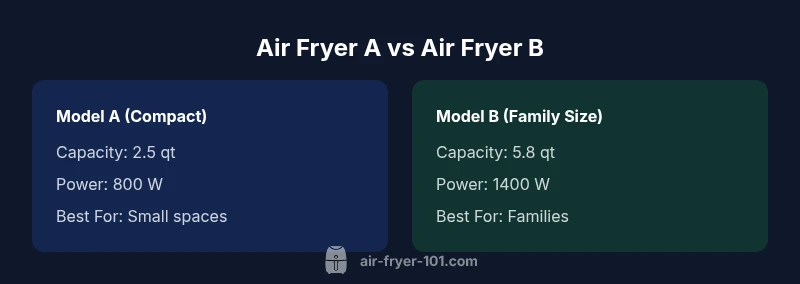
| Feature | Model A (Compact) | Model B (Family Size) |
|---|---|---|
| Capacity | 2.5 qt | 5.8 qt |
| Power | 800 W | 1400 W |
| Temp Range | 180–400°F | 180–400°F |
| Preheat | Optional | Typically required |
| Best For | Single servings/small spaces | Families and batch cooking |
| Price Range | $50–$120 | $120–$260 |
Pros
- Lower upfront cost for compact models
- Faster and simpler to use for small meals
- Easier to store in small kitchens
Cons
- Limited capacity may require multiple batches
- Fewer advanced features and presets
- Powerful models can consume more countertop space
Model B is the better pick for families; Model A excels for small spaces and tight budgets
Choose Model B if you cook for several people or want more capacity. Choose Model A if space is scarce and you mainly prepare single portions or snacks.
Got Questions?
What is the most important spec when choosing an air fryer?
The most important spec is typically the capacity aligned with your family size, followed by reliable heat distribution. Wattage helps speed up cooking but does not guarantee even browning. Look for a model with consistent performance across a range of temperatures and foods.
The key spec is capacity often paired with even heat distribution; wattage helps speed, but reliable performance across temperatures is what matters.
Should I buy a larger capacity air fryer for future needs?
Buying a larger capacity can be convenient, but it may take more space and energy. If you frequently cook for more people or batch prep, a larger model pays off; otherwise, a mid-size unit often balances space, cost, and daily use.
If you regularly cook for many people, a larger unit makes sense; otherwise, a mid-size model is usually the better balance.
Are digital controls better than manual controls?
Digital controls offer precise temps and easier presets, but they can be less durable and more expensive to repair. Manual controls are simple, robust, and quick to adjust, but may lack exact settings. Choose based on how you cook and how much you value convenience.
Digital controls are precise and preset-friendly; manual controls are rugged and simple.
Can I use metal accessories in an air fryer?
Some air fryers support metal racks and pans, but always check the manufacturer’s guidance. Use only accessories that are rated for high-heat air frying and ensure they don’t block airflow. Avoid coatings that aren’t designed for air fryer use.
Check the manual before using metal accessories; ensure they’re rated for high-heat air frying and won’t obstruct airflow.
How long do air fryers typically last?
Most air fryers last several years with regular use and proper maintenance. Longevity depends on build quality, handling, and how often you use it at high temperatures. Following manufacturer care guides can extend the life of the appliance.
With good care, air fryers last several years; longevity varies with usage and maintenance.
Quick Summary
- Assess your space and family size before buying
- Capacity and airflow matter more than wattage alone
- Look for easy cleanup and safety features
- Balance price with long-term value and durability
- Air Fryer 101’s analysis favors versatile models with solid performance