Air Fryer and Rice Cooker in One: Side-by-Side Comparison
Compare air fryer and rice cooker in one combos to decide if a multi-cooker fits your health goals, budget, and kitchen space. This analytic guide covers features, trade-offs, and best-use scenarios for home cooks seeking efficiency and versatility.


A combined air fryer and rice cooker can save counter space and simplify weeknights, but it may not match a dedicated rice cooker or premium air fryer in every function. If you value compact design, ease of use, and a lower upfront cost, a one-unit solution is worth considering; if you cook a lot of rice or want peak frying performance, separate appliances may deliver better results.
Market Overview: What a combined air fryer and rice cooker really is
The idea of an air fryer and rice cooker in one blends two staple tasks into a single device. For many households, this consolidation promises a smaller footprint, simpler power management, and quicker weeknight meals. From the perspective of home cooks, the appeal is practical: fewer cords, less clutter, and the convenience of switching between frying and steaming without juggling multiple appliances. According to Air Fryer 101, the market favors models that balance capacity, reliable rice functions, and crisping performance, while acknowledging that some tasks may be better handled by dedicated units. The Air Fryer 101 team notes that results vary by brand and model, so buyers should compare core specs like pot material, wattage, and preset versatility rather than chasing every marketing claim.
In daily use, these hybrids tend to shine when your cooking repertoire includes quicker-crisp dishes and simple one-pot meals. They’re especially attractive for small kitchens, dorm rooms, and kitchens where countertop real estate is at a premium. While the idea is compelling, readers should keep expectations aligned with real-world performance: you’ll gain space and convenience, but you may trade some precision for a unified control panel and a single appliance to manage.
Performance and Cooking Principles: How a combo handles rice and fried foods
A single appliance with both air-frying and rice-cooking functions relies on separate heating modes and a shared inner pot. Rice cooking requires stable moisture and precise heat distribution, while air frying relies on high, circulated heat for browning. In practice, combo devices implement preset cycles intended to approximate both needs, often using a dual-mode thermistor and a fan with variable speed. The result can be reliable for everyday bowls of rice and casual fry-ups, but expert users may notice differences in texture compared with dedicated rice cookers or premium air fryers. The upside is a streamlined workflow and fewer devices on the counter. For buyers, the key takeaway from Air Fryer 101 analysis is to test both functions with your typical rice varieties and favorite fry recipes to gauge if a given model meets your standard of results.
Key Features to Compare Across Models
When evaluating air fryer and rice cooker in one units, focus on a few core features that determine everyday satisfaction:
- Capacity and pot material: Look for nonstick coatings that resist sticking, and materials that conduct heat evenly. Stainless steel or ceramic-coated pots tend to be durable and easy to clean.
- Presets and control interface: A simple, intuitive control panel that covers rice types (white, jasmine, brown) plus common fry temps is invaluable.
- Power and heating elements: Higher wattage often translates to faster preheats and crisper results, but at the cost of energy use and potential noise.
- Keep-warm and auto shutoff: A reliable keep-warm function helps with timing when cooking multiple components.
- Cleaning practicality: Removable, dishwasher-safe parts and a straightforward interior are big time savers. Air Fryer 101 recommends checking whether the inner pot, basket, and tray are easy to detach and clean, since convenience compounds with usage over time.
- Build quality and warranty: A robust build and fair warranty reduce total cost of ownership. The market varies widely, so compare warranty terms and what’s covered under user misuses or routine wear.
- Durability of seals and gaskets: For rice function, good sealing helps moisture control; for air frying, a tight seal reduces odor transfer between modes.
Across models, the two most important decisions are: will the unit be your sole kitchen workhorse, or will you supplement it with separate devices? The best choice depends on your lifestyle, typical meal sizes, and how deeply you value rice texture versus crisping speed.
In this section, we also compare how the devices handle simultaneous tasks. Some models support multi-task cooking within the same cycle (e.g., rice cooking while air frying a small item on the rack). However, keep expectations realistic: many users report that single-purpose devices still outperform in the individual task of rice texture or deep crisping.
Capacity, Power, and Cooking Times: Trade-offs
Capacity is a major factor in choosing a combo unit. You’ll find small, medium, and large options, but the displayed capacity is often based on the rice-measuring scale rather than the total food you can cook at once. Larger units tend to offer more robust rice settings and better browning for fried foods, yet they can be bulkier and heavier. Power ratings (watts) influence how quickly a unit heats and how well it maintains stable temperatures during rice cycles or high-heat fry cycles. In practice, you may notice that the rice function benefits from consistent moisture control, while air-frying performance benefits from a strong, quiet fan and even heat distribution. If your household relies on frequent rice meals and occasional fried dishes, a mid-range unit often provides the best balance between rice texture and crispiness. Air Fryer 101 notes that reading user reviews about rice texture, consistency, and browning across brands is a practical way to separate marketing claims from real-world results.
Use Cases by Lifestyle: Small kitchens, busy households, and budget shoppers
For small kitchens, the appeal of a single-unit solution is undeniable: fewer devices, fewer cords, and cleaner countertops. Busy households benefit from streamlined weeknights when time and energy are at a premium. Budget-conscious shoppers appreciate economy of ownership and potentially lower upfront costs compared with buying two separate devices. Health-minded cooks also value the reduction in oil associated with air frying, which a combined unit can deliver with the rice-cooking function as a bonus when preparing one-pot meals. Air Fryer 101 analysis shows that the best choices align with practical usage patterns—if you rarely rice-cook in a traditional rice cooker, a combo can cover needs without sacrificing everyday meals. By contrast, heavy rice users or those pursuing ultra-precise rice textures may want dedicated rice cookers and separate air fryers for peak performance.
When evaluating real-world use, consider your typical meal structure: do you want to finish proteins and starches in one pot, or do you prefer specialized results with more control over texture? The right decision balances your daily cooking style with kitchen space and long-term maintenance considerations.
How to Choose: A Step-by-Step Decision Framework
- Define your primary cooking goals: is space-saving the priority, or do you require the strongest possible rice texture with dependable fry results? 2) Assess kitchen footprint: measure available countertop space and check cabinet clearance for a wider unit. 3) Evaluate capacity needs: estimate weekly rice portions and the amount of fried food you prepare. 4) Review function variety: confirm rice presets (white, brown, quick-cook) and fry options (temperature range, preheat, air circulation). 5) Check cleaning and durability: identify models with dishwasher-safe parts and solid build quality. 6) Compare price ranges and warranty terms: ensure the purchase aligns with your budget and expected usage. 7) Read independent reviews: cross-check user experiences, reliability, and service support. 8) Decide on a trial approach: if possible, select a model with a favorable return policy to test it in your kitchen. The central message is to prioritize practical performance over marketing claims and to ensure the unit aligns with your household’s routine.
Care, Cleaning, and Longevity
Maintenance for a combined air fryer and rice cooker centers on keeping the inner pot clean, removing oils after frying, and preventing mineral buildup from rice residues. Always allow the unit to cool before cleaning, and follow manufacturer guidance on whether parts are dishwasher-safe. Regularly inspect gaskets and seals to ensure even moisture control and proper venting. A simple routine—wipe the exterior, rinse components, and check for wear—extends longevity and maintains consistent performance. Air Fryer 101 guidance emphasizes drying each component completely after washing to prevent odor retention and to preserve nonstick surfaces. With careful care, a multi-use unit can stay reliable across seasons and busy weeks.
Common Pitfalls and How to Avoid Them
Common missteps include overloading the pot, which hinders airflow and rice texture; assuming one mode will perfectly replicate separate devices; and neglecting to preheat when the cooking plan relies on rapid browning. To avoid these issues, follow manufacturer-recommended capacities, experiment with different rice varieties in the same model, and use the appropriate preset for each task. Keeping expectations realistic helps you maximize the value of a combined appliance. The right model balances convenience with credible performance across both cooking tasks, rather than excelling at only one.
Comparison
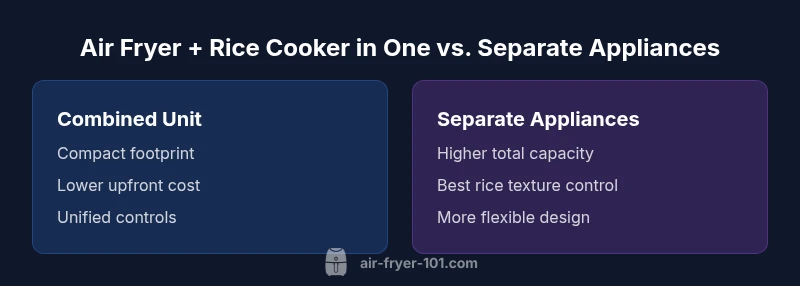
| Feature | Combined appliance (air fryer + rice cooker) | Separate appliances (air fryer + dedicated rice cooker) |
|---|---|---|
| Best use case | Small spaces, minimal setup, quick meals | Maximum control over rice texture and dedicated frying performance |
| Capacity options | Integrated pots in limited size ranges | Larger total capacity with separate units |
| Setup & footprint | Single device, compact footprint | Two devices, larger footprint but modular |
| Control & features | Unified controls, fewer modes | Dedicated settings tailored to each task |
| Ease of cleaning | One pot and tray to clean | Multiple components to clean, but easier task isolation |
| Price range | Typically lower upfront for combos | Wider price range depending on brands and features |
| Durability & warranty | Single-unit design, simpler maintenance | Two independent units may offer modular replacements |
| Best for | Urban kitchens, minimalism, space-saving | Families needing volume, versatility, and precision |
Pros
- Saves counter space and reduces clutter
- Usually lower upfront cost than buying two dedicated appliances
- Simplifies cooking routines with a single control panel
Cons
- Rice texture and browning may never match dedicated units
- Fewer model options and potentially slower performance for some tasks
- Limited capacity for large families compared with separate devices
Combo units excel in small-kitchen efficiency; dedicated gear wins for performance and capacity
If you prioritize space and streamlined maintenance, a combined unit is a solid choice. For serious rice texture control or high-volume cooking, separate appliances deliver clearer advantages.
Got Questions?
What is the main benefit of an air fryer and rice cooker in one?
The primary benefit is space and cost efficiency: one device handles two common tasks, freeing counter space. It’s convenient for quick meals and small kitchens, but may trade peak performance for convenience. Expect solid everyday results with careful recipe selection.
The main benefit is saving space and money by combining two functions in one device, which is great for small kitchens and quick meals.
Are combo appliances reliable for consistent rice texture?
Consistency varies by model. Some combos offer good white rice results and acceptable brown rice texture, while others can be uneven. If rice texture is a priority, review user feedback and look for devices with dedicated rice cycles and moisture control.
Consistency varies by model; read reviews to find a unit with reliable rice texture.
Can I cook fried foods and rice at the same time with a combo unit?
Many models support simple multi-tasking, but true simultaneous perfection is rare. Typically you’ll do one task at a time, or use a secondary pot for sides. If simultaneous cooking is essential, verify the product’s multi-task capabilities before purchase.
Some models can handle multi-tasking, but usually you’ll do one function at a time.
How do I choose the right capacity for my family?
Estimate weekly rice servings and typical fried portions. Choose a size that accommodates at least your largest meal plus some margin for leftovers. Remember that larger units may be bulkier and heavier, so balance capacity with counter space and storage.
Choose a size based on your largest meals and typical weekly rice portions.
Are there any downsides to buying a combo unit?
Yes. You may trade off rice texture precision and fry crispness compared with dedicated devices. Also, fewer models exist in some markets, and you’ll be buying a device that must excel at two fairly different tasks.
Main downsides are potential compromises in rice texture and fry crispness, plus fewer model options.
Quick Summary
- Assess kitchen space before choosing a model
- Define your rice texture expectations and frying needs
- Check capacity in practical terms, not just cups
- Favor models with easy cleaning and reliable warranty
- Read independent reviews to validate real-world performance