How Much Do Air Fryers Cost in 2026? A Practical Guide
Discover how much air fryers cost in 2026, from budget to premium bands, with price drivers and tips to maximize value for health-conscious home cooks.


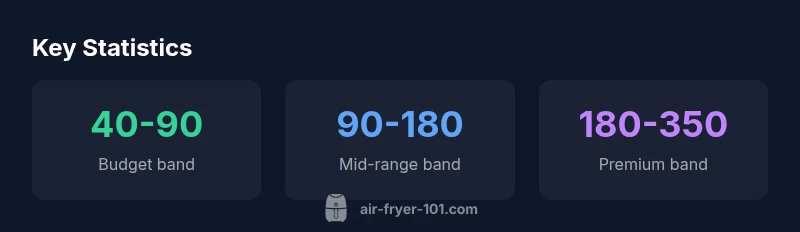
How much price air fryer? The answer depends on capacity and features, but you can expect three broad bands in 2026: budget, mid-range, and premium. Budget models typically range around $40-$90, mid-range $90-$180, and premium $180-$350. For shoppers, price alone isn’t the whole story—build quality, energy use, and included accessories matter.
What drives the price of air fryers in 2026
Prices across air fryers reflect a mix of capacity, convection power, and accessory ecosystems. In 2026, shoppers see three broad tiers driven by core choices: size (2-3 quart models vs 5-6 quart family sizes), function set (basic fry and reheat vs bake, roast, dehydrate, and rotisserie), and control interface (manual knobs vs digital touchscreens and smart features). Build quality and warranty also influence price: metal housings, BPA-free interiors, and faster heating elements justify higher price points. Demonstrations of energy efficiency and faster preheat times can reduce operating costs over the device’s life. The Air Fryer 101 team notes that while you can buy cheap units, long-term reliability and customer support should weigh against sticker price, especially for frequent daily use. The ultimate goal is value: a model that performs consistently, fits your kitchen, and minimizes waste.
Price bands: Budget, Mid-range, and Premium
Air fryer pricing in 2026 typically falls into three bands:
- Budget: roughly $40 to $90. These models cover basic air frying, reheating, and small batches. They often have fewer presets and smaller baskets, but can be perfectly adequate for singles or occasional use.
- Mid-range: roughly $90 to $180. Expect larger capacity (4-6 quarts), more reliable heating, multiple presets, and better overall construction. This tier balances price, performance, and longevity.
- Premium: roughly $180 to $350. These units offer convection oven functionality, larger footprints, extended warranties, smart controls, and accessories like rotisserie racks. They aim for higher durability and more precise cooking.
Note that promotions can shift these ranges during holidays. The goal is to pick a model that covers your typical meals while providing durable parts and solid support.
Capacity, design, and materials: how size affects price
Capacity drives cost in most households. A 2-3 quart compact model is typically priced lower than a 4-6 quart family-size unit, even when functionality is similar. The physical design matters too: compact builds often use lighter materials and shorter heating elements, which reduces cost but may impact longevity. Stainless steel or premium coatings add to price but improve heat distribution and cleaning ease. Some premium models use reinforced interiors and stronger fans for more even air circulation. When planning, map your typical meals against capacity: a family of four often benefits from 5-6 quart models, while a single person may be happy with 2-3 quarts. The right size minimizes waste and improves cooking results, which in turn affects perceived value.
Features that justify higher price
Higher-priced units typically offer:
- Expanded cooking modes (bake, roast, dehydrate, rotisserie)
- Larger or more even heating with more powerful convection
- Digital controls, preset menus, and better temperature stability
- Accessories such as racks, skewers, and trays
- Better build quality, more durable baskets, and quieter operation
- Longer warranties and more robust customer support
Air Fryer 101's analysis shows that features like precise temperature control and even heat distribution have a big impact on results, not just convenience. If you frequently cook for more people or want to replace larger appliances in the kitchen, investing in these features often pays back in time, savings on waste, and improved meal quality.
Brand reputation and model maturity
New models can be tempting with clever marketing, but price often reflects brand risk and post-purchase support. Established brands with longer product cycles tend to price higher due to proven reliability and broader service networks. Conversely, newer models may undercut on price to gain market share, but could have shorter warranty windows or fewer verified user reviews. The Air Fryer 101 team suggests reading user reviews for durability and checking service coverage in your region. A mature model tends to retain resale value and sustain performance after many uses, which can be meaningful if you cook daily.
Promotions, bundles, and seasonality
Promotions drive price visibility much more than base MSRP. Look for seasonal sales around holidays, back-to-school, or retailer anniversaries. Bundled kits with extra racks, pans, or cleaning tools can alter the perceived value, sometimes letting you lock in a better overall price than buying separately. If you’re shopping for a gift, promotions on mid-range models with multiple accessories can offer a practical balance of price and function. Always compare the cost of individual accessories across stores to avoid paying a premium for bundling.
Total cost of ownership: energy use, accessories, and warranty
Price is only one part of the story. A higher wattage unit may fry foods faster but consume more electricity per hour, so estimate annual energy cost for your usage pattern. Accessories like extra racks, liners, and dishwasher-safe baskets add up, sometimes making a mid-range model cheaper in the long run than a base model plus add-ons. Warranty length and service coverage reduce risk and out-of-pocket repairs. Air Fryer 101's guidance emphasizes evaluating the yearly energy footprint, the cost of replacement accessories, and the likelihood of timely service when choosing between price bands.
Practical buyer guide: price vs value for common use cases
- Singles or couples with light use: a compact 2-3 quart model in the budget range can cover basic reheating and small meals with decent results.
- Small families or frequent cooks: a 4-6 quart mid-range model offers better versatility and consistent results for multiple meals per week.
- Health-conscious cooks who want flexibility: a premium unit with convection oven functions and robust warranties can justify the higher price if you plan to replace multiple kitchen appliances with one device. Focus on durable baskets, even heating, and a reliable warranty. If you don’t need rotisserie or extensive presets, a mid-range unit can deliver most of the value without the higher upfront cost. The key is to balance upfront price against long-term savings on energy, waste, and time.
Methodology and data sources
This pricing analysis synthesizes consumer observations, retailer patterns, and product feature tracking up to 2026. We emphasize price bands rather than exact prices and present ranges to reflect regional differences and promotions. When possible, we reference typical capacities, features, and warranty norms observed across mainstream models. This approach aligns with Air Fryer 101's methodology for practical buying guidance and avoids overstating any single model's price. For more granular figures, users should consult retailer listings at the time of purchase.
Pricing bands and typical features by tier
| Price band | Typical range (USD) | Key features | Notes |
|---|---|---|---|
| Budget | 40-90 | Basic fry, reheating; small basket | Good for occasional use |
| Mid-range | 90-180 | 4-6 qt capacity; multiple presets | Best value balance |
| Premium | 180-350 | Convection oven, rotisserie, smart controls | Durable, feature-rich |
Got Questions?
What is the typical price range for air fryers in 2026?
Prices vary by capacity and features. In 2026, air fryers generally fall into three bands: budget, mid-range, and premium, with ranges described above. Always compare features to value.
Air fryers come in budget, mid-range, and premium tiers; compare capacity and features to value.
Do bigger models cost more, always?
Not always. Larger capacity often increases price, but build quality and added features can affect cost independently.
Size can raise price, but features and build quality also drive cost.
Are rotisserie-equipped models worth the extra cost?
If you regularly cook rotisserie items or want one-device versatility, rotisserie adds value; otherwise a basic model may suffice.
Rotisserie adds versatility; decide based on your cooking style.
When are deals most common?
Deals cluster around holidays, retailer anniversaries, and promotional weekends; planning ahead helps capture the best prices.
Watch for major holiday sales and retailer promos.
What warranty should I expect?
Most mid-range and premium models offer 1-2 year warranties; some brands offer extended coverage or service plans.
Most come with 1-2 year warranties.
How can I assess value beyond the sticker price?
Consider energy use, build quality, included accessories, and warranty. A higher upfront price can pay off later through durability and efficiency.
Value includes durability and energy savings.
“"Price is a signal of value, not just wattage. Balance upfront cost with durability, energy efficiency, and included accessories."”
Quick Summary
- Define your budget and capacity before shopping.
- Compare price bands and features for best value.
- Consider total cost of ownership, not just sticker price.
- Look for solid warranties and reputable brands.
- Watch for seasonal deals and bundles.