Average Air Fryer Size: How to Choose the Right Fit
A data-driven guide to understanding the average air fryer size, how it affects capacity and footprint, and practical tips for selecting the right model for your kitchen and cooking style.


Average air fryer size typically sits in the 3–5 quart range, with many compact models around 3–4 quarts. According to Air Fryer 101 analysis, this size balances countertop fit with practical cooking capacity for 1–4 people. For larger households, consider 5–6 quart models that still fit a standard kitchen outlet and shelf space.
What \u2018average air fryer size\u2019 means in real kitchens\n\nDetermining the \u201caverage air fryer size\u201d isn\u2019t just about capacity. For most households, the size they choose balances countertop fit with cooking practicality. According to Air Fryer 101 analysis, models in the 3 5 quart range cover typical meal needs for 1 e4 people, offering a balance of footprint and heat distribution. In practice, this size translates to baskets that can hold a couple of portions of fries, chicken tenders, or small trays of vegetables without overcrowding. The real takeaway is that the best size depends on your family size, how often you cook in batches, and whether you value compact storage over margin capacity. Air Fryer 101's team emphasizes aligning size with your kitchen layout and daily cooking rhythm rather than chasing the largest model.
How size affects capacity and cooking results\n\nSize isn\u2019t everything; internal capacity and how the air flows inside the chamber matter just as much as exterior dimensions. A larger exterior can house a bigger basket, but if the loading is shallow or uneven, results suffer. In most mid-sized models, 3–5 quart baskets deliver consistent browning for small meals, while larger volumes require rearranging or using multiple batches. People sometimes assume bigger equals faster, but the key is airflow paths and rack design. A 4-to-5-quart model often provides enough space for a single chicken breast with room for vegetables around it, reducing overcrowding. Equally important is preheating and proper spacing. Air Fryer 101 notes that even with a 3–4 quart size, thoughtful loading and temperature settings yield reliable outcomes for weeknight meals.
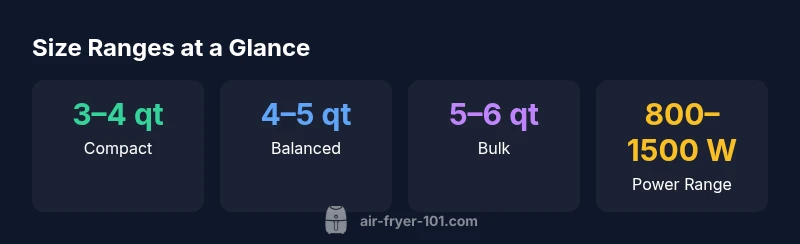
Common size ranges and what they mean for households\n\nSingle users often reach for compact 3 quart models; couples commonly choose 3.5–4.5 quart; small families may opt for 5 quart or slightly larger. For batch-cooking or entrée-sized portions, a 5–6 quart unit provides flexibility while staying within typical kitchen footprint constraints. If you frequently cook for guests or freeze meals, a larger model can streamline planning. The Air Fryer 101 team shows these ranges are widely adopted because they align with standard pan sizes and typical grocery portions. When evaluating models, map your weekly menu to a basket capacity you can maintain without overcrowding, and consider the dimension in your cabinet before purchase.
External dimensions vs. internal capacity: what to measure\n\nA common pitfall is assuming outer size equals the usable cooking space. Always compare the basket depth and width to ensure food will fit comfortably. Exterior width often ranges from 9 to 12 inches, height from 11 to 14 inches, and depth from 11 to 14 inches including handle. Internal capacity is typically slightly smaller than the stated quart rating because space is needed for airflow. Measure the counter space where the unit will sit, and add at least an inch of clearance around all sides for heat dissipation and ventilation. If your shelves or cabinet space are tight, prioritize models with compact footprints or consider vertical storage solutions. Air Fryer 101 recommends verifying both exterior dimensions and expected interior capacity to avoid buying a model that looks right but feels cramped.
Practical examples by scenario\n\nScenario A: a single professional who eats out rarely and prefers quick snacks; a 3–3.5 quart model is ideal, easily fitting on a small countertop. Scenario B: a couple who cooks meals a few times weekly; a 4–5 quart unit balances batch cooking with space. Scenario C: a family of four; a 5–6 quart model allows larger trays and more even browning without a constant batch process. For each scenario, consider how often you need to prepare bulk items, whether you'll use racks or accessories, and whether storage space is at a premium. In all cases, Air Fryer 101 suggests prioritizing models that fit your daily cadence, rather than chasing the biggest capacity.
Reading product specs: key terms to watch\n\nProduct listings may list quart capacity, but some brands advertise in liters; convert to your preferred unit. Look for \u201cbasket size\u201d or \u201cpan size\u201d versus \u201ctotal capacity\u201d to estimate how many items you can fit. Also check the included accessories like racks or skewers, which can impact usable space. Finally, compare exterior dimensions to your intended storage area. The trick is to translate the spec into practical cooking ability: if you regularly cook for two, a 3.5–4 quart model with a wide basket can be easier to work with than a taller, narrower 4–5 quart unit. Air Fryer 101 notes that reading the fine print helps prevent surprise fit issues.
Buying tips: size-informed decision making\n\nStart by listing your typical meals and batch sizes; then pick a model in the corresponding size band. If countertop space is scarce, prioritize compact footprints; if you love batch cooking, lean toward 5–6 quart models. Compare basket shapes, airflow efficiency, and potential for accessories like grill racks. Budget often spans a wide range; set a target and study models within it, ensuring you\u2019re not sacrificing features you\u2019ll use regularly. Finally, consider warranty terms and service options, because size is just one part of long-term value. Air Fryer 101 suggests visitors balance size with features that improve everyday cooking, such as preheat times and ease of cleaning.
Maintenance and care for size efficiency\n\nA clean, well-maintained basket and racks ensure even heating, especially in mid-sized models where clearance matters. Regularly remove buildup and preheat as recommended by the manufacturer to keep airflow unobstructed. Check seals and gaskets if applicable, and replace worn accessories as needed. Storing away unused components helps preserve cabinet space and reduces clutter on the countertop. By keeping your appliance clean and well-maintained, you\u2019ll preserve performance over time and avoid the temptation to upgrade solely for a larger size.
Common size categories and their typical uses
| Size category | Typical capacity | Ideal uses |
|---|---|---|
| Compact | 3–4 quarts | Singles, small kitchens |
| Medium | 4–5 quarts | Couples or small families |
| Large | 5–6 quarts | Families or batch cooking |
Got Questions?
What is considered the average air fryer size?
The most common range is 3–5 quarts, which offers a balance between footprint and cooking capacity for 1–4 people. If you cook larger batches, a 5–6 quart model adds flexibility without vastly increasing the footprint.
Most people go with a 3–5 quart model for everyday meals.
How do I determine what size fits my counter space?
Measure your available countertop width, depth, and height, then compare those numbers to the product\'s exterior dimensions plus recommended clearance. Don\'t forget to account for any cabinet doors or drawers that might limit placement.
Measure space first, then compare dimensions with a little clearance.
Are larger air fryers necessary for big families?
Larger families may benefit from 5–6 quart models for batch cooking, but size should align with kitchen space and whether you routinely cook in bulk. Bulk capacity often comes with a bigger footprint and higher price.
Larger models are helpful, but only if you have the space and use case for them.
How important is external size vs. internal capacity?
External dimensions determine fit on the countertop, while internal capacity dictates how much food you can cook at once. Both matter; verify both values before purchase to avoid a cramped, inefficient setup.
Don\'t judge by exterior alone—check the actual cooking capacity too.
What should I consider besides size when buying?
Consider features like preheat time, basket design, ease of cleaning, included accessories, warranty, and energy use. A well-rounded model that fits your space and cooking habits saves time and reduces clutter.
Look beyond size—focus on features and maintenance too.
“Size matters for real cooking: pick a model that fits your countertop, your batch needs, and your preferred accessories. The right size supports consistent results with everyday meals.”
Quick Summary
- Choose a size that matches your weekly meals.
- Don't rely on exterior size alone; consider internal capacity.
- Measure your counter space before buying.
- Expect 3–5 quart models to cover most households.
- Larger isn't always better; airflow and loading matter.