How big should your air fryer be: a practical sizing guide
Learn how to choose the right air fryer size for your family and kitchen. This Air Fryer 101 guide covers quart ranges, space needs, and practical tips to avoid common mistakes.


The ideal air fryer size depends on your household size, typical meals, and counter space. For 1-2 people, a 3-4 quart model is usually sufficient; for families, 5-6 quarts or larger. If you batch-cook or reheat large dishes, choose 6-8 quarts. Allow at least 1-2 inches of clearance around the unit for airflow and verify basket capacity matches your common portions.
Why size matters for air fryers
Choosing the right size matters because it directly affects what you can cook in a single batch, how evenly food browns, and how much countertop space the appliance will consume. The wrong size can lead to wasted energy, longer cooking times, or meals that don’t brown evenly. For many home cooks, the goal is to balance capacity with practicality—enough room for your common portions, without crowding your counter.
According to Air Fryer 101, size choices are not just about the number of servings; they also influence airflow, heat retention, and ease of use. A unit that’s too small for your typical meals will force you to split recipes into multiple batches, which increases time and energy use. Conversely, a unit that’s too large for one or two people can sit idle for most days, taking up valuable counter space. The takeaway is simple: match the unit to both your weekly menu and your kitchen footprint.
In practice, you’ll usually find three popular ranges: compact (3-4 quarts) for singles or couples; mid-size (5-6 quarts) for families of four; and larger (8 quarts or more) for bigger households or air-fryer enthusiasts who want to roast whole trays. Remember that round baskets and square pans fit differently, so think about the dishes you cook most often. If you frequently reheat large portions or cook sheet-pan meals, size matters more than you might expect.
How to measure your space and decide
Begin by measuring your available counter space. Note the width, depth, and height clearance needed to accommodate the unit's footprint and handle. Plan for at least 1-2 inches of clearance on all sides and above to ensure air can circulate. Check your countertop depth; if a model's width plus the handle exceeds available space, you may need a smaller unit or a different layout.
Next, confirm power availability. Most air fryers require a standard 120V outlet and a dedicated circuit if you use other high-wattage appliances nearby. Make sure your outlet can handle the unit’s wattage without tripping breakers. Finally, map the places where you cook most often; if you mostly reheat on a bench by the stove, ensure the unit won’t obstruct cooking flows or cause heat near cabinets.
Typical size ranges and what they mean
Air fryers typically come in compact (3-4 quarts), mid-size (5-6 quarts), and larger (8 quarts or more). A 3-4 quart unit is well-suited for 1-2 servings and quick reheats, a 5-6 quart model handles 3-4 servings and more versatile meals, while 8 quarts or larger can roast a small chicken or accommodate sheet-pan dinners for bigger households. Air Fryer 101 analysis shows that many households find 3-4 quarts best for apartments or solo cooks, 5-6 quarts ideal for small families, and 8 quarts or more great for larger families or batch cooking. When considering size, also think about the basket shape (round vs. square) and how it impacts space usage and cooking efficiency.
Capacity is not the only factor; the physical footprint matters too. A taller, narrow unit may fit where a wider model cannot, and weight distribution can influence stability on glossy countertops. If you plan to store the air fryer under a cabinet, ensure there’s enough headroom to open the lid or pull-out tray without hitting the underside of cabinetry.
How size affects performance: capacity vs. efficiency
Larger units are capable of cooking more food in a single batch, which can cut total meal prep time when feeding a family. However, bigger does not always mean faster; many models require longer preheating and heat up time to reach even browning across a larger basket. Smaller units heat quickly and are great for reheating, smaller portions, or cooking snacks. Efficiency also depends on how well the unit circulates hot air; some mid-size models strike a balance between capacity and fast, even cooking. If you frequently cook multiple items at once, verify that the design allows stacking or has a sufficiently tall basket to keep air flowing around items. Remember that food density and arrangement affect browning—crowding reduces crispiness in any size.
Another consideration is energy use. A unit with a higher wattage can heat faster but may draw more power, so evaluate your kitchen’s electrical setup and any other high-wattage devices you run at the same time. In the end, the best size aligns with your typical meals, your cooking style, and how you balance speed, texture, and energy use.
Practical tips for small kitchens
Small kitchens benefit from thoughtful placement and flexible storage. Look for compact footprints that still offer a comfortable capacity, and consider models that fit under cabinets with a shallow height. If space is tight, a square-basket model can maximize inner capacity within the same exterior footprint. Use vertical shelving or a small cart to keep the air fryer accessible without crowding counters. When choosing a model, verify the clearance around the unit in real use—the back vent should not be blocked by walls, tiles, or cabinet backs. If you cook multiple meals, a two-tier rack accessory (where supported) can let you cook two different items at once, saving time.
Maintenance matters too; choose dishwasher-safe baskets and non-stick coatings that are PTFE-free for easier cleaning and long-term durability.
How to compare models: features that matter by size
When comparing models by size, prioritize features that complement capacity. Wattage influences heating speed, while preset programs simplify common tasks (frozen fries, chicken nuggets, vegetables). Look for a model with a clear basket design that allows easy draining and turning of foods, and check that the unit provides stable performance on your countertop. A smaller model that includes a robust air path and a consistent heat source can outperform a larger, poorly ventilated unit. Don’t overlook practical details like dishwasher-safe baskets, easy-to-clean interiors, and reliable safety features (automatic shutoff, cool-touch handles).
Finally, read user reviews and verify that the model fits your kitchen dimensions. If possible, visit a showroom to see the footprint in person and assess how it would fit with your counter workflow.
Common mistakes and how to avoid them
- Buying based on aesthetics alone: prioritize capacity and airflow over looks.
- Ignoring measurements: always measure counter depth, width, and height before choosing a size.
- Underestimating clearance: allow space on all sides and above for heat circulation.
- Overfilling the basket: avoid overcrowding; air needs space to circulate for even browning.
- Skipping warranty and return policy: ensure you have a flexible return option if the size doesn’t fit in practice.
To avoid these, bring a measuring tape and a photo of your countertop to comparisons, and test fit at home when possible.
Authoritative sources
- FDA safety guidelines for kitchen appliances: https://www.fda.gov/food-safety
- US Department of Energy: Energy efficiency of kitchen appliances: https://www.energy.gov/eere/buildings/articles/energy-efficient-kitchen-appliances
- Consumer Reports air fryer buying guide: https://www.consumerreports.org/cooking-appliances/air-fryers/
Tools & Materials
- Measuring tape or ruler(To verify footprint dimensions and clearance)
- Access to a standard 120V electrical outlet(Ensure the circuit can handle the air fryer wattage (check model specs))
- Counter space with recommended clearance(Allow at least 1-2 inches on the sides and 6-8 inches above)
- Optional planning sheet or notebook(For comparing models and meals)
Steps
Estimated time: 30-60 minutes
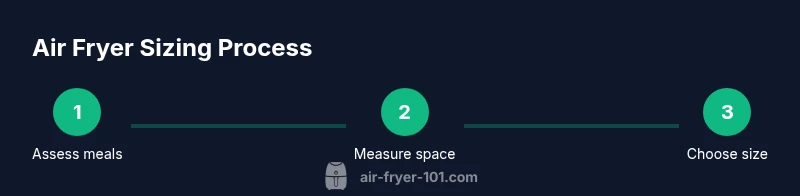
- 1
Assess weekly meals
List your typical dinners, reheats, and snacks to estimate daily serving sizes. This will guide you toward the right quart range.
Tip: Write down your top 5 meals and the average portions you serve. - 2
Measure your space
Measure width, depth, and available clearance on all sides and above the counter. Include the space for the lid/handle when open.
Tip: Use painter’s tape on the counter to visualize footprint before buying. - 3
Match meals to quart ranges
Translate your meal portions to quart capacity. 3-4 quarts suits 1-2 people, 5-6 quarts fits a small family, 8 quarts or more serves larger households or batch cooking.
Tip: If you split meals into batches, consider the next size up. - 4
Check power and ventilation
Verify outlet availability and ensure there’s enough clearance around the unit to prevent heat damage to nearby cabinets.
Tip: Avoid placing near heat-producing appliances to prevent overload. - 5
Compare models by size and features
Read specs for wattage, basket type, and cleaning options. A slightly larger model with good airflow can outperform a bigger, poorly ventilated one.
Tip: Prefer models with dishwasher-safe baskets for easier cleaning. - 6
Decide and test at home
Choose a model with a favorable return policy, then test fit on your counter with lids open and closed. Ensure it does not obstruct tasks.
Tip: If possible, test the unit in-store or through a retailer with a generous return window. - 7
Fine-tune placement and usage
Position the air fryer for easy access and safe airflow. Document how you plan to use it to maximize efficiency.
Tip: Keep a small chore list handy: wipe after use, inspect for wear, and rotate the basket occasionally.
Got Questions?
What size air fryer should I buy for a family of four?
A 5-6 quart model is a good starting point for a family of four, offering enough capacity for multiple servings without excessive bulk.
For a family of four, a 5-6 quart air fryer is usually a sensible starting point.
Is bigger always better for leftovers?
Not necessarily. A larger unit can waste energy and space if you rarely cook in bulk. Choose a size that fits your typical meals and space.
Bigger isn’t always better. Pick a size that fits your daily meals and kitchen space.
Can I fit a large air fryer in a small kitchen?
Yes, by selecting a compact footprint or under-cabinet model, but you must verify height and width clearances and ensure adequate airflow.
Yes, with careful measurement and choosing a compact model, you can fit it in a small kitchen.
Do all air fryers come with adjustable racks?
No. Some models include two-tier racks or trays as accessories, but you should check model specifications before buying.
Not all models include adjustable racks; check the product details.
How do I know if the air fryer fits on my countertop?
Measure the unit’s width, depth, and height, then compare to your counter space and any nearby cabinets. Leave airflow clearance as a safety margin.
Measure the footprint and clearance on your counter to ensure a safe fit.
Watch Video
Quick Summary
- Choose size to match meals, not just kitchen space.
- Measure counter footprint and ensure airflow clearance.
- For 1-2 people, 3-4 qt is often sufficient; for families, 5-6 qt is common.
- Consider countertop layout and power availability when deciding.
- Prioritize airflow, basket design, and ease of cleaning over sheer capacity.