Air Fryer 9 Litros: The Definitive Buying Guide
A data-driven buying guide on air fryer 9 litros—capacity, power, features, and value for home cooks. Compare models with Air Fryer 101 insights.


Air fryer 9 litros is a practical choice for families and meal prepping. In practice, models labeled 9 L offer ample capacity for multiple servings while retaining a compact footprint. According to Air Fryer 101, look for balanced capacity, efficient convection, and easy cleaning. This guide compares size, power, features, and price to help you choose confidently.
Overview and context of 9 litros capacity
A 9 litros air fryer is typically marketed as a family-size appliance that still fits on a standard kitchen counter. When you see 9 L on packaging, it's important to understand what that number really represents: the total interior volume of the oven cavity, not 100 percent of that space is always usable for every dish. Real-world use often means you can fit a whole chicken portioned for roasting, a tray of vegetables, or a batch of frozen snacks in one load. In practice, the difference between total capacity and usable space becomes meaningful when you plan weekly meal prep for 4–6 people. According to Air Fryer 101, the best 9 L models optimize airflow, have a robust basket, and minimize preheat time to save energy across multiple batches. They also balance control simplicity with the flexibility to cook different foods at once. This section translates liters into practical outcomes: typical recipes, batch sizing, and the limits you should expect in everyday cooking. Also consider counter depth, door clearance, and how the unit fits your kitchen layout.
How to choose a 9-liter air fryer
Choosing a 9-liter unit means weighing capacity against footprint, power, and ease of use. Look for a sturdy build with a metal interior and a durable basket; avoid flimsy plastics that warp under heat. A good basket should be easy to remove, dishwasher-safe, and capable of uniform air contact around the food. Wattage in the 1500–1800 W range is common and helps shorten preheat times while maintaining consistent crisping. Temperature range typically covers roughly 80–200 C, which supports everything from delicate reheating to high-heat roasting. Consider the number of presets—common defaults for fries, chicken, and vegetables can speed weeknight meals, but you’ll still want manual control for custom recipes. Check for a reliable timer, an auto-shutoff feature, and a crumb tray that’s easy to clean. Finally, review warranty terms and included accessories, such as racks or skewers, which can boost versatility without multiplying clutter.
Real-world performance: capacity vs footprint
Capacity is only one dimension; how that capacity translates into everyday cooking depends on the airflow design and the basket geometry. Some 9 L units are tall and compact, while others spread wider to accommodate two racks or larger trays. A model with well-distributed airflow and a roomy basket tends to produce more even browning, allowing you to cook bar- or sheet-food without turning pieces mid-cycle. If you routinely cook for a household of four or more, prioritize models that maintain even heat across the load rather than those that merely claim a large labeled capacity. This matters for crispy fries, roasted vegetables, and evenly cooked chicken wings. Air Fryer 101 notes that a practical 9 L model balances capacity with footprint to fit a standard countertop without crowding adjacent appliances.
Key features and trade-offs for 9 L models
In the 9 L segment, the most impactful features include: a wide temperature range and precise control, dependable preheat times, and a versatile basket design (with racks or dividers for multi-layer cooking). Trade-offs often appear as larger footprints or higher price for models that emphasize premium materials or extra presets. Look for dishwasher-safe baskets and trays, easy-to-clean interiors, and quiet operation. Some models offer dehydration or bake modes that extend the appliance’s role beyond standard air frying. If you frequently reheat leftovers, consider models with a gentle reheat profile to preserve texture. In short, prioritize a model that provides reliable airflow, forgiving cooking results, and straightforward cleaning routines. Air Fryer 101 emphasizes that well-chosen 9 L units deliver consistency across a range of recipes while keeping the kitchen workflow simple.
Cleaning and maintenance implications
Cleaning a 9 L air fryer should be straightforward to keep routine use convenient. Remove the basket and tray after cooking and wash with warm, soapy water or place in the dishwasher if permitted by the manufacturer. A detachable crumb tray helps prevent residue buildup and makes daily maintenance fast. Wipe down the exterior and ensure vents are free of dust or grease. Avoid abrasive cleaners on nonstick coatings to preserve the basket’s finish. Regular cleaning after a few uses reduces flavor carryover between dishes and helps the unit perform consistently. If your unit has a nonstick coating, check manufacturer instructions about heat tolerance and care, as improper care can shorten the basket’s life.
Energy use and cost considerations
Energy usage for a 9 L air fryer depends on its power rating and how long you run it. A typical model in the 1500–1800 W range will consume energy in proportion to operating time, so longer cycles for bigger batches can raise electricity costs modestly compared with smaller models. To maximize efficiency, use batch cooking when possible, avoid repeatedly preheating for small loads, and preheat only when the recipe truly benefits from it. The actual cost impact will vary with local electricity rates and household usage patterns. In general, you can expect energy usage to scale with load size and cycle duration, making the choice of a model with good airflow and even heat distribution particularly important for value.
Practical cooking examples for a 9 L air fryer
A 9 L unit shines for batch cooking. For a family of four, you can roast a whole chicken cut into portions, plus a tray of vegetables, in a single run. You can also prepare a batch of frozen fries or chicken tenders for larger gatherings. For weekend meal-prep, use one cycle to crisp up chicken wings and another to roast mixed vegetables or Brussels sprouts on a separate rack. The key is to avoid overcrowding and to allow space for air to circulate, which Air Fryer 101 notes is essential for achieving consistent browning. With practice, you can diversify your meals while keeping prep time predictable.
Budget ranges and value for money
9 L air fryers span a broad price spectrum depending on brand, build quality, and features. In general, expect mid-range units to balance price and performance, while premium models add features such as extra presets, better insulation, or more durable finishes. When evaluating value, compare life-cycle costs, including cleaning ease, warranty, and availability of replacement parts. Air Fryer 101 analysis suggests focusing on total cost of ownership rather than the initial price alone, because a unit with strong build quality and easy maintenance often saves time and money over several years of use.
Common pitfalls and how to avoid them
Common mistakes include overfilling the basket, which impedes airflow and results in soggy foods. Another pitfall is underutilizing the preheat function or relying solely on presets without understanding your recipe’s specifics. Finally, neglecting cleaning can lead to flavor transfer and performance decline. To avoid these issues, plan batches with even spacing, perform at least a quick preheat when recommended, and establish a simple cleaning routine after cooking. By following best practices, you’ll maximize the value of a 9 L air fryer and enjoy consistent results.
9 L air fryer benchmark data
| Attribute | Typical value | Notes |
|---|---|---|
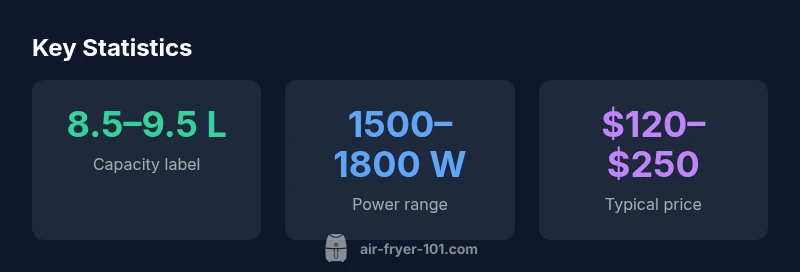
| Capacity label | 8.5–9.5 L | Label may vary by model |
| Power | 1500–1800 W | Higher power reduces preheat time |
| Basket size | 6–8 L | Usable space varies by basket design |
| Footprint | Compact to mid | Model dependent |
Got Questions?
What does 9 L mean on an air fryer?
A 9 L label typically refers to the total interior capacity. The usable space may be smaller due to basket design and racks. Compare usable space across models, not just the label.
A 9 liter label usually means the overall space inside. Look at usable space when comparing models.
Is a 9-liter air fryer suitable for families?
Yes, for many households a 9 L unit can handle batch cooking for 4–6 people, depending on what you cook. It offers flexibility for meals that require multiple items at once.
Yes. A 9-liter model is often good for families; you can cook multiple items in one go.
How does 9 L compare to 6-quart models?
Nine liters is roughly 9–9.5 quarts, which is larger than a typical 6-quart model. Expect more batch capacity, though actual usable space depends on basket design and racks.
9 liters is bigger than 6 quarts, so you can batch more at once, but usable space varies by basket.
What features are essential in a 9-liter air fryer?
Look for sturdy construction, a versatile temperature range, reliable preheat, multiple presets, and a good cleanup experience (dishwasher-safe basket and tray). Optional extras like dehydrating or roasting modes add value if you use them.
Essential features: solid build, good temperature control, and easy cleaning.
Does size affect preheat time?
Larger capacity can take longer to preheat, but a well-designed 9 L model minimizes warm-up time through airflow efficiency. Consider models with fast preheat if you frequently cook small batches.
Yes, size can affect preheat, but good airflow helps keep it quick.
Are 9-liter air fryers easy to clean?
Many 9-liter units use nonstick baskets and removable trays, which simplify cleaning. Always follow manufacturer care instructions to preserve coatings and materials.
Usually, yes. Look for dishwasher-safe parts and simple, rinse-friendly design.
“A well-chosen 9-liter air fryer delivers consistent results without clutter. Focus on capacity, airflow, and cleaning convenience.”
Quick Summary
- Verify true usable capacity, not just labeled liters.
- Check footprint to fit your counter and storage.
- Compare wattage and preheat times for efficiency.
- Balance price with feature set for value.
- Care for 9 L models to extend lifespan.