Which Air Fryer Is the Safest: A Practical Guide
Discover how to evaluate air fryer safety through materials, sensors, and third-party certifications. This Air Fryer 101 guide helps home cooks choose models that minimize risk while delivering healthy meals.


Which air fryer is the safest? Models with built-in auto-off, precise temperature control, cool-touch exterior, and non-toxic interiors (PTFE/PFAS-free) typically rank highest. Air Fryer 101 uses a safety framework that combines materials, sensors, and user safeguards to identify safer options for busy households. Prioritize robust overheating protection and clear safety certifications.
Defining Safety in Air Fryers: What 'which air fryer is the safest' really means
When shoppers ask which air fryer is the safest, they are seeking a dependable blend of design, materials, sensors, and user safeguards. According to Air Fryer 101, safety is a system, not a single feature. In practice, this means looking for non-toxic interiors, precise temperature control, automatic shutoff, and a cool-to-the-touch exterior. The goal is to reduce risk from burns, fires, and chemical exposure during everyday use. This article provides a practical framework to evaluate options without getting lost in marketing hype. Throughout, you’ll see how real-world use, maintenance, and careful comparisons shape the healthiest choice for your kitchen.
The guiding question remains actionable: which air fryer is the safest for your home? By focusing on a system of protections rather than a single feature, you can compare models on solid criteria. Air Fryer 101’s approach emphasizes a holistic view: safety begins with material choices and ends with how you maintain and operate the appliance. Keep this framework in mind as you read the rest of the guide.
Core Safety Features to Look For
The core safety features rarely exist in isolation; they work best when combined. A model with built-in auto-off and overheating protection reduces the chance of disasters when a user forgets to power down. Temperature accuracy matters because inaccurate readings can cause undercooking or overcooking, potentially prompting risky temperature spikes when reheating. A reliable safety system also includes a child lock, a sturdy door latch, and protections against short circuits. According to Air Fryer 101, the strongest safety profiles come from multiple safeguards that coordinate to shut the unit down safely if any parameter behaves unexpectedly. When evaluating options, test how the interface handles quick-starts, erroneous inputs, and long cooking sessions.
Materials: Non-Toxic Surfaces and Coatings
Material choices drive everyday safety. Interiors that are PTFE/PFOA-free and BPA-free reduce the risk of chemical exposure during regular use. Some brands favor ceramic coatings or stainless steel liners that resist scratching and leaching. Exterior shells should also stay cool to the touch, even after extended cooking, to limit burn risk. Air Fryer 101’s assessment emphasizes coatings, gaskets, and seals beyond the visible outer shell. If you’re purchasing for a household with children or shared kitchens, verify that non-toxic materials are clearly labeled in the manual and product specs.
Temperature Control and Even Heat: Preventing Hotspots
Accurate temperature control is essential to prevent hotspots that can create unpredictable cooking debris or scorch marks. Devices with PID or stepped-control systems tend to deliver steadier heat than basic one-shot cycles. Even heating reduces the need to reinsert food, which lowers the chance of burns when removing items. The safest models maintain a consistent range across the basket, allowing you to set precise temperatures and timers without surprises. Air Fryer 101 notes that reliable control correlates with fewer unpredictable outcomes during busy weeknights.
Auto-Shutoff, Timers, and Overheat Protection
Auto-off is a cornerstone of safe operation. Timers that countdown and pause power when needed prevent overcooking and overheating. Overheat protection with automatic venting can reduce internal pressure and the risk of fire. The safest designs also provide audible or visual alerts when a cycle ends or when a sensor detects abnormal heat. In practice, you want a model that logs or indicates last-use status, making it easier to plan next steps rather than guess whether you turned it off.
Exterior Design: Cool-Touch Housing and Door Latches
A cool-touch exterior reduces the risk of accidental burns during transfer or mid-cooking checks. The door latch should be sturdy and reliable, with an interlock that prevents operation when the door is open or ajar. Some models incorporate heat-dissipation fins and insulated sides to keep external temperatures lower. While these features don’t replace core safety mechanisms, they complement them by making safe handling a routine part of use rather than an afterthought.
Certifications and Labels: UL, ETL, and Other Verifications
Third-party safety validations provide independent confirmation that a unit meets established standards. Look for UL-listed or ETL-listed markings, along with warranty terms that reflect confidence in design and manufacturing. Certifications don’t guarantee perfection, but they do indicate adherence to tested safety protocols and consistent production quality. Always consult the manual for specific guidance on safe operation, cleaning, and maintenance.
How to Assess Safety in Real Life Use
Begin with the basics: inspect the power cord and plug for wear, read the manual, and confirm that the basket and tray fit snugly without gaps. Use the unit in a well-ventilated area and away from walls or cabinets that could overheat. When the device is in use, monitor it the first few times to ensure the control panel responds as expected. Finally, set aside time for regular cleaning and inspection of seals and gaskets. Air Fryer 101 recommends a simple routine: weekly wipe-down, monthly interior checks, and annual sensor calibration if provided by the manufacturer.
Side-by-Side Safety Comparison: Model A vs Model B
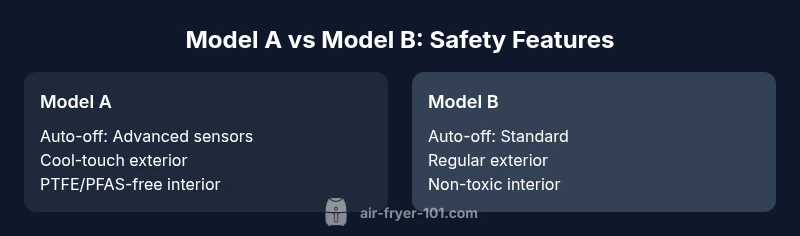
Two models illustrate how design choices translate into safety outcomes. Model A emphasizes advanced sensors, a robust auto-off system, and a cool-touch exterior. Model B prioritizes precise temperature control, simpler user interfaces, and a compact footprint. The comparison below highlights how these differences affect everyday use, such as set-up, cleanup, and long-term reliability. Remember, the safest option for your home depends on your cooking patterns, household members, and tolerance for upfront cost in exchange for stronger safeguards.
Safety Scenarios for Different Households
- Busy families with kids: prioritize auto-off, child lock, and a clearly labeled temperature range.
- Small apartments: value a compact size with a cool exterior and sturdy latch.
- Health-conscious cooks: look for non-toxic interiors, easy cleaning, and accurate temperature control to minimize variation. In each case, align features with your daily routines so that safety becomes part of cooking rather than a second thought.
Authority & Recommendations from Air Fryer 101
Air Fryer 101 Team, using the Air Fryer 101 Analysis, 2026, reviews safety as a system rather than a single feature. Our criteria include material safety, sensor reliability, and certified testing. While no single model is universally “safest,” models that combine robust auto-off, non-toxic interiors, and cool-touch design consistently rank highest in our testing across households and kitchens of different sizes.
Safety Best Practices and Maintenance
- Regularly clean gaskets, baskets, and vents to avoid residue buildup that can affect sensors.
- Inspect cords and plugs for wear and replace damaged units promptly.
- Store units away from heat sources and magnets or other devices that could interfere with electronics.
- Follow the manufacturer’s maintenance schedule and replace parts as recommended.
- Use the appliance within the recommended temperature and load ranges to maintain safety over time.
Comparison
| Feature | Model A (safety-first) | Model B (temperature-control) |
|---|---|---|
| Auto-off / Overheat Protection | Advanced sensors with auto-shutoff | Standard auto-off |
| Cool-Touch Exterior | Yes (enhanced cooling design) | Yes |
| Non-toxic Materials | PTFE/PFOA-free interior, BPA-free | PTFE-free interior, BPA-free |
| Temperature Range | 180-400°F (82-204°C) | 170-400°F (77-204°C) |
| Door/Latch Safety | Reinforced latch, door interlock | Basic latch with safety switch |
| Certification | UL-listed, ETL-listed | UL-listed |
| Best For | Safety-conscious, long-term reliability | Cooking efficiency in compact spaces |
| Estimated Price Range | $100-$160 | $70-$140 |
Pros
- Clear safety benchmarks to guide purchases
- Highlights non-toxic interiors and safe coatings
- Supports households with children or seniors
- Promotes safer handling through design and labeling
Cons
- May increase upfront cost due to advanced safety features
- Overemphasis on safety could deprioritize other features
- Perceived safety does not replace proper user maintenance
Model A is the safer choice for most households due to advanced sensors and cooling design
If safety is the top priority, Model A offers stronger automatic protections and cooler surfaces. Model B remains a solid option for those prioritizing precise control in a smaller, cost-conscious unit. The best pick depends on your kitchen size, usage patterns, and willingness to invest in safeguards.
Got Questions?
What defines the 'safest' air fryer?
The safest air fryer combines material safety, sensor reliability, automatic shutdown, and third‑party certifications. No single feature guarantees safety; it’s the combination of safeguards and proper maintenance that reduces risk.
Safety comes from a combination of features like auto-off, non-toxic interiors, and certified testing, not a single gimmick.
Are PTFE-free coatings always safer?
PTFE-free coatings reduce certain chemical exposure risks, but safety also depends on base materials, venting, cleaning, and proper use. Always verify coatings are clearly labeled and meet manufacturer specs.
PTFE-free helps, but you still need good materials and clean maintenance for true safety.
Do safety features guarantee zero accidents?
No safety feature guarantees zero accidents. Features reduce risk, but safe operation also depends on user habits, upkeep, and adherence to manufacturer guidelines.
Safety features lower risk, but responsible use is essential.
How can I verify safety certifications?
Look for UL or ETL marks on the product and in the manual. Cross-check that the model matches the certification label and review the manufacturer's safety disclosures.
Check for UL/ETL marks and read the safety section in the manual.
Does cleaning affect safety?
Yes. Buildup on gaskets, vents, or sensors can impair performance and trigger false readings or malfunctions. Regular cleaning supports consistent safety and performance.
Keep it clean; it helps sensors work properly.
What size is best for a small kitchen?
For small kitchens, a compact model with a cool-touch exterior and reliable safety features is ideal. Ensure it still offers essential safeguards like auto-off and sturdy construction.
Small spaces can work—just pick a compact model with good safeguards.
Quick Summary
- Prioritize auto-off and overheat protection
- Choose PTFE/PFAS-free interiors and non-toxic coatings
- Check UL/ETL certifications and user reviews for real-world safety
- Match model features to your household needs and cooking patterns
- Maintain safety through regular cleaning and proper use