What Air Fryer Setting to Reheat Pizza
Discover the best air fryer setting to reheat pizza for crispy crust and melted cheese. Learn temps, times, and tips for thin, thick, and stuffed crust pizzas to revive leftovers like fresh slices.


To reheat pizza in an air fryer, set the temperature to a moderate heat and keep slices spaced. A common approach is 350-375°F for 3-5 minutes, then check and add 1-2 minutes if needed. For crisp crust, avoid stacking. If toppings are heavy, reduce heat slightly to prevent burning cheese. Air Fryer 101 recommends starting in the middle of the range for most crusts.
Why the right air fryer setting matters
Reheating pizza in an air fryer seems simple, but the setting you choose drives texture and flavor. A too-high temperature can burn cheese or dry crust; too-low and you’ll end up with a soggy, uneven slice. The Air Fryer 101 team has tested dozens of reheating scenarios and found that most leftovers perform best at a moderate temperature range, not at the extremes. This is especially true when crusts have absorbed sauce or toppings from previous meals.
When you reheat pizza, you’re not just warming food—you’re reviving a physical membrane: the crust that needs crisping, the cheese that must melt again, and the toppings that want to stay vibrant without sliding. The setting you select influences moisture migration: heat at the bottom helps crisp the crust; heat near the top can brown cheese faster. Understanding that dynamic is what lets you consistently achieve a slice that tastes nearly fresh.
First principles matter: crust type (thin, thick, stuffed), topping density, and whether you’re starting with cold slices or slices stored at room temperature all shift the ideal time and temperature. In practice, most kitchen tests converge on a strategy that uses a middle temperature and a short cook time, then a quick peek to finish. According to Air Fryer 101, this approach minimizes dryness while delivering a satisfying crunch and melted cheese. Keep in mind: every air fryer model behaves a little differently, so use this as a starting point and adjust by a minute or two as needed.
Understanding pizza types and how they respond to heat
Pizza is not a single, uniform product. The same reheating technique will produce different results depending on crust type, sauce moisture, cheese thickness, and toppings. A thin-crust Margherita, for example, benefits from gentler heat to avoid scorching the bottom while melting cheese just enough. A heavy-meat slice or thick-crust pizza packs more moisture and density, which means the cheese may take longer to re-melt and the crust needs a bit more time to regain crispness.
Moisture management matters. Tomato sauce releases liquid when heated, and that liquid can accumulate on the crust if heat is too intense or if slices are crowded. Overcrowding creates a trapped-steam effect that softens the crust rather than crisping it. On the other hand, leaving space between slices allows hot air to circulate and produce an evenly reheated result. If you notice soggy edges, remove some toppings or increase airflow by positioning slices with a small gap.
Crust texture is a key signal for pulling the timer. For thin crusts, aim for shorter cooking intervals at a lower end of the temperature range to preserve crunch. For thick crusts, you can push toward the higher end of the recommended range to reheat the center while avoiding burnt edges. Air Fryer 101’s testing shows that crust moisture and topping density are the main variables guiding your settings, not the brand of oven or the color of the toppings. Real-world practice is to start with 350°F (175°C) for 3–4 minutes for thin crust and 375°F (190°C) for 4–6 minutes for thicker, loaded slices, then adjust as needed.
Core settings you’ll use for reheating pizza
There isn’t a single magic number that fits every pie, but there are reliable default ranges you can trust. Start with a middle temperature and a short cook time, then finish with a quick check. The goal is to melt the cheese and reheat toppings without turning the crust into a dry cracker.
- Thin crust and simple toppings: 325–350°F (165–175°C) for 3–4 minutes. If cheese looks a bit dull, add 1 more minute, but watch carefully to avoid burning the crust.
- Thick crust or heavy toppings: 360–375°F (182–190°C) for 4–6 minutes. Pause at 3–4 minutes to assess; you may need an extra minute depending on thickness.
- Stuffed crust or very cheesy slices: 340–360°F (171–182°C) for 4–5 minutes, then check and adjust.
- Frozen slices (if you must): 340–360°F (171–182°C) for 6–9 minutes, flipping once for even heat.
Note: If your air fryer runs hot or your slices were refrigerated for a long time, you might need a minute or two less or more. Always monitor the first reheats and adjust your timer by 1 minute increments.
Preheating and prep: getting ready to reheat pizza
Preheating is optional on many models, but it can speed up reheating and yield a crisper crust. If you decide to preheat, set the air fryer to the target temperature and run for 2–3 minutes before placing slices inside. For a quick, no-preheat approach, place slices straight into the basket or rack after you’ve arranged them with space. The choice often comes down to time sensitivity and how crispy you want the crust.
Before placing pizza in the air fryer, consider whether you’ll use parchment paper or a silicone liner. Perforated parchment helps keep cheese from pooling and makes cleanup easier, while silicone mats provide a non-stick surface and are reusable. If you’re concerned about cheese strings, consider removing the top toppings or using a light spray of oil along the crust edge. This step reduces sticking and helps the crust brown evenly.
Finally, arrange the slices in a single layer with space between pieces. Overcrowding creates steam and sogginess rather than a crisp finish. If you’re reheating multiple pizzas, do them in batches rather than stacking them. A well-spaced layout ensures hot air reaches every surface and yields consistent results across all slices.
Reheating different pizza styles: tailored guidance
Pizza comes in many forms, and a one-size-fits-all setting isn’t ideal. For a traditional thin crust, start with 350°F for 3–4 minutes and listen for a gentle sizzle that indicates browning is underway. For pan-style or deep-dish pizzas, push toward 360–375°F for 5–7 minutes while checking the crust’s edge for a light brow. For stuffed-crust or extra-cheesy slices, you’ll want a shorter initial window at 340–360°F for 4–6 minutes, then finish at 375°F if the center is still cold.
If toppings include mushrooms, peppers, or delicate greens, consider covering the slice loosely with foil for part of the cook to keep moisture in check and protect delicate toppings from scorching. Conversely, if you crave extra crispiness on the bottom, remove the foil after the first 2–3 minutes. The right balance depends on how you like your pizza and the specific air fryer model you own.
Troubleshooting common issues and how to fix them
Even with careful settings, you may encounter soggy edges, uneven heating, or cheese slump. The most common cause of soggy crust is overcrowding; the fix is simple: cook in batches with space between slices. If the cheese looks burnt or crust edges are turning too dark, extend the reheating time by only 30–60 seconds instead of raising the temperature. If melting cheese is slow, your crust might be too far from the hot air; try a slightly higher temperature or a preheated oven step.
Safety and cleaning: finishing touches
Always unplug and let the air fryer cool before cleaning. Clean any melted cheese residue and crumbs from the basket promptly to avoid smoke during future uses. If you used parchment, remove it carefully to avoid tearing when hot. Replace liners regularly to keep your device clean and avoid buildup on the heating element. A quick wipe after reheating keeps the appliance odor-free and ready for the next batch.
Tools & Materials
- Air fryer(Ensure it has a basket or rack that can hold slices in a single layer)
- Parchment paper or silicone liner(Perforated parchment helps keep cheese from pooling; silicone is reusable)
- Tongs or small spatula(For safe handling of hot slices)
- Tray or rack insert (optional)(Can help elevate slices for even airflow)
- Paper towels or cloths(For quick cleanup of any splatter)
Steps
Estimated time: 8-12 minutes
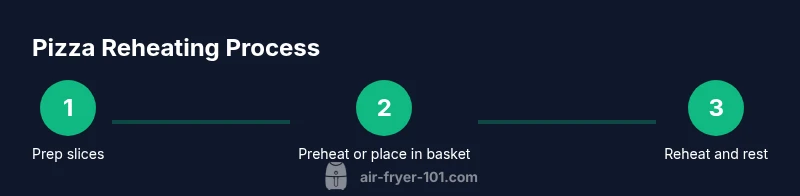
- 1
Check and prep slices
Inspect leftovers and separate slices with sauce-heavy toppings. Bring to room temperature if stored in the fridge for faster, more even reheating. This initial check helps you tailor time and temperature to crust type.
Tip: Separate slices so air can circulate and avoid sticking. - 2
Preheat the air fryer (optional)
If your model recommends preheating, run the appliance at the target temperature for 2–3 minutes before adding pizza. Preheating accelerates moisture evaporation and helps crisp the crust.
Tip: Preheating is especially helpful for thicker crusts. - 3
Arrange slices in a single layer
Place slices in a single layer with space between them. Do not stack. Proper spacing ensures even heat distribution and avoids soggy edges.
Tip: Use a parchment liner if cheese is prone to sticking. - 4
Start reheating at the middle of the range
Set the air fryer to the default range (see core settings) and begin with a 3–4 minute cook time for thin crust or 4–6 minutes for thicker pies. Check progress halfway through.
Tip: If cheese hasn’t melted after the initial window, continue in 1-minute increments. - 5
Adjust and finish for crispness
If edges aren’t browning, extend by 1–2 minutes. If cheese is bubbling too vigorously or crust is darkening, reduce heat slightly and rotate slices for even exposure.
Tip: Rotate slices halfway to prevent hot spots. - 6
Rest and serve
Let the pizza rest for 1–2 minutes after removal to let the cheese set a little and make slicing easier. Serve immediately for best texture.
Tip: Resting improves texture and reduces cheese stringing.
Got Questions?
Can I reheat any type of pizza in an air fryer?
Most common pizzas reheat well in an air fryer, but ultra-thin crust, stuffed crust, or very saucy pies may require slight adjustments to time and temperature. Start with a middle-range setting and monitor carefully the first time.
Most common pizzas reheat well in an air fryer, but you may need to adjust time and temperature for stuffed crust or very saucy pies.
Do I need to preheat the air fryer for reheating pizza?
Preheating is optional on many models. It can speed up crisping, especially for thicker crusts. If you’re in a hurry, skip preheat and place slices directly in the basket.
Preheating is optional, but can help with faster crisping, especially for thick crusts. If you’re in a hurry, you can skip it.
What temperature works best for thin vs thick crust?
Thin crust usually does well around 325–350°F for 3–4 minutes, while thick crust or loaded slices benefit from 360–375°F for 4–6 minutes. Always start in the middle and adjust.
Thin crust around 325–350°F; thick crust around 360–375°F. Start in the middle and adjust as needed.
How long does it take to reheat a single slice vs multiple slices?
A single slice plans for 3–4 minutes (thin crust) or 4–6 minutes (thick crust). Multiple slices may require the higher end of the range or an extra minute, and should be cooked in batches for best results.
Single slices take about 3–6 minutes; multiple slices may need a bit more time and should be done in batches.
Can I reheat frozen pizza in an air fryer?
Yes, but it takes longer. Start at 340–360°F for 6–9 minutes, flipping once. Check for melt and crust texture and add time in 1-minute steps as needed.
Yes, you can reheat frozen pizza in an air fryer. Use 340–360°F for 6–9 minutes and flip once.
Will cheese separate or dry out during reheating?
Cheese can dry if heated too long or at too high a temperature. Keep to mid-range temps and avoid overcrowding. If cheese looks dry, reduce time and add a minute or two at a lower temp.
Cheese can dry if overcooked. Use mid-range temps and don’t overcrowd; adjust time to avoid dryness.
Watch Video
Quick Summary
- Start with a middle-range temperature for most crusts.
- Space slices to ensure even reheating.
- Adjust time in 1-minute increments for best texture.
- Use parchment or a liner to simplify cleanup.
- Rest briefly after reheating for optimal bite.