Smart Oven Air Fryer Pro vs Joule: An Objective Comparison
A rigorous, objective comparison of Smart Oven Air Fryer Pro and Joule Smart Oven to help home cooks choose the best all-in-one countertop solution for health, convenience, and budget.


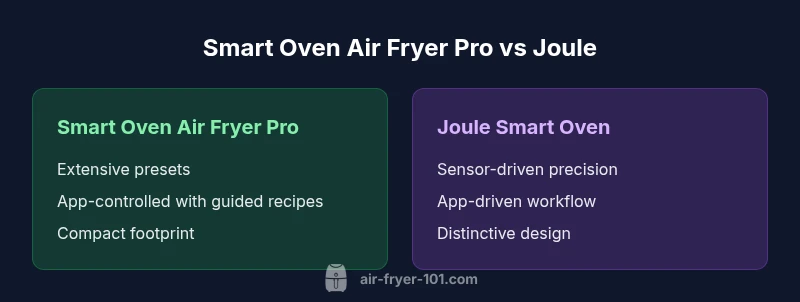
Both the Smart Oven Air Fryer Pro and Joule Smart Oven offer countertop versatility, but they target different cooks. The Pro leans toward multi-function efficiency with broad presets and strong app features, while Joule emphasizes precise sensors and a streamlined workflow. For most kitchen setups, the Pro provides better all-round value.
How to read this comparison: scope and definitions
This comparison analyzes two popular countertop smart ovens designed to blend air frying with baking, roasting, and other functions. The Smart Oven Air Fryer Pro emphasizes versatility through a broad preset library and robust connectivity, while the Joule Smart Oven focuses on sensor-driven precision and a streamlined cooking workflow. Throughout this article, we discuss performance, features, value, and real-world usage in ordinary home kitchens. For context, this guide also considers typical countertop space, convenience needs, and long-term maintenance. According to Air Fryer 101 analysis, most home cooks prioritize a balance of reliability, ease of use, and value when choosing between all-in-one countertop units. The keyword that anchors this comparison is smart oven air fryer pro vs joule, a phrase you’ll see echoed across the practical guidance and scenarios.
What sets these devices apart at a glance
At a high level, the Smart Oven Air Fryer Pro is built to be a versatile, all-in-one unit with a wide range of presets and features designed to handle everyday meals and snacks with minimal fuss. Joule Smart Oven, in contrast, leans into sensor-driven precision and a streamlined user experience that appeals to cooks who want guided efficiency and a tactile, predictable workflow. If you cook in small spaces or frequently prepare quick weeknight meals, the Pro’s breadth can translate into more confident results. If you value sensor accuracy, app-driven recipes, and a cleaner interface, Joule can feel like the more refined tool. Both units fit on a typical kitchen counter and connect to Wi-Fi for remote control and updates.
Cooking performance: speed, texture, and versatility
Performance is not only about speed; it’s about how consistently these devices produce appetizing results across a range of foods. The Pro’s broader temperature and time presets can yield crispier textures on tougher items (like bone-in wings or thick-cut fries) with less manual tuning. Its multi-function approach often means faster preheats for some programs, though the exact time savings vary by dish. Joule emphasizes sensor-based control that adapts to food weight and moisture, which can translate to less guesswork for delicate items like fish or vegetables. In practice, both units excel at standard air-fried favorites, but Pro tends to edge out for a wide variety of foods due to its more expansive preset library and configurable modes. Real-world owners report strong outcomes on roast, bake, and reheat tasks with both devices, with Joule sometimes offering smoother results on items that benefit from sensor feedback.
Presets, sensors, and smart features
Presets simplify everyday cooking by offering one-touch programs for popular foods. The Pro generally ships with a broad preset catalog that covers common categories (frozen foods, vegetables, poultry, seafood, baking, and reheating) and may include customizable timers. Joule emphasizes sensor-based control, which modulates time and temperature based on estimated food weight or density. Both devices typically feature app integration for remote control, notifications, and guided recipes, plus compatibility with voice assistants in many regions. In practice, the Pro’s versatility can feel overwhelming to new users, while Joule’s sensor-centric approach can reduce trial-and-error but might require a learning curve to maximize its guided workflows. If you value quick access via physical controls, the Pro still preserves straightforward operation alongside smart features.
Capacity, footprint, and kitchen fit
Capacity and footprint are often the deciding factors in small kitchens. The Smart Oven Air Fryer Pro is designed to be compact yet capable, making it easier to fit in tight spaces without sacrificing usable interior volume. Joule tends to have a sleek, modern silhouette that may translate into a slightly larger physical footprint, depending on the model. In terms of interior capacity, both units aim to accommodate a family meal or a batch of snacks, but actual usable space varies with rack configurations and tray sizes. If you routinely cook for several people, prioritize the model with a comfortable interior and flexible rack setup. If countertop space is at a premium, compare the external dimensions and door clearance to ensure a comfortable fit.
Energy use, price context, and value
Energy use is influenced more by cooking time and temperature than by the appliance’s stated wattage alone. Both devices are designed to be energy-efficient for small batches and quick meals, with the Pro’s broader set of modes sometimes allowing shorter cycles. Price context varies by retailer, promotions, and bundled accessories. Because final prices change, it’s better to compare current offers rather than rely on suggested retail pricing. In terms of value, the Pro’s wide feature base can yield better long-term savings if you frequently use specialty programs, while Joule’s sensor-driven approach may reduce waste with precise results on select meals. Overall value hinges on your cooking style and willingness to rely on smart features for routine tasks.
Real-world usage: scenarios and user stories
Consider a weeknight scenario where you want crispy chicken wings, roasted vegetables, and a quick bake for a dessert. The Pro’s presets can streamline each step with minimal adjustment, delivering consistent results across items in two to three batches. A family preparing a weeknight dinner and a late dessert might appreciate Joule’s sensor-driven guidance for precise portions and predictable outcomes, reducing the guesswork for novice cooks. In apartment living or shared kitchens, the compact footprint and app-accessible features are attractive. Ultimately, the best choice depends on whether you place more value on breadth of programs (Pro) or precision and workflow efficiency (Joule).
How to choose: decision framework by your cooking style
- If you prioritize versatility and quick, one-touch access to many modes, lean toward the Pro. 2) If you value sensor-based precision and workflow efficiency with guided recipes, Joule may be the better fit. 3) Consider your typical meal size: the Pro generally handles a wider variety of batch sizes, while Joule shines in controlled environments where exact results matter. 4) Assess your need for smart features versus simplicity. 5) Weigh price and ongoing value: a higher upfront cost might be offset by fewer retries and better batch results over time. 6) Check compatibility with your existing smart home setup, and verify availability of replacement parts and service in your region.
Practical cleaning, maintenance, and longevity tips
Cleaning and maintenance extend the life of any countertop unit. Remove and wash dishwasher-safe trays and racks after each use and wipe down the interior with a mild, non-abrasive cleaner. Periodically inspect seals and door gaskets for wear, and replace accessories that show signs of wear. Use a light coating of cooking oil on non-stick surfaces to preserve release properties. Keep firmware up-to-date to benefit from performance optimizations and bug fixes. Finally, protect your investment with a heat-resistant mat under the unit and avoid placing it in areas with high humidity or heat sources that could degrade electronics.
Final checklist before purchase
- Define your space: measure footprint and door clearance.
- List must-have programs: do you need broader presets or sensor-based automation?
- Evaluate ecosystem: app reliability, voice assistant compatibility, and customer support.
- Consider long-term costs: bundle inclusions, replacement parts, and warranty terms.
- Read user reviews focusing on reliability and real-world cooking results.
- Compare retailer offers for price, bundles, and after-sales service.
Comparison
| Feature | Smart Oven Air Fryer Pro | Joule Smart Oven |
|---|---|---|
| Cooking tech | Convection air fry with broad presets | Sensor-driven precision with guided recipes |
| Presets and smart features | Extensive presets, app control, energy-saver options | Strong app workflows with sensor-based adjustments |
| Capacity/footprint | Compact footprint with flexible rack options | Sleeker design, potentially larger footprint depending on model |
| Smart integration | Wi‑Fi, voice assistant compatibility | App-driven with voice-friendly features |
| Ease of cleaning | Dishwasher-safe trays and surfaces | Removable components with easy cleanup |
| Price context | Varies by retailer; typically mid-range to premium | Varies by retailer; often premium due to sensors |
Pros
- Versatile all-in-one capability reduces clutter and appliance count
- Broad presets save time on common meals and snacks
- Smart features enable guided cooking and remote control
- Compact footprint fits small kitchens and apartments
- Good long-term value if you cook diverse meals regularly
Cons
- Higher upfront cost than single-function air fryers
- Proliferation of presets can be overwhelming for new users
- Sensor-based workflows may require a learning curve for some cooks
- App reliability and firmware updates can affect daily usability
Smart Oven Air Fryer Pro is the recommended pick for most home cooks seeking an all-in-one countertop solution.
Air Fryer 101's analysis in 2026 supports a preference for Pro when versatility and ease of use across a variety of meals are priorities. Joule remains a strong alternative for users who value sensor-driven precision and streamlined workflows, but its feature set is more specialized. Your final choice should hinge on whether you want a broader program library or a more guided, sensor-based experience.
Got Questions?
What is the main difference between Smart Oven Air Fryer Pro and Joule Smart Oven?
The Pro emphasizes broad versatility with a large preset library and strong app features, while Joule focuses on sensor-driven precision and a streamlined workflow. Both aim to simplify countertop cooking but appeal to different priorities.
The Pro is all about versatility with many presets; Joule prioritizes sensor-driven precision and easy workflows.
Which device is better for small apartments?
Both are countertop units with compact footprints, but the Pro generally offers more flexible configurations and presets, making it a better overall fit for varied meals in tight spaces. Joule’s efficiency stems from its guided, sensor-based approach, which can feel less flexible for more complex meals.
For apartments, the Pro’s versatility usually wins out, though Joule is strong if you want guided, precise cooking.
Do they support remote operation or voice assistants?
Yes, both typically offer app control for remote operation and many models support popular voice assistants. Availability can vary by region and model, so check the specific features of the unit you’re considering.
Both can be controlled via an app, and many models work with voice assistants.
What about cleaning and maintenance?
Both units use removable, dishwasher-safe trays and racks. Regular cleaning of the interior and proper maintenance of seals help maintain performance and prevent residue buildup.
Keep the trays and racks clean, and wipe the interior regularly to prevent buildup.
Which is more affordable?
Prices vary by retailer and promotions. Generally, the Pro offers broader features at a mid-to-premium price, while Joule can be at a premium due to sensors and guided workflows. Look for bundle deals and warranty terms to maximize value.
Price varies; expect similar ballparks but watch for bundles and warranties to maximize value.
Quick Summary
- Prioritize versatility and broad presets if space and time matter
- Choose sensor-driven precision for guided cooking and consistency
- Compare real-world use cases rather than specs alone
- Factor retailer price variations and bundled accessories into value
- Consider brand support and firmware updates as part of long-term value