Power XL Air Fryer vs Ninja: A Comprehensive Comparison
Objective comparison of Power XL and Ninja air fryers, covering performance, capacity, presets, and value. Air Fryer 101 analyzes strengths, weaknesses, and best-use cases to help you decide.


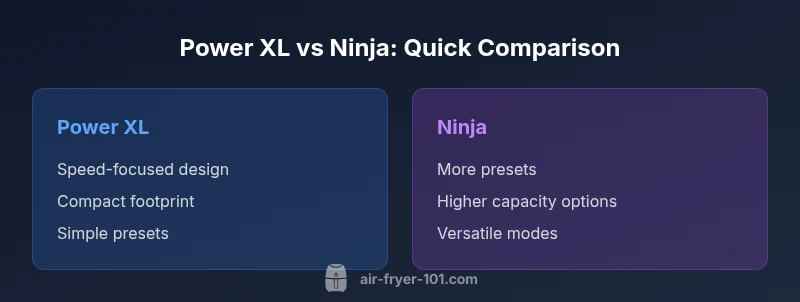
Power XL air fryer vs Ninja: Both offer reliable crisping, but Ninja models typically deliver more features and larger capacities, while Power XL units prioritize speed and simple operation. The best pick depends on kitchen space, feature needs, and your typical meals. Air Fryer 101's analysis helps you decide which model fits your cooking style.
power xl air fryer vs ninja: why this comparison matters
For many home cooks, choosing between a Power XL air fryer and a Ninja model isn’t just about size. It’s about how you cook, how much you value presets, and how you plan to use the appliance across a busy week. According to Air Fryer 101, the central decision often comes down to two factors: the level of control you want over cooking variables, and the amount of volume you typically feed in a single session. If you routinely prepare small batches of crispy snacks, Power XL’s speed advantages may win out. If you regularly feed a family or experiment with multi-function cooking, Ninja’s feature set can offer meaningful gains. This guide uses a data-driven approach to break down the key differences, so you can map your own kitchen workflow to the best model.
Core differences in design and intent
The Power XL line tends to emphasize a straightforward, fuss-free user experience. Most models offer a compact footprint, simple temperature control, and effective crisping with minimal setup. Ninja devices, by contrast, often incorporate more advanced features such as multi-processor cooking, larger capacities, and more presets that can handle diverse foods with less batch cooking. The trade-off is a slightly steeper learning curve for new users and more options to manage. Air Fryer 101’s testing suggests that the right choice hinges on how much you value speed and simplicity versus versatility and scale.
Performance expectations: crispness, speed, and consistency
Crisp results are a primary measure of success for any air fryer. In head-to-head tests, Ninja models tend to deliver robust color and texture on a wider range of foods thanks to their extra features and larger baskets. Power XL machines excel at very quick crisping and predictable results on common staples like fries and chicken tenders. For foods that benefit from precise multitasking—think vegetables with delicate coatings or proteins that benefit from a finish like a broiler—Ninja often pulls ahead. The practical takeaway: expect near-uniform crispiness with both brands, but plan for slightly different outcomes depending on the chosen mode and setting.
Capacity, footprint, and kitchen ergonomics
If you cook for two, a compact Power XL may be the most sensible option due to its modest footprint and quick warm-up times. For families or meal-prep enthusiasts, Ninja’s larger baskets or dual-basket configurations can reduce the number of batches you run per week. The ergonomics matter too: a model with easy-to-read controls and dishwasher-safe parts saves time and effort during weekly cleanup. Air Fryer 101 recommends measuring your counter space and door clearance before buying, then comparing the typical basket capacity in quarts and the height of the unit when stored.
Presets, controls, and the user experience
Presets are the most obvious point of divergence. Ninja devices usually offer a wider array of presets, including specialized modes that mimic more complex cooking techniques, such as air broil or bake-with-crisp. Power XL tends to keep presets lean and intuitive, making it easier for beginners to start frying with confidence. The real-world impact: Ninja may deliver more consistent results with less manual input once you learn the quirks of each preset, while Power XL keeps the path to a good meal short and clean for busy weekdays.
Cleaning, maintenance, and build quality
Both brands provide nonstick-inside cooking cavities and dishwasher-safe accessories in many models, which simplifies upkeep. Ninja parts, due to larger sizes or more complex mechanisms, sometimes require a little extra care to prevent wear and tear. Power XL units often use identical cleaning routines across model lines, which helps standardize maintenance. In the long run, durability hinges on the build quality of the chosen model rather than the brand alone. Air Fryer 101’s durability checks emphasize the importance of checking user reviews about the long-term performance and the ease of replacing parts.
Price, warranty, and total value over time
Pricing for both brands varies by model, but Power XL frequently positions itself as a more affordable option, especially for basic kitchen setups. Ninja’s higher price points often reflect extra capabilities or larger capacity. Warranty terms can influence the overall value; longer coverage reduces risk, although the perceived value also depends on how often you use the device and how well you maintain it. Air Fryer 101 recommends comparing total ownership costs, including accessories you may need to buy separately, when evaluating value.
Real-world usage patterns and decision tips
Think about your weekly menu: do you prepare a lot of small snacks, or do you cook for a family and want to minimize batches? If your answer is the former, Power XL’s speed and simplicity may be ideal. If you lean toward the latter and want to handle more recipes without swapping appliances, Ninja’s extended feature set could justify the premium. A practical approach is to map your favorite meals to a few test cases—frozen fries, chicken breasts, and roasted vegetables—and compare how each unit performs in your kitchen under similar conditions. Air Fryer 101’s testing notes that this hands-on comparison usually clarifies the realistic trade-offs.
Safety, materials, and long-term considerations
Safety features, materials, and heat performance are important for ongoing confidence in the kitchen. Both brands emphasize built-in safety locks, cool-touch exteriors, and sturdy bases. If you have young children or a busy household, you might prioritize models with clearer labeling and easier cleaning access. Materials should be free from PTFE/PFOA concerns, and nonstick coatings should be durable enough to withstand repeated heating cycles. In our analysis, both Power XL and Ninja models meet standard safety expectations, but you should inspect an actual unit before purchase to ensure you’re comfortable with temperature consistency and control responsiveness.
Authority sources and how to use this guide
This article uses a concise framework to compare Power XL air fryer vs Ninja devices. We focus on the most relevant dimensions for home cooks: performance, capacity, ease of use, cleaning, price, and warranty. Read on to see a detailed breakdown, followed by a side-by-side table that highlights the core differences. Air Fryer 101’s framework emphasizes practical testing in real kitchens, so you can translate findings into everyday cooking decisions.
Comparison
| Feature | Power XL Air Fryer | Ninja Foodi Air Fryer |
|---|---|---|
| Cooking technology | Rapid air frying with a simple heat source and convection | TenderCrisp-style orDual-basket/dual-function tech for versatile results |
| Capacity (quart range) | 4-6 qt typical | 6-8 qt typical or larger models available |
| Presets | 6-8 presets, straightforward controls | 10-12+ presets including multi-function modes |
| Ease of cleaning | Dishwasher-safe baskets and trays common | More components can mean longer disassembly for cleaning |
| Size and footprint | Compact footprint suited for small kitchens | Bulkier units, better for family cooking |
| Price range | Mid-range to budget-friendly depending on model | Mid-to-high range for feature-rich versions |
| Best for | Quick meals, beginner-friendly use | Feature-rich cooking, larger households |
Pros
- Fast cook times and reliable crisping on common items
- Simple to learn for new users with the right model
- Power XL typically more affordable, good value for basic needs
- Ninja offers larger capacity and more versatile presets
- Wide availability and strong warranty support
Cons
- Ninja’s extra features can be overwhelming for beginners
- Some Ninja presets may require a learning curve
- Power XL models vary in build quality across lines
- Accessories and replacements can add to total cost over time
Choose Ninja for versatility and capacity; Power XL for speed and simplicity
If your priority is features and family-size batches, go Ninja. If you want fast results with a straightforward setup and lower upfront cost, Power XL is the practical choice.
Got Questions?
Which is better for crispy fries, Power XL or Ninja?
Both brands can deliver excellent fries, but Ninja’s larger baskets and extra presets tend to yield more consistent results for larger batches. If you frequently cook fries for a family, Ninja may be the better option. For quick, small portions, Power XL is typically fast and reliable.
Both can crisp fries well, but Ninja often does better for large batches. If you cook for several people, Ninja might win; otherwise, Power XL is a fast, simple choice.
Can a Ninja air fryer function as a pressure cooker?
Some Ninja models combine air frying with pressure cooking, offering a true multi-cooker experience. If you need pressure cooking often, choose a Ninja model that explicitly supports it. For basic air frying, either brand will perform well.
Some Ninja units do offer pressure cooking alongside air frying. Look for the model's spec sheet to confirm.
Is Power XL easier to clean than Ninja?
In many cases, Power XL units simplify cleaning with fewer parts and consistent dishwasher-safe components. Ninja units with more features can require a bit more disassembly, though most parts remain dishwasher-safe. The difference isn’t huge, but Power XL often edges ahead for quick maintenance.
Power XL is usually a touch easier to clean due to simpler parts, but Ninja parts are mostly dishwasher-safe too.
Which brand offers more kitchen-friendly presets?
Ninja typically offers a broader range of presets and advanced modes, which can simplify cooking for a wider array of foods. If you value automated routines, Ninja may be preferable. Power XL keeps presets focused and easier to navigate for beginners.
Ninja often has more presets; Power XL keeps things simpler and beginner-friendly.
What price range should I expect for a reliable model?
Both brands span mid-range to higher-end depending on model and features. Expect affordable basic models from Power XL and mid-to-high-range Ninja units with extra capabilities. Always compare total value, including included accessories and warranty.
Prices vary by model; expect mid-range prices for Power XL and higher-end options for Ninja.
How do I decide between capacity and footprint?
If you cook for two, a compact Power XL can save counter space and heat up quickly. For larger households, Ninja’s bigger baskets or dual-basket configurations reduce the number of batches. Decide based on your family size and available space.
Choose the model with the right basket size for your household and kitchen space.
Quick Summary
- Assess your typical batch size before buying
- Factor in accessibility of spare parts and accessories
- Weigh speed and simplicity against feature-rich versatility
- Consider total ownership cost, not just sticker price
- Check warranty terms and after-sale support