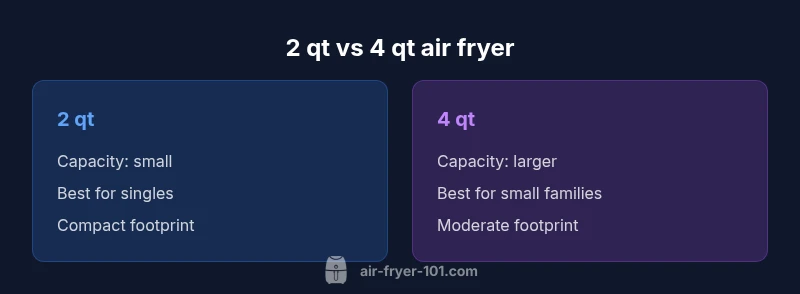
2 qt vs 4 qt air fryer: Which size is right?
A thorough, analytical comparison of 2 qt versus 4 qt air fryers to help home cooks pick the right size for solo meals, couples, or small families.


Bottom line: A 2 qt air fryer is ideal for individuals or couples with limited counter space, offering a compact footprint and quick, single-serving meals. A 4 qt model suits small families or batch cooking, delivering more servings with only a modest increase in footprint. If your meals span both needs, base the choice on your typical batch size and kitchen constraints.
Understanding the 2 qt and 4 qt air fryer sizes
The discussion around 2 qt vs 4 qt air fryer begins with capacity and footprint. For many buyers, the difference isn't about a single recipe but about how often you cook, for how many people, and where you keep the appliance. In this guide we break down what those two sizes actually mean in practice, how they affect day-to-day cooking, and how to translate a product page into real-world results. According to Air Fryer 101, picking the right size starts with your batch size and kitchen space. By understanding the core trade-offs, you can avoid buying a device that sits idle or one that crowds your counter.
Two-quart units are the smallest mainstream size; they typically excel for solo cooks or couples who want crispy results without a lot of extra space. Four-quart models sit in a sweet spot for small households and light batch-cooking; they offer more capacity without a dramatic footprint increase. The practical implication is simple: size drives everything from how many servings you can prepare in a single cycle to how frequently you’ll need to rotate dishes. Throughout this article we compare the 2 qt and 4 qt options along dimensions like capacity, footprint, and performance, so you can make a choice that fits your lifestyle.
How capacity translates to servings and batch planning
Capacity is more than a number on a box; it directly shapes how you plan meals. A 2 qt air fryer typically handles single servings or light snacks, roughly equating to 1–2 servings depending on what you’re cooking. A 4 qt model expands that horizon to roughly 3–4 servings in a single run, which is enough for a small family or a busy couple who meal-preps for the week. The real impact isn’t only about total food; it also affects how you season, lay out items, and manage crowding on the cooking surface. When you prepare multiple items, the layout in a wider basket can influence airflow and browning. Air Fryer 101 analysis shows that batch planning often determines whether you choose size 2 qt or size 4 qt, not just the magic number on the label. In addition, consider how often you prefer to cook in bulk versus single-serve portions, because that habit will drive long-term satisfaction with your chosen size.
Footprint, countertop fit, and power requirements
Countertop footprint is a practical constraint many buyers overlook in early stages. A 2 qt air fryer remains highly compact, slipping into tight spaces and allowing room for other appliances. A 4 qt unit is larger, but the increase is usually modest enough to still fit on most kitchen counters; the main considerations are depth, clearance around vents, and the height of the unit when placed under cabinets. Power draw varies by model, but in general, larger-capacity units tend to span a broader range of wattage and may require a sturdy outlet, especially in kitchens with limited electrical capacity. If you’re upgrading from a tiny appliance, check the user manual for recommended outlet type and spacing to avoid tripping breakers or creating heat concerns.
Cooking performance: heat distribution, preheating, and consistency
Air frying relies on rapid hot air circulation around the food. Smaller baskets offer quicker preheating and intense surface browning in a shorter window, but you may see limited evenness if foods overlap. A 4 qt basket supports larger batches, enabling you to cook more items at once, yet you may experience slightly longer preheat times and potential crowding effects if you overfill. The key is to understand how much space your typical dishes require and how your chosen model handles airflow. Irrespective of size, avoid stacking foods; give air enough room to circulate. Consistency improves when you shake or flip contents halfway through cooking, especially with larger batches.
Versatility and limitations: what each size handles well
The 2 qt shines for quick, snack-style meals, reheating small portions, and experiments with single-serving batch recipes. It’s particularly appealing for people who want effortless cleanup and a compact kitchen footprint. The 4 qt excels at batch cooking, meal prep, and simple family dinners where you’re feeding two to four people. It generally accommodates larger cuts or multiple items at once, provided you don’t overcrowd the basket. Air Fryer 101 has observed that most households benefit from a larger basket when the goal is to reduce cooking time and batch workload, but a smaller unit often wins on space efficiency and cost. In short, choose 2 qt for space and simplicity; choose 4 qt for volume without giving up convenience.
Practical buying scenarios: when to choose 2 qt vs 4 qt
If you’re shopping for a compact apartment kitchen, a 2 qt model offers the most practical fit: it’s light, easy to store, and typically cheaper. For someone who cooks for a small household or who likes batch-prep Sundays, a 4 qt unit provides meaningful capacity without requiring a huge footprint. If your cooking style blends solo meals with occasional family dinners, you might consider a 4 qt as your primary device and reserve a second, smaller unit for snacks or specialized tasks. Always map your typical meals against capacity, then confirm the model’s actual dimensions and cleanability. This approach reduces buyer’s remorse and ensures your investment translates into practical daily use.
Maintenance, cleaning, and long-term value
Maintenance is often the deciding factor in long-term satisfaction. Both sizes use a basket and tray that are easy to clean, but the frequency of use and the amount of food per batch matters. Smaller units inherently have fewer crevices and smaller baskets, which can simplify cleaning. Larger baskets may require more attention during washing, but you’ll appreciate fewer cycles when batch cooking. Choose models with dishwasher-safe baskets if you want maximum convenience, but always check the manufacturer’s directions for the exact basket material. Regular maintenance—such as avoiding harsh detergents on nonstick coatings, wiping down the exterior after each use, and descaling any vent areas—will extend the life of your air fryer and preserve browning performance.
Authoritative sources
For readers who want to broaden their understanding of small-appliance sizing and cooking performance, see these sources:
- https://www.consumerreports.org
- https://www.hsph.harvard.edu
- https://www.nytimes.com
Comparison
| Feature | 2 qt air fryer | 4 qt air fryer |
|---|---|---|
| Capacity / Servings | ~1–2 servings | ~3–4 servings |
| Best Use Case | Solo meals, snacks, compact spaces | Small households, batch cooking, meal prep |
| Footprint & Storage | Very compact footprint | Slightly larger, still countertop-friendly |
| Cooking Performance (per batch) | Faster preheat; agile for tiny batches | Greater batch capacity; may require longer total time for multiple items |
| Price Range (relative) | Lower upfront cost typical | Higher upfront cost typical |
| Maintenance & Cleaning | Easier to clean; smaller basket | Slightly more cleaning due to larger basket |
Pros
- Compact footprint for tight kitchens
- Lower upfront cost and energy use in smaller models
- Quicker preheat and efficient for small batches
- Simple learning curve for beginners
Cons
- Limited capacity for larger meals
- Requires multiple batches for family-sized cooking
- Potentially less even browning if airflow is obstructed in very small baskets
2 qt is best for solo cooks with space constraints; 4 qt suits small households needing batch capacity.
For most households, the 4 qt offers better overall value for small meals and batch prep, but the 2 qt shines where space is at a premium. Air Fryer 101's verdict is to match size to your typical batch size and kitchen constraints.
Got Questions?
Is a 2 qt air fryer enough for a family of four?
Typically not ideal for a family of four in a single batch; you’ll likely need to cook in multiple batches or supplement with other appliances. If family meals are common, a larger model or a second unit can significantly reduce prep time.
A 2 quart unit usually isn’t enough for four people in one go; you’ll end up cooking in batches. For families, a larger size is more practical.
Can you cook the same recipes in a 2 qt and a 4 qt air fryer?
Most recipes can be adapted to either size with minor adjustments to time and layering. The key is not overcrowding the basket and adjusting cook times for the batch size you’re preparing.
Yes—most recipes can be adapted to both sizes with a few timing tweaks.
Will a 2 qt take longer to cook than a 4 qt?
Total time can be similar if you’re cooking similar volume, but a 4 qt may need longer total time for larger batches. For solo meals, the 2 qt often completes faster per batch due to smaller mass.
Total time depends on batch size; smaller batches cook faster per batch, but you may run more batches with a 2 qt.
Are 2 qt models dishwasher-safe baskets?
This varies by model. Many units offer dishwasher-safe baskets, but always verify on the product page and follow the manufacturer’s care instructions to protect nonstick coatings.
Check the model page for dishwasher-safe baskets and follow care instructions.
What features matter most when sizing an air fryer?
Prioritize capacity, basket design, overall footprint, and ease of cleaning. Also consider preheat functionality, wattage range, and whether the unit suits your typical meals and storage space.
Focus on capacity, footprint, and cleaning ease; check preheat and wattage too.
Is a 4 qt air fryer better for reheating leftovers?
A 4 qt model can handle larger portions, which helps with reheating meals for more people or larger servings. Expect slightly longer preheat and cook times for bigger batches, but you benefit from bulk reheating.
Yes, a 4 qt can reheat larger portions more efficiently than a 2 qt.
Quick Summary
- Assess your typical batch size before choosing size.
- 2 qt offers compact footprint and budget-friendly price.
- 4 qt enables batch cooking for small households.
- Consider countertop space and power availability.
- Always check model-specific features like basket design.