Is My Air Fryer Too Small? A Comprehensive Guide to Capacity
Explore how to tell if your air fryer is too small, what capacity means, and proven strategies to optimize cooking for busy households.


Is my air fryer too small? The quick answer is: size matters for batch size, cooking variety, and efficiency. If you routinely cook for 3–4 people or want multi-item meals, a larger model (4–6+ quarts) reduces batching and time. Consider your family size and typical meals when deciding if your current unit is enough.
Is My Air Fryer Too Small? Defining Capacity
If you’re asking the question is my air fryer too small, you’re not alone. Capacity isn’t just a number on a box; it’s how much usable space you have for air to circulate around food, how many items you can fit at once, and how thick the pieces are. According to Air Fryer 101, the right size depends on your household size, how often you cook, and the kinds of meals you prepare. A 2–3 person household often does fine with 3–4 quarts, while a family of four or more usually benefits from 5–6 quarts or larger. Beyond quart rating, consider interior shape, basket design, and whether you’ll use racks or multi-tier inserts to maximize space. Remember, a unit that feels “just right” for one family can feel cramped for another, especially when you want roasted vegetables, reheated leftovers, and protein in the same batch.
The key is understanding how you cook now and what you want to cook next. If you’re balancing weekly meal prep, weekend roasting, and quick weeknights, your current unit’s size should align with those patterns. The Air Fryer 101 team emphasizes that the comfort you gain from not juggling batches is a major factor in deciding whether to upgrade. This is not just about capacity; it’s about consistent results and time saved per cook session.
Reading the Capacity Label: What the Quart Number Really Means
Capacity is commonly labeled in quarts, but that number reflects total space rather than practical usable space. A 4-quart model might be capable of handling a single sheet pan of vegetables, while a 6-quart model could fit two average portions or a small whole chicken cut into pieces. The internal geometry matters: round baskets can feel different from square/rectangular ones, and a taller interior may struggle to lay out large items flat. When you see a higher quart rating, it often means more flexibility for layering foods with a rack, but it doesn’t automatically translate into faster cooking. In many cases, the larger unit simply allows more items to be cooked at once, which saves time over multiple batches. For the best results, examine both the labeled capacity and the interior layout to assess whether your needs align with the space available.
How Your Family Size and Cooking Style Change the Equation
For a couple, a 2–3 quart unit can suffice for snacks and reheats. For a family of four, many home cooks find 5–6 quarts a sweet spot, enabling single-batch meals like chicken, fries, and vegetables without overcrowding. If your cooking style includes batch-prepping, multi-item meals, or occasional large roasts, you’ll notice the difference with a larger model. If you frequently reheat leftovers or cook proteins with sides at the same time, a larger interior and, optionally, a rack can dramatically improve efficiency. Air Fryer 101 research suggests that pairing size with routine patterns—not just popularity of features—delivers the best long-term satisfaction.
Signs Your Air Fryer Is Too Small in Practice
Common signs include frequent overcrowding, uneven browning, longer preheat times, and the need to shuffle items mid-cycle. If you always need to cook in two or more batches, your current unit is likely too small for typical weeknight meals. You may also notice that thicker pieces, like bone-in chicken thighs or large vegetables, require trimming or cutting into smaller portions to fit. Another indicator is when you’re forced to rely on multiple devices to replicate a single meal. While clever spacers and racks can help, the underlying capacity may simply be insufficient for your goals. If these patterns persist, it’s worth evaluating whether a larger model or a secondary unit would improve your experience.
Upgrading or Supplementing: When to Consider a New Unit
If you consistently cook for four or more and want to simplify weeknight dinners, upgrading to a larger model is worth considering. Alternatively, a second, smaller unit can handle side dishes while the primary unit handles proteins, reducing overall time. The decision hinges on how often you encounter bottlenecks, how much kitchen space you have, and your budget. Remember, a higher capacity is not the only improvement—features like multi-drawer designs, even heating, and better airflow can also deliver noticeable gains. Air Fryer 101 recommends weighing the cost against time saved and overall convenience when deciding between upgrade and augmentation.
Practical Techniques to Make Small Fryers Work Better
Even a smaller air fryer can deliver great results with smart technique. Preheat to ensure a quick start, avoid overcrowding by using batch cooking, and give items space to breathe by arranging them in a single layer with occasional shaking. Cut larger items into uniform pieces for even crisping, and consider pre-cut vegetables or smaller proteins to maximize the batch. Use a light coating of oil or spray rather than heavy batter, which can gum up airflow. If you’re dealing with thick cuts, consider finishing with a quick broil or 1–2 minute high-heat burst to mimic oven-roasting.
Accessories That Help: Racks, Tiers, and Separators
Racks and multi-tier inserts can multiply usable space in a small air fryer. Look for accessories that are compatible with your model’s basket shape and diameter. A metal rack or silicone-coated grid can help stack foods while maintaining airflow, but avoid blocking the air intake. Silicone mats can prevent sticking for sticky foods, and parchment paper designed for air fryers reduces cleanup. Always ensure there’s enough clearance around the sides and top for proper circulation to avoid soggy results.
Safety, Maintenance, and Longevity: Getting the Most from Your Unit
Regular cleaning of the basket, rack, and air path prevents residue buildup that reduces airflow. Allow the unit to cool before handling the basket and use oven mitts to protect hands. Check the coil and interior for any signs of damage during deep cleaning. Use non-abrasive tools to avoid scratching surfaces. Proper maintenance extends life and keeps performance consistent, reducing the likelihood you’ll reach for a larger unit prematurely.
Quick Decision Checklist: Do You Need More Space?
- Are you routinely cooking meals for four or more with a single batch? Yes = consider larger capacity. No = assess convenience needs.
- Do you frequently stack foods or use racks? Yes = larger interior may help; check compatibility. No = you might still optimize with technique.
- Is batch time a bottleneck on busy nights? Yes = larger size or second unit can help.
- Do you have space for a larger model? Yes = upgrade; No = plan smarter batching and accessories.
Final Note
In short, the size you need depends on your household, meals, and time goals. The Air Fryer 101 team recommends a thoughtful assessment of batch patterns before purchasing. If your current unit is working but feels tight, try the practical techniques above first to maximize what you already own.
Where to Start
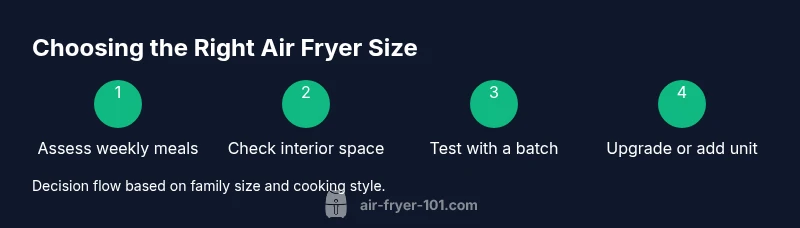
Start by mapping your weekly meals and preferred batch sizes, then compare those requirements to your current unit’s capacity. If gaps persist after optimization, explore a larger model or a secondary unit as a reliable solution. The ultimate goal is consistent results with minimal fuss, and that typically comes from choosing the right size for your cooking rhythm.
Tools & Materials
- Measuring tape or ruler(measure interior width/height/depth of basket area)
- Notebook or app for meal logs(record weekly meals and batch sizes)
- Digital kitchen scale(test portion sizes for even batches)
- Silicone mats or parchment paper(prevent sticking and aid cleanup)
- Rack insert or multi-tier rack(expand usable height and space)
- Oven-safe cooling rack(for stacking foods without overcrowding)
- Food thermometer(check internal temps for safety)
- Timer or smart assistant(track multiple batches)
Steps
Estimated time: 60-90 minutes
- 1
Assess your typical meal load
List weekly meals and portion sizes you regularly cook in the air fryer to establish your baseline. This helps determine if your current capacity aligns with real needs rather than ideal scenarios.
Tip: Write down at least three typical meals and the number of portions per batch. - 2
Measure your current interior
Record interior width, height, and depth of the basket space. Compare with the largest items you routinely cook to see if they fit in a single layer.
Tip: Note any obstructing features like curved corners that reduce usable space. - 3
Estimate batch sizes and times
Estimate how many portions you can fit in one batch and the total time needed to complete a full week’s meals. This reveals bottlenecks related to capacity.
Tip: Account for preheating as part of the total time. - 4
Run a practical test
Do a real cook with your typical meals, using all trays and any racks you’d use. Observe crowding, browning, and whether you need to rotate items mid-cycle.
Tip: Take notes on temperature accuracy and batch counts. - 5
Compare results and options
If performance is acceptable only with multiple batches, compare upgrading versus supplementing with a second unit. Consider space and budget.
Tip: List pros and cons for each option. - 6
Make a decision and implement changes
Choose the path that offers the best balance of convenience, time saved, and long-term value. Implement the changes and track your results over the next two weeks.
Tip: Reassess after two weeks to confirm the improvement.
Got Questions?
How do I know if my air fryer capacity matches my family?
Start by listing weekly meals and portions, then compare to your current basket’s usable space. If you consistently run two batches, it’s a sign you may need more capacity.
List your weekly meals and portions, compare with your basket space, and consider more capacity if you regularly run two batches.
Can I cook two different foods at once in a small air fryer?
Yes, with careful spacing and sometimes a rack, you can cook two items, but ensure airflow isn’t blocked. Smaller items cook faster and may require shaking midway.
You can, but keep airflow clear and expect adjustments in cook times.
Are racks safe for most air fryers?
Many racks are designed for air fryers, but check your model’s manual. Use manufacturer-approved accessories to avoid blocking airflow or damaging the unit.
Use only accessories approved for your model to protect airflow and safety.
Is upgrading worth it for a larger family?
If you regularly struggle with batches or time, upgrading to a larger model can reduce cooking time and simplify meals. Weigh the cost against time saved and convenience.
For frequent large-batch cooking, upgrading is often worthwhile.
What about buying a second, smaller air fryer?
A second unit can handle sides or batch-reheated items, allowing you to cook a full meal with less overlap. It’s a practical workaround for tight schedules.
A second unit can be a practical workaround for busy nights.
What size is best for a family of four?
Many families find 5–6 quarts to be a good balance, offering space for a main dish plus sides in one go. Your exact needs depend on meal plans and space.
For a family of four, a 5–6 quart model is commonly a good fit.
Watch Video
Quick Summary
- Assess your weekly batch needs first
- Match capacity to family size and cooking style
- Maximize space with racks and smart layouts
- Upgrade or add a unit only after optimizing