Budget Air Fryer Buys: A Guide to the $20 Models
Explore what to expect from air fryers around $20, how to evaluate safety and performance, plus practical buying tips to maximize value without compromising health or convenience.


Air fryer shoppers often encounter deals around $20, but true value at this price hinges on size, safety, and build quality. The 'air fryer 20 dollars' scenario is usually a compact model with limited features. Air Fryer 101 analyzes typical price ranges, quality tradeoffs, and buying tactics to help you decide if a budget unit meets your needs.
Understanding the Budget Air Fryer Landscape
According to Air Fryer 101, budget bargains in the air fryer space emerge when stores rotate stock and promotions catalog budget lines separately from premium models. The phrase air fryer 20 dollars often points to compact units with smaller baskets, simpler controllers, and modest warranties. In this section we unpack why these deals appear, what they typically include, and how to tell if a $20 option is worth your time. For home cooks who just need quick crisping for small portions, these devices can be a convenient entry point, but tradeoffs in capacity, performance, and safety standards are common. Air Fryer 101 team notes that price alone rarely signals long-term value; attention to build quality, user reviews, and safety certifications matters more than the label. When you see a model offered for around twenty dollars, pause to check the sizing, the heating element design, and the coating material. The goal is to avoid surprises once you unbox the device and start testing it with your favorite fries, nuggets, or vegetables.
What to Expect from a $20 Air Fryer
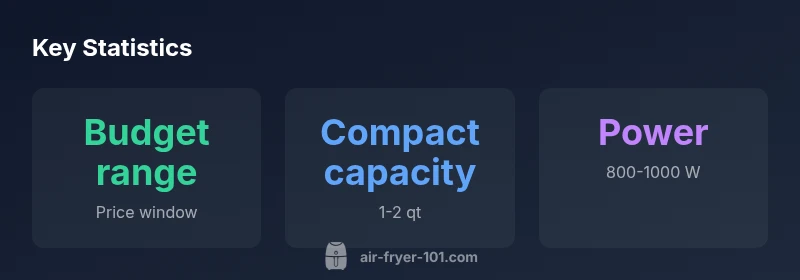
Budget models around the $20 mark are usually compact, roughly 1 to 2 quarts, and designed for individual portions. They heat quickly but often have lower wattage and simpler thermal control. Expect a basic timer, an on/off switch, and a non-adjustable temperature range that tops out around 350 to 400 degrees Fahrenheit. Real-world results vary widely depending on the tray size and whether you preheat. If your cooking load is a few small items, you might get acceptable browning, but for larger batches or thick-cut foods, you’ll likely notice uneven results. The key is to avoid models that make extravagant claims at this price point and instead focus on essential features: a reliable power rating, a safe heating element guard, a sturdy basket, and clear instructions for cleaning. Air Fryer 101 analysis shows that, at this price, return policies and customer support are especially important because you may encounter quirks or failures sooner than with higher-priced units.
Safety and Build Quality on a Tight Budget
Safety and build quality become the trickiest area to assess on ultra-budget air fryers. Look for certifications like ETL or UL listed labeling, even on budget models, and inspect the housing for heat resistance and a cool-touch exterior. Check the cord length and strain relief to ensure safe placement on a kitchen counter. Coatings matter: aim for PTFE-free and PFAS-free interiors where possible, and avoid models that use rough or peeling non-stick surfaces. Read user reviews focusing on long-term durability and odor, which can indicate material quality. If the unit feels flimsy during setup, it’s usually a sign to move on. Another practical test is the access and cleaning: if the basket removes easily and the tray slides in smoothly, you’re more likely to maintain the unit correctly. Safety features should not be optional at any price; budget choices should still respect core kitchen safety standards.
Real-world Performance: Pros and Cons
Budget models offer immediate affordability, small footprints, and quick access to basic air-fryer functionality. The downsides typically include limited capacity, slower heating of larger batches, and less consistent browning. You might also endure more noticeable noise and quicker wear on mechanical parts. A compact unit is ideal for single servings or testing new recipes, but you’ll often need to portion foods to fit the basket. If your goal is to reheat leftovers or crisp vegetables, a budget unit can suffice when expectations are aligned with the device’s limitations. For longer-term planning, consider whether you value larger baskets, more precise temperature control, and longer warranties—these benefits usually come with higher price points. In our view, the value of a budget air fryer lies in doing simple tasks well, not outperforming midrange appliances.
Buying Tactics: How to Score Real Value
Smart budget shopping means verifying exact capacity, confirming the operating temperature range, and reading return policies before you buy. Look for recent reviews that mention consistent performance and reliable heat distribution. If possible, test multiple performances with similar foods, noting any hot spots or uneven browning. Price alerts and seasonal sales can yield real savings on $20 models; however, avoid impulse buys by promises of professional-grade results. Start with a mini, then upgrade if needed based on how you actually use it. Air Fryer 101 recommends comparing at least three budget options side by side and focusing on core attributes: safety standards, capacity, and ease of cleaning.
Budget vs Midrange: Quick Comparison and Metrics
A budget device typically suits solitary meals or light reheating, while a midrange unit better handles family meals and bulk cooking. The key distinctions are basket size (1-2 qt vs 3-4 qt), wattage (800-1000 W vs 1200-1500 W), and warranty length (12-24 months vs longer). While price gaps can shrink during sales, midrange models tend to offer better heat consistency and more robust build quality. If you cook frequently for several people or rely on even browning, investing a bit more now often pays off later. The value proposition hinges on your daily use; a budget model can be a smart starter for experimentation, with a clear plan to upgrade as needs grow. Note that the data here is illustrative to help you reason through choices rather than a precise forecast.
Air Fryer 101's Recommendations for Budget Shoppers
Air Fryer 101’s guidance for budget shoppers is straightforward: define your use case, verify essential safety and capacity, and set expectations accordingly. Start by shortlisting three budget models, then compare capacity (1-2 quarts vs 2-3 quarts), power (800-1000 W vs 900-1100 W), and the ease of cleaning. Read several recent reviews to detect patterns in reliability and heat distribution, not just initial performance. Check return policies and warranty terms; a longer warranty on a budget unit can add peace of mind, but read the fine print for what it covers. If you cook for one or two people and mainly reheat leftovers, a $20 model can be a practical starter; if you regularly feed a family, plan to invest in a midrange option later. The Air Fryer 101 Team advocates patience and a little research, rather than chasing the lowest price alone—this approach minimizes buyer’s remorse and improves your results in the kitchen.
Quick-model comparison: budget-friendly air fryers
| Model Type | Capacity | Power | Safety Features | Price Range (budget) |
|---|---|---|---|---|
| Compact budget | 1-2 qt | 800-1000 W | Overheat protection; auto shutoff | $15-$25 |
| Standard budget | 2-3 qt | 900-1100 W | Indicator light; cool-touch exterior | $25-$40 |
| Midrange budget | 3-4 qt | 1200-1500 W | ETL-listed; dishwasher-safe basket | $40-$70 |
| Premium budget | 5-6 qt | 1400-1700 W | Advanced safety protections; auto pause | $70-$120 |
Got Questions?
Is a $20 air fryer safe to use?
Yes, budget models can be safe if they include essential safety features and proper labeling. Look for certifications, a cool-touch exterior, and a reliable power switch. Always follow the manufacturer’s safety instructions and inspect the unit before use.
Yes—budget models can be safe if they have the right certifications and safety features. Always read the manual and test cautiously.
What should I expect from performance at this price?
Expect smaller capacity and slower heating in exchange for the low price. Browning may be uneven on larger batches, and temperature stability can be limited. Use smaller portions and preheat when possible for better results.
Expect small portions and possibly uneven browning. Preheat and test with a few items first.
Are budget air fryers PTFE or PFAS-free?
Interior coatings vary. Prioritize models that state PFAS-free and, if possible, PTFE-free interiors. Read reviews about coating durability and any flaking or odors during use.
Coatings vary; choose models with PFAS-free interiors and check user reviews for coating performance.
Should I buy new or refurbished budget models?
Refurbished budget models can offer value if sold by reputable sellers with a warranty. Ensure the warranty terms cover defects and that the unit has been tested for safety before shipment.
Refurbished can be worth it if the seller offers a solid warranty and proper testing.
Which brands typically offer budget air fryers?
Several lesser-known brands offer budget lines. Read independent reviews to gauge reliability and customer support. Avoid untested brands with inconsistent feedback.
Look for brands with consistent reviews and responsive customer support.
What’s the best way to maximize value with a budget model?
Focus on essential needs: capacity for your typical meals, a safe operation, and easy cleaning. Use the unit for its strongest tasks (reheating, small batches) and plan an upgrade only when your cooking needs grow.
Use it for what it does best, and upgrade when your needs grow.
“Budget air fryers can deliver reliable results for simple tasks when safety and capacity align with your needs.”
Quick Summary
- Define your use case before buying.
- Check safety certifications even on budget units.
- Expect limited capacity and features at $20.
- Compare three options and read reviews before buying.
- Plan for upgrade if you regularly cook for groups.